Key Takeaways
- Holistic addiction recovery in Orange County means integrated clinical care for mental health and substance use together, with mindfulness, movement, and family support reinforcing therapy and psychiatry rather than replacing them.
- Fewer than 8% of people with co-occurring disorders receive integrated care, yet treating both conditions together is linked to better outcomes across substance use, psychiatric symptoms, and daily functioning 9.
- California’s CalAIM initiative is consolidating county mental health and substance use services into one integrated behavioral health program by January 2027, reshaping how local treatment is delivered 4.
- Before choosing a program, ask whether one team treats both conditions on one plan, which evidence-based therapies clinicians use, and how psychiatric care, family work, and aftercare are coordinated.
What “Whole-Person” Care Actually Means When You’re Hurting
If you’re reading this, something has probably already broken open. Maybe you’re the one struggling with substances and a mind that won’t quiet down. Maybe you’re a parent who hasn’t slept in weeks, or a partner watching someone you love disappear into a pattern you can’t reach. Whatever brought you here, take a breath. You’re already doing something hard, and that counts.
The phrase “holistic addiction recovery in Orange County” gets used a lot, and it can sound like marketing fluff — soft lighting, beach yoga, maybe a green smoothie. That’s not what this article is about. Real holistic care isn’t a vibe. It’s a clinical commitment to treating you as a whole person: your mind, your body, your relationships, and the mental health condition that’s almost certainly tangled up with the substance use.
Here’s what that means in plain language. When someone is using alcohol, opioids, stimulants, or prescription medications in a way that’s hurting them, there’s usually something else underneath — anxiety, depression, trauma, ADHD, bipolar disorder, OCD, or a long history that never got addressed. Federal research is direct about this: when a mental health condition and a substance use disorder show up together, it’s almost always better to treat them at the same time instead of in separate offices on separate weeks 12. NIDA puts it bluntly — effective treatment attends to the multiple needs of the individual, not just his or her drug use
14.
So when we talk about holistic addiction recovery in Orange County, we mean care that doesn’t split you into pieces. Therapy and psychiatric support sit at the center. Mindfulness, movement, family work, and community connection wrap around that center. None of it replaces the clinical work — it strengthens it. You deserve all of it, not a fragment.
Why Integrated Dual Diagnosis Is the Real Definition of Holistic
The Gap Between What People Need and What They Get
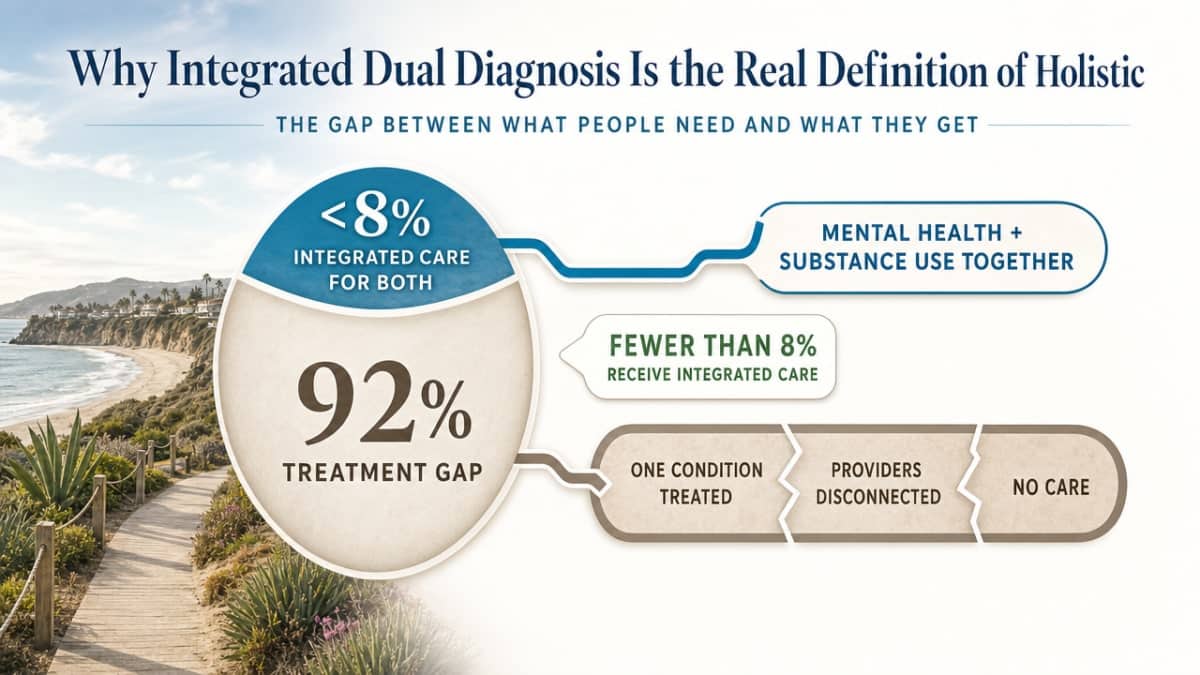
Here’s something that’s hard to read, but worth knowing: in a 2021 implementation study drawing on the 2018 National Survey on Drug Use and Health, fewer than 8% of people in the United States with co-occurring mental health and substance use disorders said they received integrated care for both conditions 6. Not 8% of people in treatment. 8% of everyone living with both at once. The other 92%? They either got help for one and not the other, bounced between providers who didn’t talk to each other, or got nothing at all.
If you’ve been in that 92%, you already know what it feels like. You go to one office for the depression. Another for the drinking. A primary care doctor refills a prescription without anyone asking how the anxiety is connecting to the pills. You repeat your story to four different intake coordinators. You start to wonder if you’re the problem.
You’re not. The system is fragmented, and researchers have been documenting that fragmentation for years 3. That’s exactly why the phrase “holistic addiction recovery in Orange County” has to mean something more than extra amenities. If a program treats your substance use but ignores the panic attacks, or treats the trauma but never asks what you’re drinking to quiet it, that isn’t holistic. That’s still split care wearing a softer label.
Why Treating Mind and Substance Use Together Works Better
When researchers stack integrated treatment side by side with the usual split-up approach, the results lean in the same direction across multiple studies. A peer-reviewed effectiveness review of co-occurring disorder care found that integrated programs were associated with better outcomes across three areas at once: substance use, psychiatric symptoms, and day-to-day functioning 9. Three pillars, not one. That’s the part that matters for you.
Think about what “functioning” actually means in real life. It’s whether you can get out of bed without dread. Whether you can sit through a workday. Whether your kids see a parent who’s present. When care addresses only the substance use, the depression or PTSD underneath can keep dragging on those pieces of your life — and untreated mental health symptoms are one of the strongest predictors of returning to use. A separate review on alcohol use disorder and co-occurring mental health conditions found that people with both face higher relapse rates, more psychiatric service use, and more emergency room visits when their conditions are treated separately 13.
The reverse is also true. Treat the substance use in isolation, and the mental health symptoms can flare. Treat the mental health symptoms in isolation, and the substance use keeps undoing the progress. That’s why holistic addiction recovery in Orange County, in any honest clinical sense, means one care plan that holds both at once.
What this looks like on the ground is straightforward. Your therapist and your psychiatrist are part of the same team. Your group sessions assume you may be working on trauma and sobriety in the same week. Your medication, if you need it, is managed by someone who understands how it interacts with your recovery. And the body-based pieces — sleep, movement, mindfulness, nutrition — wrap around that core. None of that is decoration. It’s how holistic addiction recovery in Orange County earns its name.
The Orange County Backdrop You’re Recovering Inside Of
Recovery doesn’t happen in a vacuum. It happens inside a specific place, with specific pressures and specific resources, and Orange County has both. Knowing what’s around you can take some of the guesswork out of an already exhausting decision.
Start with the hard part. In 2020, the Orange County Sheriff-Coroner Department reviewed roughly 11,700 cases, and drug-related deaths made up a significant share of those — a local pattern that has only grown more urgent as fentanyl has spread through the regional drug supply 5. You probably already feel that weight if you’ve lost someone, or come close. That’s not meant to scare you. It’s meant to say: if you’re looking for help right now, your instinct is correct. The risk of waiting is real, and so is the way out.
The good news is that the system you’re entering is changing in your favor. California’s CalAIM Behavioral Health Initiative is consolidating county mental health and substance use services into one integrated specialty behavioral health program by January 1, 2027 4. In plain terms, that means the state has officially decided that the old split — “mental health over here, addiction over there” — was failing people, and it’s being rebuilt around the kind of integrated care that holistic addiction recovery in Orange County depends on. Many local programs have already been moving this direction for years.
You’ll also find that the county is dense with treatment options across a wide range of formats, from inpatient detox to outpatient programs that fit around a job and a family 1. That density is a gift when you’re trying to find the right match, and it’s also why asking sharper questions matters — which is exactly what the next section helps you do. For now, take this in: you are not searching alone in an empty field. You’re choosing inside a region that’s actively reorganizing itself to treat you as a whole person.
What an Integrated Week of Care Looks Like in Practice
Therapy, Psychiatry, and the Clinical Spine
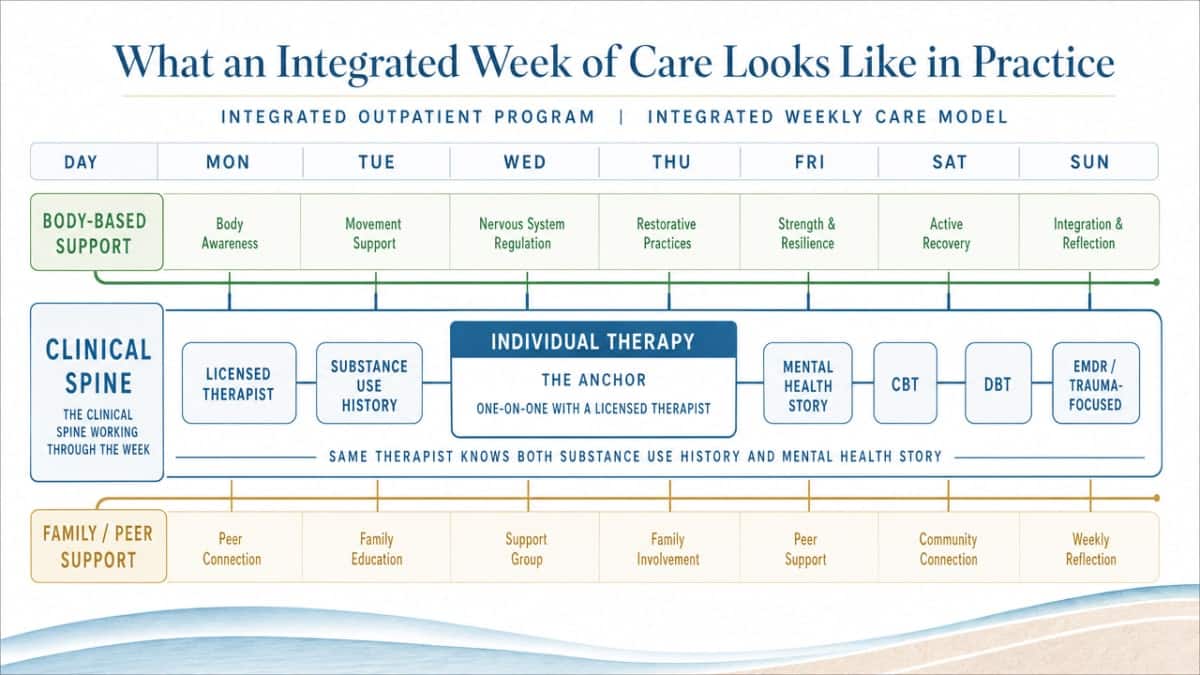
If you’ve never been inside an integrated outpatient program, it can feel mysterious from the outside. Let’s pull back the curtain a little. The clinical spine of holistic addiction recovery in Orange County is built from a few specific pieces that work together throughout your week.
Individual therapy is usually the anchor. You’ll meet one-on-one with a licensed therapist who knows both your substance use history and your mental health story — not two different people in two different buildings. The work draws on evidence-based methods that have years of research behind them: Cognitive Behavioral Therapy to help you notice and shift the thoughts that drive use, Dialectical Behavior Therapy when emotional intensity or self-harm is part of the picture, and trauma-focused approaches like EMDR when something older is fueling the present.
Group therapy fills out most days. You’ll sit with other adults who are working on similar things — not telling war stories, but practicing skills, processing what happened in the week, and learning that you are very much not alone. Process groups, relapse prevention, and trauma-focused groups each do different jobs.
Psychiatric care runs alongside all of this. A prescriber who specializes in co-occurring conditions reviews your medications, adjusts them when needed, and watches for interactions that someone outside this world might miss. NIDA’s guidance is clear that effective treatment combines behavioral therapy with medication when appropriate, tailored to your specific needs 14. That coordinated combination is what separates real integrated care from a program that just adds a meditation class to a standard track.
Mindfulness, Movement, and Body-Based Support
Here’s where the word “holistic” usually gets misused. You’ve probably seen programs advertise yoga decks and sound baths like the activities themselves are the treatment. They’re not. But the body-based pieces, used the right way, do meaningful work — and there’s research to back that up.
A review of complementary and integrative health approaches for substance use disorders found that mindfulness-based interventions show promising effects on relapse prevention, while being clear that these methods belong alongside evidence-based treatment, not in place of it 10. That’s the honest framing. Mindfulness can teach you how to sit with a craving instead of immediately acting on it. Yoga and movement can rebuild a relationship with a body that has been numbed, ignored, or pushed through years of hard use. Sleep work, nutrition support, and basic physical care give your nervous system something it has probably been missing for a long time.
One structured example helps make this concrete. Mindfulness-Oriented Recovery Enhancement, often shortened to MORE, is a clinical intervention that combines three specific practices:
- Mindfulness training to interrupt automatic responses,
- Cognitive reappraisal to rework painful thoughts, and
- Savoring to rebuild the brain’s response to healthy rewards.
Clinical trials of MORE showed it significantly reduced opioid misuse among participants with chronic pain 11. That’s not yoga as decoration. That’s a tested mind-body protocol with measurable results.
In a good week of holistic addiction recovery in Orange County, you might do a mindfulness group on Monday, an experiential or movement-based group midweek, and individual work that returns to those tools when life gets hard. The point isn’t to feel relaxed for an hour. The point is to build skills your body can reach for when your mind is overwhelmed.
Family, Peers, and the People You Go Home To
Recovery doesn’t end when you leave the building each afternoon. You go home — to a spouse, a parent, kids, a roommate, or sometimes to a quiet apartment that has felt too quiet for too long. Whatever waits for you there matters, and integrated programs take that seriously.
Family therapy is one piece of this. When the people closest to you understand what’s happening clinically — not just that you’re “in treatment,” but how your anxiety connects to your drinking, or how trauma shaped patterns nobody talked about — relationships have a real chance to heal. SAMHSA’s guidance on co-occurring disorders specifically recommends combining therapy, medication when appropriate, peer support, and social services as part of a coordinated recovery plan 7. Your family isn’t a side conversation. They’re part of the system you’ll lean on after the program ends.
Peer support is the other piece. Group members become people who text you on a hard Tuesday. Alumni connections, 12-step or other community meetings, and structured peer engagement give you a circle that gets it without explanation. For many people, this is what makes holistic addiction recovery in Orange County actually stick — the clinical work plants something new, and community keeps watering it.
Reaching out to one person this week, even just to say you’re trying, counts. That small move is part of the work, too.
Choosing a Program: Questions That Cut Through the Marketing
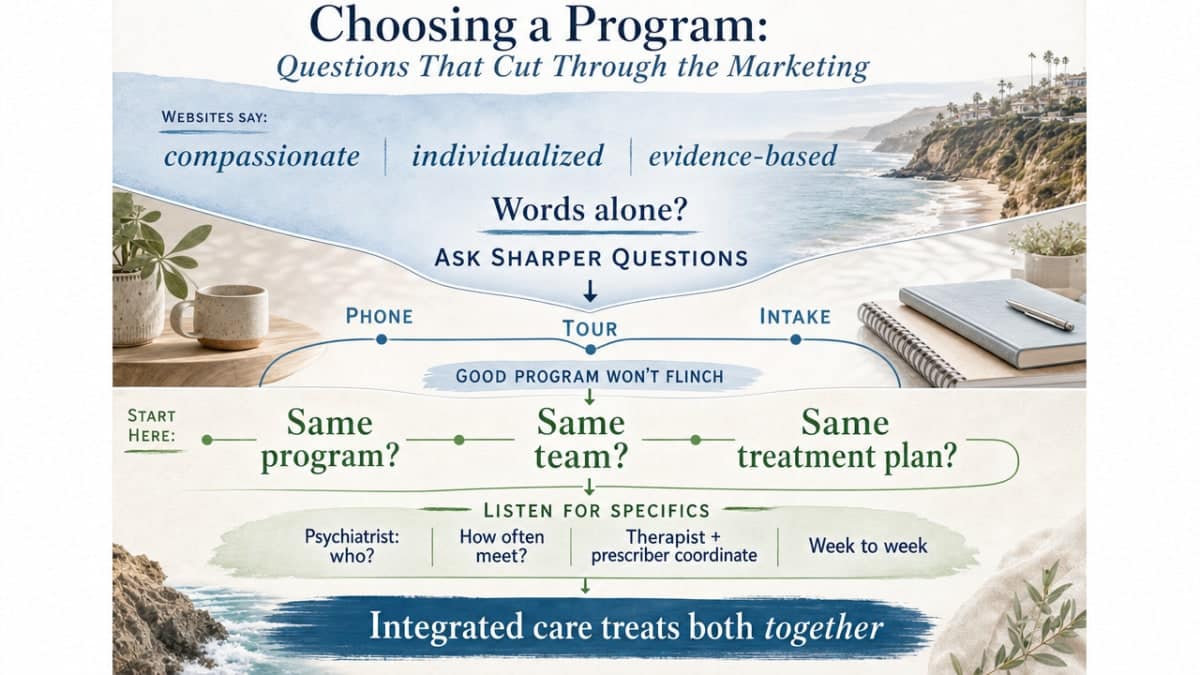
Every program’s website will tell you they offer compassionate, individualized, evidence-based care. Most of them mean it. But the words alone won’t tell you whether a place is the right match for someone with both a mental health condition and a substance use disorder. You need sharper questions, and you’re allowed to ask them — over the phone, on a tour, in an intake meeting. A good program will not flinch.
Start with the dual diagnosis question, and ask it directly: do you treat mental health and substance use in the same program, with the same team, on the same treatment plan? Listen for specifics. A real integrated program can tell you who the psychiatrist is, how often you’d meet, and how your therapist and prescriber coordinate week to week. Federal guidance is consistent that these conditions do better when treated together, not handed off 12. If the answer feels vague, that’s information.
Ask what evidence-based therapies the clinical team is trained in. You’re listening for named approaches — CBT, DBT, EMDR, motivational interviewing — and for how those methods get matched to your situation. The principle to keep in mind is that no single treatment works for everyone, and effective programs combine several components based on what you actually need 14.
Then ask about the rest of the person. What does the program do for sleep, movement, family relationships, and aftercare? How are complementary practices like mindfulness used, and are they offered alongside clinical work rather than instead of it 10? Ask about accreditation, licensing, insurance, and what happens when you finish the structured phase. Ask how they handle a setback without making you feel like you’ve failed.
One more question worth asking yourself: when you got off the call, did you feel slightly more human than when you got on? Holistic addiction recovery in Orange County should feel clinically serious and personally warm in the same breath. If a program can only do one of those, keep looking.
Keeping Your Life While You Heal: Outpatient and Aftercare
One of the biggest fears people carry into this decision is simple: if I get help, will I lose everything I’ve built? Your job. Your apartment. Your role as a parent. The structure that’s been holding you together, even imperfectly. That fear is real, and it stops a lot of people from making the call. It shouldn’t stop you.
Outpatient programs are designed specifically so you can keep your life while you heal. A Partial Hospitalization Program runs during the day, several hours a session, several days a week — intensive enough to do real clinical work, structured enough that you go home at night. An Intensive Outpatient Program steps down from there, often with evening options so you can hold a job during the day and still get treatment in the same week. For many people, this is the format where holistic addiction recovery in Orange County actually becomes possible, because it doesn’t ask you to choose between healing and the life you’re healing for.
What matters clinically is that the intensity matches what you need. NIDA’s guidance is that treatment plans should be reviewed and modified as your needs shift, with multiple components combined to fit your situation 14. Good programs adjust as you stabilize. You might start in PHP, move to IOP, and then transition into a structured aftercare phase.
Aftercare is the part most people underestimate. The first months after a structured program ends are when relapse risk is highest, and a sustainable recovery depends on what’s in place when the schedule loosens. SAMHSA’s co-occurring disorders guidance specifically recommends combining therapy, medication when appropriate, peer support, and social services as ongoing supports, not just initial ones 7. That means alumni groups, continued individual sessions, family check-ins, and a community you can reach for on a hard Tuesday night. Many local programs work with major commercial insurers, which makes longer-term care more reachable than people assume. You don’t have to figure all of this out today. You just have to make the next call.
Taking the Next Step Toward Holistic Addiction Recovery in Orange County
If you’ve read this far, something in you is still looking for a way through. That matters. The decision to reach for help rarely arrives as a thunderclap — it usually shows up quietly, in the form of someone reading an article on a Tuesday night and wondering if a different kind of life might still be possible. It is. And the next step is smaller than it feels.
You don’t have to have it all figured out before you make a call. You don’t need to know which therapy you want, what your insurance covers, or whether you’re “bad enough” to deserve help. (You are.) A good intake conversation does that work with you. If you’re not ready to call a program directly, SAMHSA’s National Helpline is free, confidential, and available 24 hours a day, 365 days a year for individuals and families facing mental health and substance use concerns 8. One phone call. No commitment beyond honesty.
When you’re ready to look at local options, holistic addiction recovery in Orange County is here — at places like 449 Recovery and other integrated programs across the region — built around the kind of whole-person, dual diagnosis care this article has described. Make the next call. That’s the only step you have to take today.
Frequently Asked Questions
What does “holistic” really mean in addiction recovery?
Holistic addiction recovery in Orange County means treating you as a whole person, not just the substance use. That means clinical therapy and psychiatric care at the center, with mindfulness, movement, family work, and community support wrapped around it. The word isn’t about spa amenities — it’s about not splitting your mind, body, and mental health into separate buckets. Effective treatment addresses the multiple needs of the individual, not only the substance use itself 14.
How is dual diagnosis treatment different from regular rehab?
Regular rehab often treats substance use alone. Dual diagnosis treatment addresses your mental health condition — anxiety, depression, trauma, bipolar, ADHD — at the same time, with one team and one plan. NIDA is direct that when these conditions show up together, treating them simultaneously usually works better than handing you between separate providers 12. That coordinated approach is the clinical backbone of real holistic addiction recovery in Orange County.
Can I keep working or living at home during treatment?
Yes, for many people. Partial Hospitalization and Intensive Outpatient programs are built so you can sleep at home, see your kids, and often keep a job — especially with evening IOP options. The intensity is real, but it works around your life instead of replacing it. Plans should be adjusted as your needs shift, with several treatment components combined to match where you are 14. That flexibility is part of why outpatient care fits so many situations.
Do practices like mindfulness and yoga actually help with addiction?
They can help, when used the right way. A review of complementary approaches for substance use found mindfulness-based interventions show promising effects on relapse prevention, but the authors are clear these methods belong alongside evidence-based treatment, not in place of it 10. Think of mindfulness as a skill that helps you sit with a craving instead of acting on it. It strengthens your clinical work — it doesn’t substitute for therapy or psychiatric care.
What questions should I ask when choosing a program in Orange County?
Ask whether mental health and substance use are treated by the same team on the same plan. Ask which evidence-based therapies the clinicians are trained in — CBT, DBT, EMDR, motivational interviewing. Ask how psychiatric care is coordinated, what aftercare looks like, and how setbacks are handled without shame. A good program will answer specifically. Holistic addiction recovery in Orange County should feel clinically serious and personally warm in the same conversation 7.
How do I help a family member who may not be ready for treatment?
Stay connected without ultimatums. Learn what co-occurring disorders actually are so the conversation isn’t about blame. SAMHSA’s National Helpline is free, confidential, and available 24 hours a day, 365 days a year for family members too — you can call before your loved one is ready 8. Small steps count: one honest talk, one shared article, one call you make for yourself. Readiness often grows when someone feels less alone in it.
References
- National Survey of Substance Abuse Treatment Services (N-SSATS), California 2019. https://www.samhsa.gov/data/sites/default/files/quick_statistics/state_profiles/NSSATS-CA19.pdf
- Integrating Substance Use Disorder Services with Primary Care. https://pmc.ncbi.nlm.nih.gov/articles/PMC3664544/
- Adoption of Integrated Care for People with Co-Occurring Mental Health and Substance Use Conditions. https://aspe.hhs.gov/sites/default/files/documents/e2ccdd7991f1de5060983598cb66624f/adoption-integrated-care.pdf
- CalAIM Behavioral Health Initiative – DHCS. https://www.dhcs.ca.gov/calaim-behavioral-health-initiative/
- Coroner Division Annual Report 2020, Orange County Sheriff-Coroner Department. https://ocsheriff.gov/sites/ocsd/files/2021-12/Annual%20Report%202020%20-%20FINAL_0.pdf
- Sustainment of Integrated Care in Addiction Treatment Settings. https://pmc.ncbi.nlm.nih.gov/articles/PMC8814048/
- Managing Life with Co-Occurring Disorders. https://www.samhsa.gov/mental-health/serious-mental-illness/co-occurring-disorders
- National Helpline. https://www.samhsa.gov/find-help/national-helpline
- The Effectiveness of Integrated Treatment in Co-Occurring Disorders: A Review of the Evidence. https://www.ncbi.nlm.nih.gov/pmc/articles/PMC6924552/
- Complementary and Integrative Health Approaches for Substance Use Disorders. https://www.ncbi.nlm.nih.gov/pmc/articles/PMC5750904/
- Mindfulness-Oriented Recovery Enhancement for Addiction, Stress, and Pain. https://www.ncbi.nlm.nih.gov/pmc/articles/PMC5689136/
- Co-Occurring Disorders and Health Conditions. https://nida.nih.gov/research-topics/co-occurring-disorders-health-conditions
- Integrating Treatment for Co-Occurring Mental Health Conditions. https://pmc.ncbi.nlm.nih.gov/articles/PMC6799972/
- Treatment Approaches for Drug Addiction. https://www.drugabuse.gov/publications/drugfacts/treatment-approaches-drug-addiction