Key Takeaways
- Evening IOP in Orange County runs roughly 6:00 to 9:00 p.m. on weekdays, delivering at least 9 structured clinical hours weekly without requiring time off work 1.
- A credible program holds DHCS licensing and CARF accreditation, integrates co-occurring mental health and substance use care on one team, and treats at least 90 days 16, 18.
- Evening IOP fits anxious professionals who have outgrown weekly therapy and people stepping down from residential care, with research showing intensive outpatient outcomes comparable to higher levels 11, 15.
The 6:00 p.m. Session After a 9-Hour Workday
You closed your laptop at 5:15. The 405 was the 405. You grabbed a protein bar in the car because group starts at 6:00, and the only thing worse than walking in late is walking in hungry and late. This is what looking up an iop program near me actually means when you have a job, a calendar full of standing meetings, and people who depend on you Monday through Friday.
Here’s what you already know: weekly therapy stopped being enough a while ago. The anxiety isn’t loosening. The drinking, or the Klonopin, or the 11 p.m. doomscroll, has stopped feeling like a coping tool and started feeling like the problem. You’ve read enough to understand that an iop program near me sits between traditional outpatient therapy and a higher level of care, and that the evening track exists precisely so people like you don’t have to choose between treatment and a paycheck.
What you may not know yet is that evening IOP isn’t a watered-down version of daytime treatment. It’s the same clinical level of care, delivered at the hours that match your life. The structure is real. The dose is real. The expectations are real. And the fact that you’re still working while you do it isn’t a workaround. For a lot of adults in Orange County, it’s the part that makes the work stick.
What Evening IOP Actually Involves
The Clinical Threshold That Defines This Level of Care
When you type “iop program near me” into a search bar at 11 p.m., you’re not looking for a brochure. You’re trying to figure out whether this thing is real treatment or just group therapy with a fancier name. Here’s the line that matters: an intensive outpatient program is defined, at the federal level, by clinical hours. Medicare guidance specifies that you qualify for IOP services when your care plan calls for at least 9 hours of therapeutic services each week 1. That’s the floor, not the ceiling.
Picture the continuum. Standard outpatient therapy is roughly one hour a week with a therapist you like and trust. Partial hospitalization sits at the other end, often running 20 or more clinical hours per week and functioning almost like a full-time job. Evening IOP lives in the middle, anchored at that 9-hour mark, with structured services delivered across multiple sessions.
That gap between 1 hour and 9+ hours is the entire point. It’s the difference between processing your week once and actually building skills, getting real psychiatric oversight, and doing the kind of repeated, structured work that changes how your nervous system responds on a Tuesday afternoon. An iop program near me that meets this threshold is offering a clinical level of care recognized by federal payers, not a wellness package.
The hours aren’t padding. They’re the dose. And when the dose is delivered in the evening, the clinical structure doesn’t change, just the clock.
A Sample Evening Week for a Working Professional
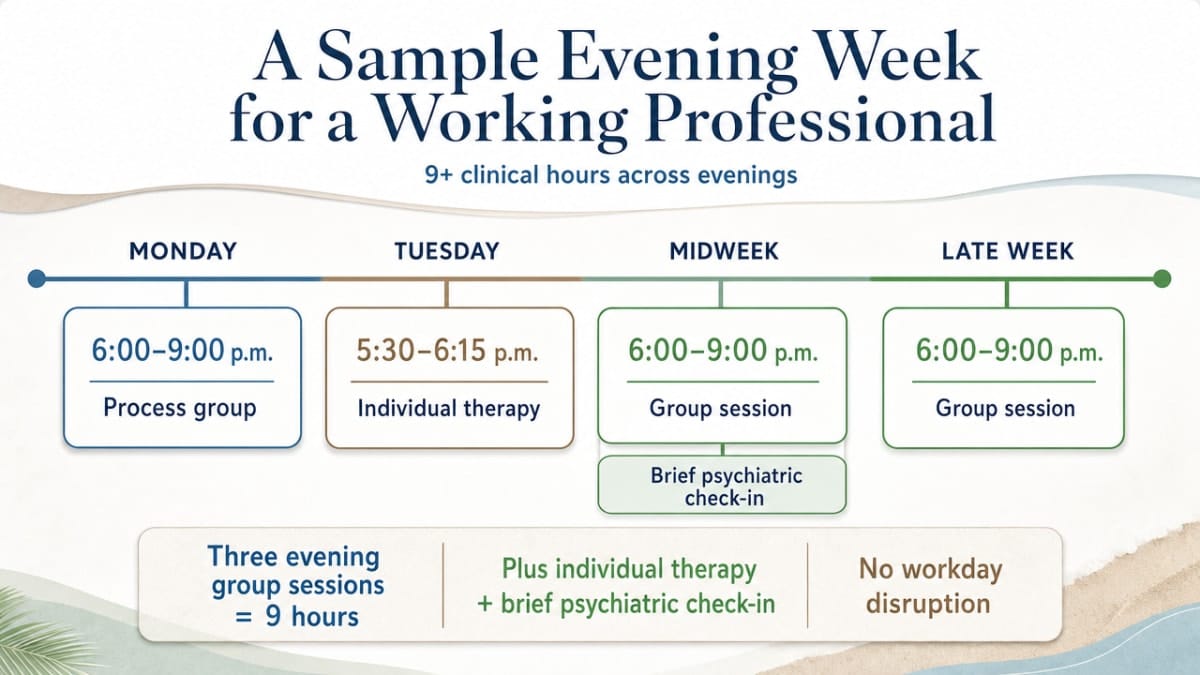
So what does 9+ hours actually look like when you’re still pulling a paycheck? Most evening tracks structure the week around three group sessions, typically 3 hours each, scheduled in the 6:00 to 9:00 p.m. window 1. Add one individual therapy slot and a brief psychiatric check-in for medication management, and you’ve cleared the clinical threshold without touching your workday.
A realistic week for someone you might recognize:
- Monday, 6:00–9:00 p.m. — Process group. You walk in still mentally drafting the email you didn’t send. Forty minutes in, you’re actually present. The facilitator runs a structured check-in, then the group moves into the week’s clinical focus, often a DBT or CBT skill you’ll use before Friday.
- Tuesday, 5:30–6:15 p.m. — Individual therapy. One-on-one with your primary clinician. This is where the personal work happens, the trauma piece, the family-of-origin piece, the specific anxiety pattern that group can’t fully address.
- Wednesday, 6:00–9:00 p.m. — Skills group. Concrete tools: distress tolerance, cognitive restructuring, urge surfing if substance use is part of the picture.
- Thursday, 6:00–9:00 p.m. — Process or specialty group, sometimes trauma-focused, sometimes dual diagnosis–focused.
- Once every week or two — A 20-minute psychiatric appointment, often telehealth, to monitor medication and adjust if needed.
That’s 9.5 to 10+ clinical hours, hitting the federal definition of an iop program near me 1. You’re still at your desk Monday through Friday. You’re still making your kid’s soccer game on Saturday. The treatment is built around your life, not stacked on top of it. The Sunday-night scramble to reorganize your calendar around therapy? It doesn’t happen here, because the schedule was designed for someone who already has one.
Who Evening IOP Is Actually For
The Anxious Professional Who Has Outgrown Weekly Therapy
You can probably name the moment weekly therapy stopped doing the job. Maybe it was the third Sunday in a row you white-knuckled through the evening because Monday was coming. Maybe it was your therapist saying, gently, “I think you might need more than what we’re doing here.” Maybe it was the realization that you spend 50 minutes a week unpacking a problem that takes 167 hours to live inside.
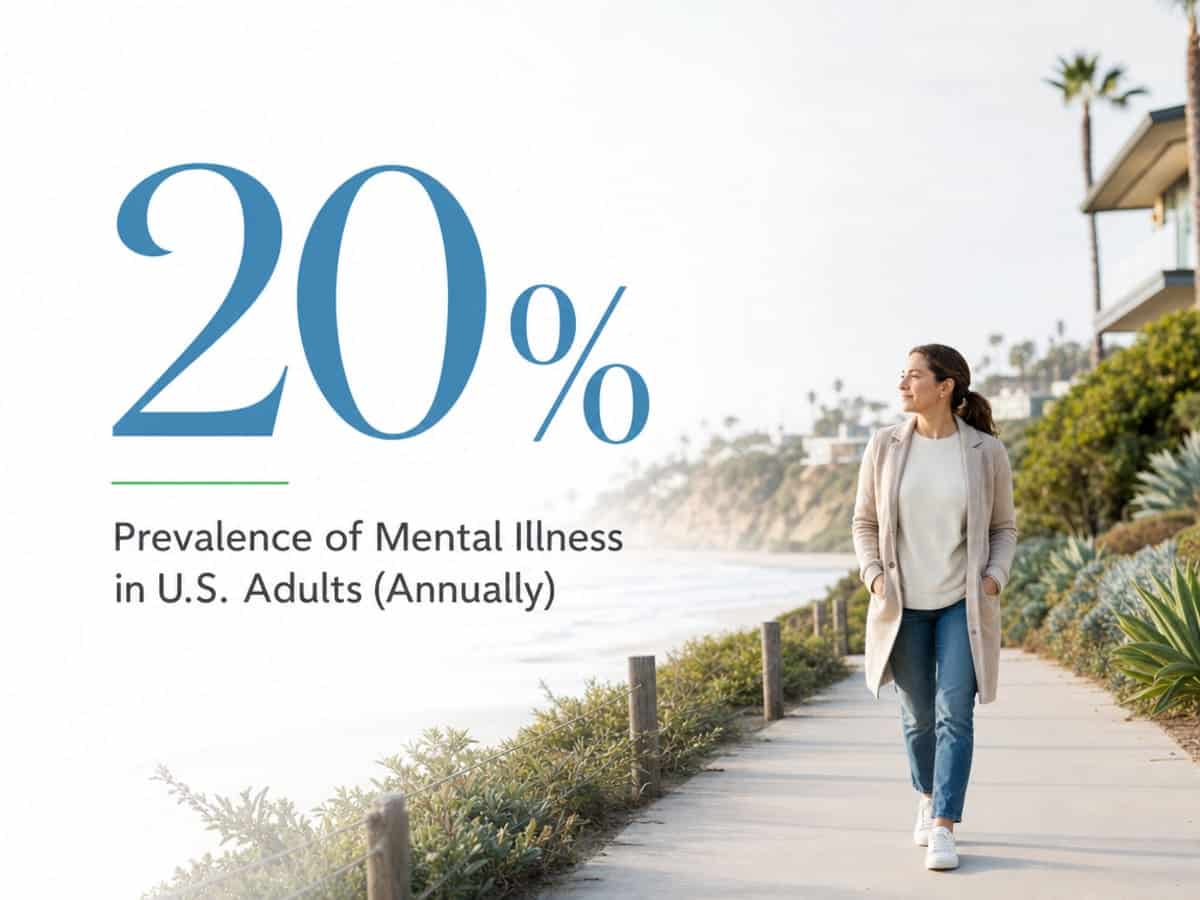
If that’s the place you’re searching from when you look up an iop program near me, you’re not an outlier. NIMH data show that nearly one in five U.S. adults lives with a mental illness in any given year 7. That’s not a niche population. That’s the person two desks over, the senior manager on your Wednesday call, the friend you text at midnight. The scale of need is part of why intensive outpatient care exists as a defined level of treatment in the first place.
Research on intensive outpatient programs for anxiety and mood disorders specifically shows meaningful symptom reduction over the course of treatment, with structured, multi-hour weekly care producing changes that weekly therapy alone often can’t reach 14. The clinical reason is simple: skills require repetition, and a panic response that’s been wired in for years doesn’t unwire in 50 minutes once a week. The evening track of an iop program near me gives you the repetition without asking you to step away from the life you’re trying to stabilize.
Stepping Down From Residential or Up From Outpatient
Two doors open into evening IOP, and they look different from the inside.
The first is a step down. You finished a residential or partial hospitalization stay, and now you’re staring at the gap between 24-hour structure and a single weekly therapy appointment. That gap is where a lot of progress quietly comes undone. A randomized trial comparing intensive outpatient care to standard outpatient aftercare for alcohol dependence found that more intensive programming produced comparable or better outcomes in key domains, supporting the use of intensive outpatient as a real step-down option rather than a token follow-up 11. SAMHSA’s TIP 47 makes a related point at the program-design level: outcomes for many people in intensive outpatient treatment are comparable to inpatient and residential treatment when the services offered are similar 15. The intensity does the work, not the bed.
The second door is a step up. You’ve been in weekly therapy for months, maybe years. Your clinician is good. You like them. And something has shifted, anxiety is sharper, sleep is worse, the drinking crept up, the meds aren’t holding. An iop program near me that runs evenings lets you raise the dose without dismantling your job or your custody schedule.
Either door, the question is the same: do you need more structure than you currently have to get where you’re trying to go? If the answer is yes, evening IOP is built for that yes.
Dual Diagnosis: When Anxiety, Depression, or Trauma Meets Substance Use
The Patterns Orange County Professionals Actually Present With
The intake form asks you to check a box. Anxiety. Depression. PTSD. Alcohol use. Stimulant use. You check two. Maybe three. And then you wonder if that disqualifies you from an iop program near me, or if it’s actually the reason you need one.
Here’s the clinical reality: it’s the reason. NIDA’s research on comorbidity is direct about this. People experiencing substance use challenges often have one or more associated mental health conditions, and the two pull on each other in both directions 9. The pattern isn’t unusual. It’s the norm.
What it looks like in the people who actually walk through the door:
The senior account manager whose generalized anxiety has been quietly managed with a nightly bottle of wine that became two glasses with dinner that became something she stopped counting around 2022. The software engineer prescribed Klonopin for panic attacks who now feels worse on the days he forgets it than he ever did before the script. The litigator carrying untreated trauma from a car accident who started using stimulants to power through depositions and is now sleeping three hours a night. The nurse with treatment-resistant depression who discovered that two edibles after a shift made the apartment feel less heavy, until they didn’t.
None of these are character failures. They’re recognizable clinical patterns, and an iop program near me built for working adults has seen each of them many times over.
What Integrated, Co-Occurring-Enhanced Treatment Looks Like in Practice
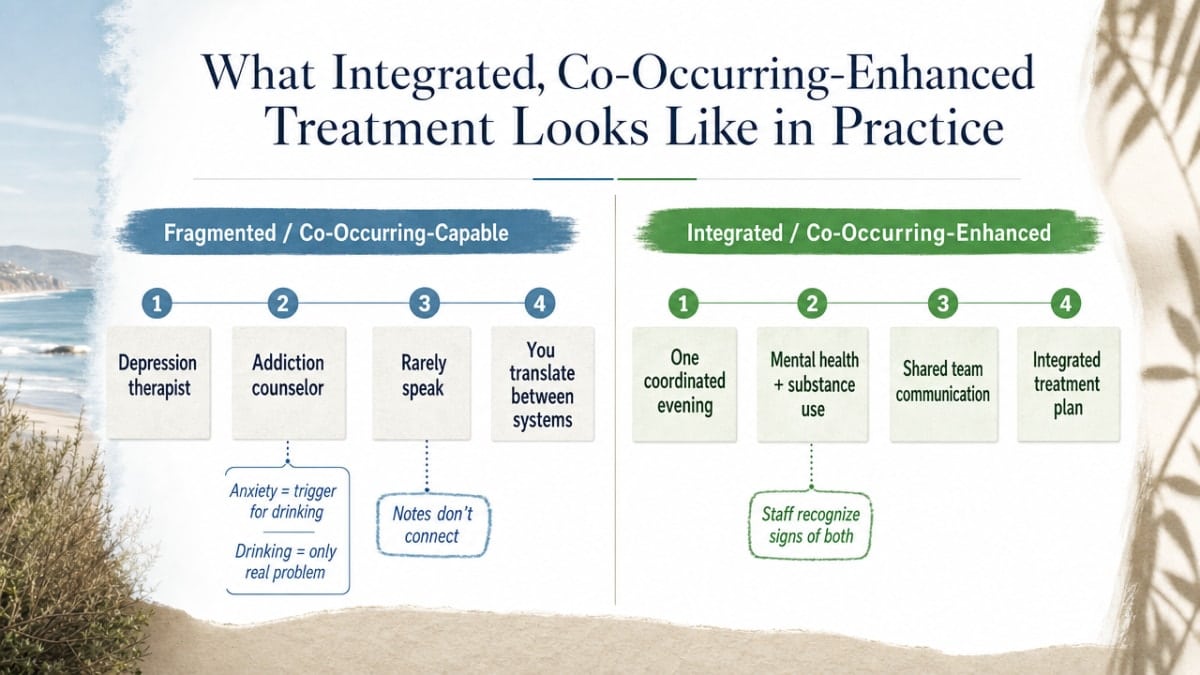
The way these conditions get treated matters as much as whether they get treated. SAMHSA’s framework distinguishes between programs that are co-occurring–capable and programs that are co-occurring–enhanced, with the enhanced model offering a higher level of integration between substance use and mental health services and staff trained to recognize the signs and symptoms of both 18. That distinction shows up in how a Tuesday evening actually unfolds.
In a fragmented model, you’d see a therapist for depression on one track and an addiction counselor on another, with the two clinicians rarely speaking. The anxiety gets framed as a trigger for drinking, or the drinking gets framed as the only real problem. You end up translating between two systems that don’t share notes.
In an integrated evening iop program near me, the same clinical team treats both at once. Your CBT work on catastrophic thinking sits next to relapse prevention skills in the same group. Your psychiatric medication review accounts for what you’re drinking, what you’re not, and what the depression is doing this week. Trauma processing happens at a pace your nervous system can hold without sending you back to old coping.
The outcome data support this design. Research on intensive outpatient programs serving people with co-occurring substance use and psychiatric disorders shows meaningful reductions in both psychiatric symptoms and substance use when services are delivered together 13. One condition does not wait in line behind the other.
Duration: How Long an Evening IOP Should Run
Here’s where working professionals tend to push back: how long is this going to take? You want a number. You want to put it in your calendar and plan around it. The honest answer isn’t a marketing number, it’s a clinical one.
Three months sounds like a lot when you’re standing on the outside of it. From the inside, it tends to break down in a way that makes sense. The first few weeks are stabilization, getting the schedule to actually hold, getting through the first hard groups, getting medication adjusted if that’s part of the plan. The middle stretch is where the real skills work lands, the repetitions that change how you respond to a Sunday-night spike or a Friday-afternoon urge. The final phase is about transferring what you’ve built into a life that runs without 9 weekly hours of clinical scaffolding.
Some people need longer. Some step down to a less intensive aftercare track at the 90-day mark and keep building from there. What you should be wary of is an iop program near me that promises a fixed, short-term arc without a real conversation about what your specific clinical picture calls for. Duration is part of the dose. Cutting it short is cutting the treatment.
Judging Whether a Local Program Is Clinically Credible
Licensing, Accreditation, and the California Context
Two acronyms do most of the heavy lifting when you’re trying to tell a serious program apart from a marketing operation: DHCS and CARF. DHCS is the California Department of Health Care Services, which licenses behavioral health facilities operating in the state. CARF is the Commission on Accreditation of Rehabilitation Facilities, a third-party accreditor that audits clinical operations, treatment planning, staff credentialing, and outcomes tracking. When you’re vetting an iop program near me, both names should appear somewhere on the website or in your first phone call. If they don’t, ask why.
The broader regulatory context matters too. California’s CalAIM Behavioral Health Initiative is reshaping how Medi-Cal behavioral health services are paid for, documented, and coordinated, with an emphasis on integrated care across mental health and substance use treatment 5. You don’t need to memorize the policy. You do want to know that the program you’re considering operates inside a system the state is actively pushing toward better-integrated, outcomes-focused care, not a one-off operation working around the edges.
Credible programs talk about their licensing the way a good restaurant talks about its kitchen. Plainly, and without being asked twice.
Questions to Ask Before You Commit to Any IOP Program Near Me
The intake call is a clinical conversation, not a sales pitch. You’re allowed to interview them. A short list of questions tends to separate the programs that will hold up from the ones that won’t:
- Who runs my care? Ask for the credentials of the clinical leadership and the licensure of the people who’ll actually be in the room with you. Licensed therapists. A psychiatrist or psychiatric nurse practitioner for medication management. Group facilitators with real training, not just lived experience alone.
- How do you handle co-occurring conditions? If the answer is vague, that’s information. A credible iop program near me should be able to describe how mental health and substance use treatment are integrated within the same clinical team, in line with the co-occurring-enhanced framework SAMHSA outlines 18.
- What’s the actual weekly structure? They should be able to name the days, the hours, the group topics, and the frequency of individual therapy without consulting a brochure.
- How long does treatment usually last, and what does step-down look like? A real answer references clinical milestones, not a fixed sales calendar.
- Are you in-network with my insurance? A straightforward yes or no, plus a verification process that takes hours, not weeks.
- What happens if I have a crisis at 11 p.m. on a Saturday? The program should have a clear answer. “Call 988” isn’t enough on its own. Ask what their team does.
If a program can answer these without hedging, you’re looking at a real one.
Markers of Progress a Working Professional Will Actually Notice
Progress in an evening IOP program near me doesn’t usually announce itself. It shows up in small, specific shifts that a working adult tends to notice before anyone else does. Not because they’re dramatic, but because you live inside your own week and you know what your baseline used to be.
Around week three or four, sleep often starts to change. You’re not sleeping perfectly. You’re sleeping through the night, or you’re falling back asleep at 3:47 a.m. instead of staring at the ceiling until your alarm. That’s not luck. That’s a combination of medication actually being managed, alcohol or benzodiazepine use being addressed, and a nervous system that’s getting four to five new hours of structured regulation work each week.
The Sunday-night thing tends to shift next. The chest-tight, scrolling-the-work-inbox, why-is-it-already-dark feeling. It doesn’t disappear. It loses its grip. You notice you made it through a Sunday evening without the second drink, or the third refresh of the calendar, or the spiral about Monday’s meeting. You name it as it’s happening, which is a skill the Wednesday group has been drilling for weeks.
The 3 p.m. workday spike is another one. Working professionals in an iop program near me often report that the mid-afternoon panic surge, the one that used to send them to the parking lot for ten minutes of paced breathing or worse, starts to land softer and pass faster. The pattern isn’t gone. Your response to it is different.
Then there are the relational markers. You snap at your partner less. You’re present at your kid’s bath time instead of mentally rehearsing tomorrow. You finish a workday and don’t immediately need a chemical buffer between work-you and home-you. These are the changes that don’t show up on a symptom scale but matter to the people sharing a roof with you.
None of this is finished work at the 90-day mark. It’s the foundation that makes the next phase of care, lighter outpatient, aftercare groups, ongoing individual therapy, actually hold.
Making the Call: Starting an Evening IOP Program Near Me in Orange County
You don’t have to be certain. You have to be willing to make the call. The intake conversation for an evening iop program near me is usually 20 to 30 minutes, often after hours, and it doesn’t commit you to anything except getting clear on what you actually need. They’ll ask about your work schedule, what’s been happening clinically, your history with care, your insurance. You’ll get an honest read on whether evening IOP is the right level, or whether something lighter or more intensive fits the picture better.
The hardest part is the dialing. The next-hardest part is telling one person at work, or at home, that you’re doing this. After that, the structure does what structure does, it holds you while you do the work. If you’re in Orange County and you’re ready for that call, 449 Recovery’s evening IOP track was built for the week you’re already living.
Frequently Asked Questions
Can I keep working full-time while attending an evening IOP program near me?
Yes. Evening tracks are designed for working adults, with group sessions typically running 6:00 to 9:00 p.m. on weekdays and individual therapy slots scheduled around them. You keep your job, your benefits, and your routines. The trade-off is real, three or more evenings a week is a meaningful commitment, but it doesn’t require taking leave or explaining a gap on your calendar.
How is evening IOP different from weekly therapy or a higher level of care?
Weekly therapy delivers roughly one clinical hour. An iop program near me delivers at least 9 structured hours per week, per Medicare guidance defining this level of care 1. Partial hospitalization runs higher still, often 20+ hours. The clinical difference is dose: more repetition of skills, more peer support, more psychiatric oversight, and integrated care for co-occurring conditions that a single weekly session can’t deliver.
Does evening IOP handle co-occurring anxiety, depression, and substance use together?
A well-designed evening IOP treats them in the same clinical episode, not on separate tracks. Co-occurring-enhanced programs have staff trained in both mental health and substance use, with integrated treatment planning 18. Outcome research on intensive outpatient programs serving people with co-occurring conditions shows meaningful reductions in both psychiatric symptoms and substance use when services are delivered together rather than sequentially 13. Ask how integration actually works.
What does a typical evening IOP week actually look like for a working adult?
Most weeks include three group sessions of roughly 3 hours each, scheduled in the 6:00 to 9:00 p.m. window, plus one individual therapy appointment and periodic psychiatric check-ins for medication management. Groups rotate between process work, skills training (often CBT and DBT), and specialty content like trauma or relapse prevention. Total clinical contact lands at 9 to 10+ structured hours weekly, the federally recognized IOP threshold.
How do I judge whether an evening IOP in Orange County is clinically credible?
Look for DHCS licensing and CARF accreditation, the two credentials a serious program states plainly. Ask about clinical leadership credentials, how co-occurring conditions are handled within the same team, the exact weekly structure, and the program’s stance on treatment duration. California’s coordinated behavioral health environment under CalAIM also pushes toward integrated, outcomes-focused care 5. Vague answers about any of this are themselves an answer.
Is evening IOP appropriate as a step-down from residential treatment?
For many people, yes. A randomized trial comparing intensive outpatient care to standard outpatient aftercare for alcohol dependence found that more intensive programming produced comparable or better outcomes in key domains, supporting evening IOP as a clinically substantive step-down rather than a token follow-up 11. The structure helps maintain gains made in residential care while you reintegrate into work and family life with real clinical support still in place.
References
- Intensive Outpatient Program Services. https://www.medicare.gov/coverage/mental-health-care-outpatient-intensive-outpatient-program-services
- Principles of Drug Addiction Treatment: A Research-Based Guide (Third Edition). https://nida.nih.gov/sites/default/files/podat-3rdEd-508.pdf
- NIDA Treatment Guidelines (Module on Treatment Principles). https://webcampus.med.drexel.edu/nida/module_1/content/5_0_Treatment.htm
- Table 4.2, Principles of Effective Treatment for Substance Use Disorders. https://www.ncbi.nlm.nih.gov/books/NBK424859/table/ch4.t2/
- CalAIM Behavioral Health Initiative. https://www.dhcs.ca.gov/calaim-behavioral-health-initiative/
- CalAIM Behavioral Health Initiative Frequently Asked Questions. https://www.dhcs.ca.gov/calaim-behavioral-health-initiative-frequently-asked-questions/
- Mental Illness – NIMH Statistics. https://www.nimh.nih.gov/health/statistics/mental-illness
- Treatment Approaches for Drug Addiction. https://nida.nih.gov/publications/drugfacts/treatment-approaches-drug-addiction
- Comorbidity: Substance Use Disorders and Other Mental Illnesses. https://nida.nih.gov/publications/drugfacts/comorbidity-substance-use-disorders-other-mental-illnesses
- Principles of Effective Treatment. https://nida.nih.gov/publications/principles-drug-addiction-treatment-research-based-guide-third-edition/principles-effective-treatment
- A randomized trial of intensive outpatient (day treatment) vs. standard outpatient aftercare for alcohol dependence. https://pubmed.ncbi.nlm.nih.gov/22003423/
- Intensive outpatient treatment for alcohol-dependent patients: A 6-month outcome study. https://pubmed.ncbi.nlm.nih.gov/16022929/
- Effectiveness of intensive outpatient programs for co-occurring substance use and psychiatric disorders. https://pubmed.ncbi.nlm.nih.gov/25734857/
- Intensive outpatient treatment for anxiety and mood disorders: A naturalistic study. https://pubmed.ncbi.nlm.nih.gov/23528034/
- Chapter 3. Intensive Outpatient Treatment and the Continuum of Care. https://www.ncbi.nlm.nih.gov/books/NBK64088/
- Substance Abuse: Clinical Issues in Intensive Outpatient Treatment (TIP 47). https://www.ncbi.nlm.nih.gov/books/NBK64093/
- TIP 47 – Clinical Issues in Intensive Outpatient Treatment – SAMHSA. https://www.samhsa.gov/resource/ebp/tip-47-substance-abuse-clinical-issues-intensive-outpatient-treatment
- Chapter 7—Treatment Models and Settings for People With Co-Occurring Disorders. https://www.ncbi.nlm.nih.gov/books/NBK571024/
- Specialty Mental Health Services for Children and Youth – DHCS. https://www.dhcs.ca.gov/services/mental-health-services-division-default/specialty-mental-health-services-for-children-and-youth
- CalAIM Behavioral Health Initiative Frequently Asked Questions (BH-DMC-ODS). https://www.dhcs.ca.gov/calaim-behavioral-health-initiative-frequently-asked-questions-calaim-bh-initiative-faq-bh-dmc-ods/