Key Takeaways
- Behavioral health treatment is the umbrella term for coordinated clinical care that addresses mental health conditions, substance use disorders, and the ways the two overlap in daily life.
- When both conditions are active, integrated care where one team handles both on a single plan produces better outcomes than parallel or sequential approaches 1, 3.
- Levels of care scale to what’s happening: standard outpatient for weekly work, IOP for several days a week, and PHP for daily structure without hospitalization 5, 6.
- A program built for dual diagnosis names both conditions on one plan, uses motivational approaches for ambivalence, and tracks progress with measurement-based care 3, 7, 10.
When Two Conditions Show Up Together
You already know something isn’t lining up. Maybe the anxiety got louder and the drinking got heavier, and now you can’t tell which one started it. Maybe the depression came first, and the pills that helped at 2 a.m. stopped helping and started running your day. Maybe you’re the one watching a family member cycle through the same ER, the same promises, the same relapse.
When a mental health condition and a substance use disorder are happening at the same time, that’s called a co-occurring disorder, or dual diagnosis. It’s not rare, and it’s not a personal failing. It’s the specific situation that behavioral health treatment was built to address.
Here’s the part that matters: treating one condition while ignoring the other tends to leave you stuck. Research on integrated care shows better outcomes when the same clinical team addresses both conditions together, in one place, with one coordinated plan 1, 3. That’s the standard this article walks you through.
You don’t have to have the vocabulary yet. You just have to keep reading. The rest of this piece explains what behavioral health treatment actually is, what it looks like day to day, and how to tell if a program is built for what you’re carrying.
Defining Behavioral Health Treatment Without the Jargon
Behavioral health treatment is the umbrella term for clinical care that addresses mental health conditions, substance use disorders, and the ways they tangle together. It covers therapy, medication when needed, structured programs that meet several days a week, and the coordination that holds those pieces together 2, 4.
The word “behavioral” throws people off. It doesn’t mean your behavior is the problem. It means the care is built around what’s happening in your thinking, your feelings, and the choices you’re making under pressure—and how to shift those patterns with tools that have research behind them. Talk therapy is part of it. So is help with medications for depression, anxiety, bipolar disorder, or opioid use. So is learning skills to ride out a craving or a panic wave without doing the thing you’ll regret 4, 8.
What separates behavioral health treatment from a single therapist appointment is coordination. A clinical team looks at the whole picture: the diagnosis, the substances involved, sleep, relationships, trauma history, and what you actually want your life to look like six months from now 5. Then they build a plan around it.
If both a mental health condition and a substance use disorder are in play, behavioral health treatment is designed to handle both—not one, then the other 3.
Integrated Care Is the Whole Point
One Team, One Plan, One Setting
When both a mental health condition and a substance use disorder are in the picture, the way care is organized matters as much as what’s in it. Integrated behavioral health treatment means the same clinicians, working in one setting, deliver mental health and substance use interventions in a coordinated way 3. Not two clinics talking on the phone. Not a therapist who handles the anxiety while someone else, somewhere else, handles the drinking. One team, one plan, one place.
What that looks like in practice: your therapist knows your medications. Your prescriber knows what came up in group last week. The family session accounts for the fact that you’re three weeks into cutting back on benzos and sleep is a wreck. Nobody’s asking you to translate between two systems that were never designed to speak to each other.
This coordination shows up in your treatment plan. It names both conditions. It sequences the work so you’re not blindsided by trauma content in week two of stabilization. It adjusts as you go. Behavioral health treatment built this way treats the overlap as the actual problem, not as a scheduling headache to solve later 1.
Integrated vs. Parallel vs. Sequential Treatment
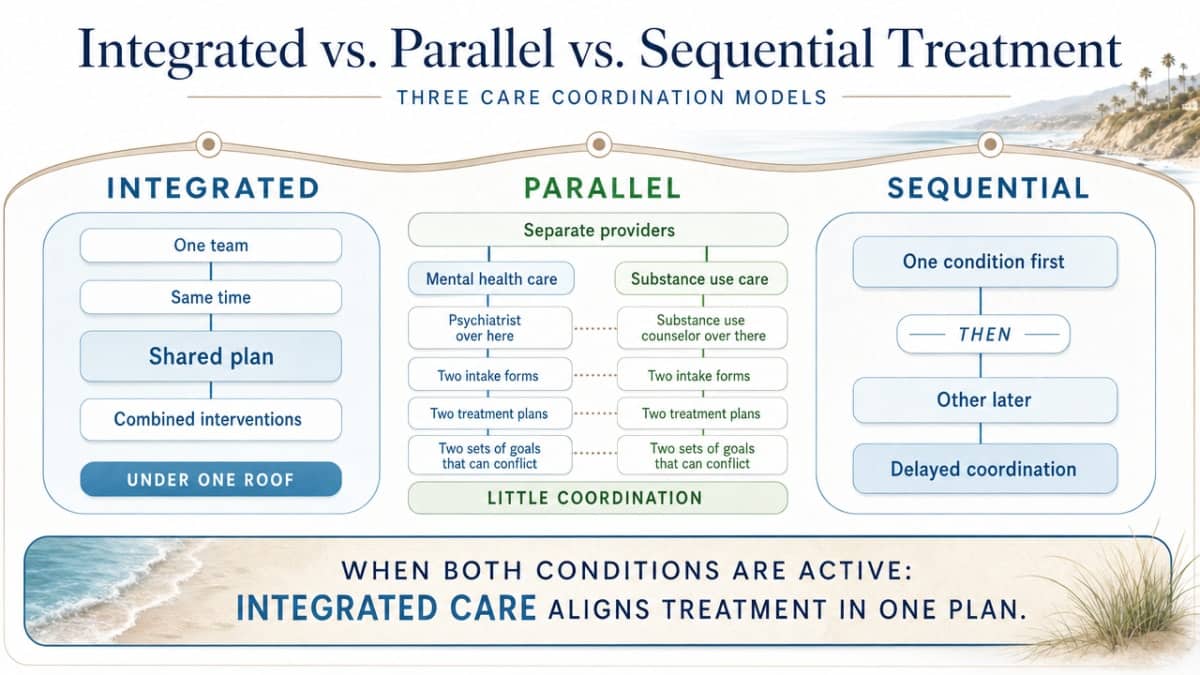
Three models get used, and only one of them tends to hold up when both conditions are active. It helps to see the difference plainly, because a lot of people have been through the other two and blamed themselves when the results didn’t stick.
- Integrated treatment
- Puts everything under one roof. The same clinicians address the mental health condition and the substance use disorder at the same time, with a shared plan. Interventions are combined at the clinical level, not just referred between agencies 3. This is what behavioral health treatment for dual diagnosis is supposed to be.
- Parallel treatment
- Means you’re getting both kinds of care, but from separate providers who aren’t really coordinating. A psychiatrist over here. A substance use counselor over there. Two intake forms, two treatment plans, two sets of goals that sometimes contradict each other. You end up doing the coordination work yourself, on your worst days, which is when it’s least possible 1.
- Sequential treatment
- Asks you to finish one before you start the other. Get sober first, then we’ll treat the depression. Or: stabilize the bipolar disorder, then come back for the substance use piece. For people whose conditions feed each other, that order rarely works. The untreated condition tends to pull the treated one back under 3.
If you’re trying to figure out which model you’ve been in, ask a simple question: does one clinical team own both problems, or are you the connective tissue between two? Integrated behavioral health treatment is the version where you’re not the switchboard.
What the Levels of Care Actually Look Like
Standard Outpatient: Weekly Sessions, Real Life Around Them
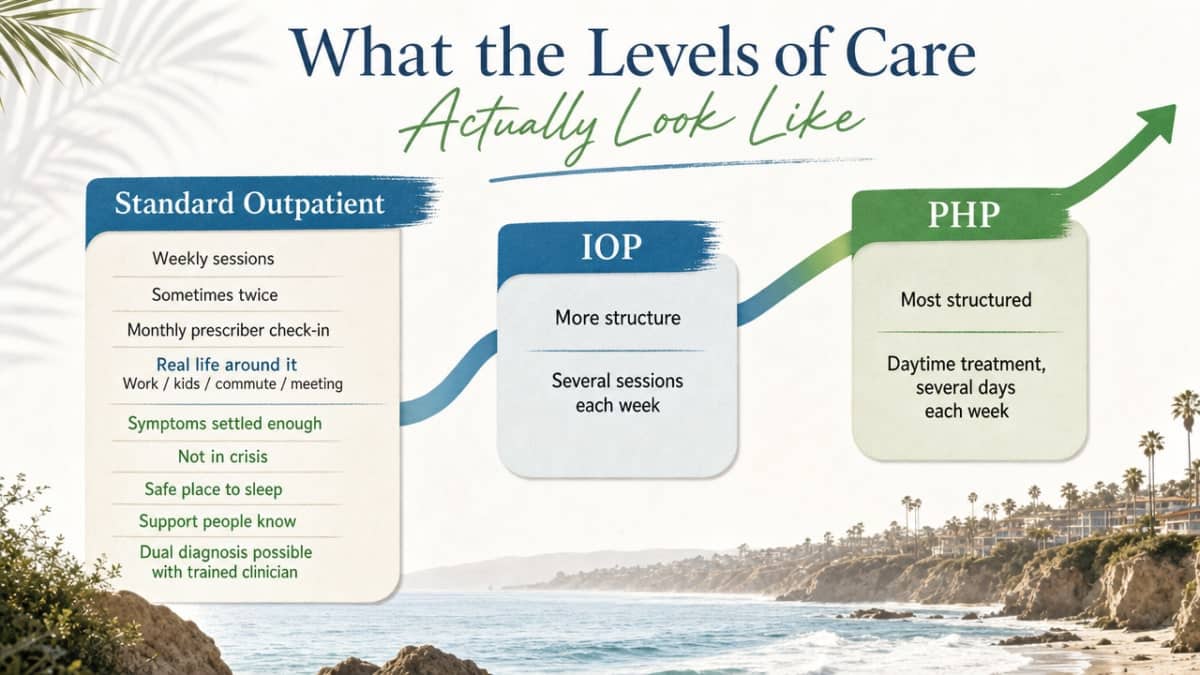
Standard outpatient is the version most people picture when they hear “therapy.” You come in once a week, sometimes twice, for an individual session. There might be a monthly check-in with a prescriber. The rest of your life happens around it—your job, your kids, your commute, your Tuesday night meeting if you have one 5.
This level fits when your symptoms are settled enough that a weekly conversation can move the work forward. You’re not in crisis. You’re not white-knuckling every afternoon. You have somewhere safe to sleep and people who know what you’re working on.
For dual diagnosis, standard outpatient can absolutely be the right level—if the clinician is trained to handle both conditions and isn’t sending you elsewhere for the substance use piece. If you’re finding that one weekly hour keeps getting eaten by whichever crisis was loudest that week, and nothing is actually shifting, that’s usually a sign you need something with more contact. Behavioral health treatment isn’t one-size-fits-all, and stepping up isn’t a failure 2.
Intensive Outpatient (IOP): Several Days a Week, Evenings Often Available
IOP is a step up in contact, not a step down in your life. You typically come in three to five days a week for a few hours at a time—group therapy, individual therapy, skills work, and often family sessions built into the schedule 5. Many programs run evening tracks so you can keep working during the day, which matters if losing your paycheck would make everything worse.
What IOP is built for: the middle ground where weekly therapy isn’t holding, but you don’t need a hospital. You might be a few weeks out from a relapse. You might be stabilizing on a new medication. You might be in early recovery and needing more structure than a therapist’s calendar can offer.
For co-occurring conditions, IOP is where a lot of the real integrated work happens. You have enough contact hours in the week for the team to see patterns—what triggers the panic, when the cravings spike, how sleep is tracking—and to adjust the plan while it’s still adjustable. Behavioral health treatment at this level can address both conditions in the same rooms, on the same days, with the same clinicians 3.
Partial Hospitalization (PHP): Structured Days, Sleep at Home
PHP is the most intensive level of behavioral health treatment you can get without being admitted to a hospital. You spend most of the day at the program—typically five or six hours, five days a week—doing individual therapy, group work, skills training, family sessions, and medication management. Then you go home to sleep in your own bed.
The American Association for Partial Hospitalization defines a PHP as “an outpatient program specifically designed for the diagnosis or active treatment of a serious mental disorder when there is a reasonable expectation of improvement or when it is necessary to maintain a patient’s functional level and prevent relapse or full hospitalization” 6.
Read that twice. It’s built for the moment when things are serious enough that a few hours a week won’t cut it, but you don’t need round-the-clock care.
People come to PHP after a hospital discharge, after an ER visit, after a relapse that shook everyone, or when the co-occurring conditions have escalated to the point that daily structure is what keeps the week from unraveling. Sleeping at home matters. You practice what you’re learning in the actual environment you have to live in, which is different from practicing it inside a facility you’ll leave in 30 days 6. Behavioral health treatment at this level is intensive without pulling you out of your life entirely.
Inside a Treatment Plan: The Components That Do the Work
Assessment and Treatment Planning
Before anything else happens, someone sits down with you and asks a lot of questions. Not to catch you out. To understand what you’re actually dealing with.
A good assessment covers both sides of the equation at once: the mental health symptoms, the substance use pattern, medical history, sleep, trauma, medications you’ve tried, what’s worked, what hasn’t, and what you want to be different 7. It also screens for risk. If you’re in crisis, that shapes what happens next.
From there, a treatment plan gets built with you, not handed to you. It names both conditions, sets goals you can actually recognize as yours, and sequences the work so nothing gets tackled before you’re steady enough to tackle it 7. Behavioral health treatment lives or dies at this step. A vague plan produces vague results.
Individual Therapy: CBT, DBT, EMDR, and Why Names Matter
Individual therapy is the one-on-one hour where the deeper work happens. The names get thrown around a lot, so here’s what they actually mean in a room.
- Cognitive Behavioral Therapy (CBT)
- Helps you spot the thoughts that fire before a drink, a pill, or a spiral, and build different responses. It’s practical. You leave sessions with something to try 8.
- Dialectical Behavior Therapy (DBT)
- Was built for people whose emotions run hot and fast—big waves that used to only get quiet with a substance. DBT teaches distress tolerance, emotion regulation, and interpersonal skills you can use when the wave hits 8.
- EMDR (Eye Movement Desensitization and Reprocessing)
- Is a trauma-focused therapy. If old events are still driving the panic or the using, EMDR helps the brain process what got stuck without making you re-live it in detail.
Names matter because they tell you what a program actually does. If a clinician says “we do therapy,” ask which kind, for which condition, and why that combination. Behavioral health treatment worth your time can answer that in plain language 4.
Group Therapy and Motivational Interviewing
Group therapy is where a lot of the shift happens, even for people who swore they’d never speak in a group. You sit with six or eight other adults who are working on some version of what you’re working on. You hear yourself in what they say. You get feedback that lands differently than it would from a therapist across a desk.
Groups in behavioral health treatment aren’t confession circles. They’re structured around skills—coping with cravings, managing anxiety, rebuilding trust, sitting with anger without acting on it—delivered by a clinician who keeps the room safe 4, 8.
Motivational Interviewing (MI) often runs underneath the individual and group work. It’s a way of talking that meets you where you actually are, ambivalence included. Not being all-in on change isn’t a disqualification. MI works with that instead of against it 7. If you’ve had someone lecture you into shutting down, MI is the opposite of that experience.
Family Therapy as Clinical Care, Not a Courtesy
Family therapy isn’t a nice add-on. It’s part of the clinical work, especially when a substance use disorder has changed how a household functions. The people around you have adapted to the crisis, and some of those adaptations—walking on eggshells, hiding money, covering for missed work—shape how recovery goes once you’re home each night.
In behavioral health treatment, family sessions address the patterns in the room, not just the person in the chair. The goal is to shift the interactions that keep the substance use going and strengthen the ones that support recovery 9. That might mean coaching a partner through what to say when you come home rough. It might mean helping a parent stop the responses that everyone knows aren’t working but nobody knows how to change.
You don’t need a perfect family. You need people willing to sit in a room and try. That’s often enough for the work to move.
Medication Management
Medication is a tool, not a verdict. For many people in behavioral health treatment, the right prescription is what makes the therapy possible—an antidepressant that lifts the fog enough for CBT to land, a mood stabilizer that keeps bipolar swings from tearing up the week, medication for opioid use disorder that quiets the physical pull.
Integrated care combines behavioral therapies, medications, and care management in one place so nothing gets prescribed in a vacuum 2. The prescriber talks to your therapist. Doses get adjusted based on what’s showing up in sessions. If you’re tapering off a benzodiazepine, that happens under supervision, not on your own with a pill cutter and Google.
Ask questions. What is this for. How long. What are we watching for. A team that welcomes those questions is a team worth staying with 2.
Measurement-Based Care: Why Someone Should Be Tracking Your Progress
If a past round of treatment felt like guesswork, there’s a name for what was missing. Measurement-based care is the practice of using short, standardized questionnaires at regular intervals to track how your symptoms and functioning are actually moving. Not once at intake and never again. Every week, or every session, in a form you can see.
You fill out something brief—a depression scale, an anxiety scale, a craving check-in, a sleep and functioning measure. The clinician looks at the numbers with you. If the depression score has been flat for four weeks, that’s a signal to change something: adjust the medication, shift the therapy approach, add a group, revisit the plan. Routine outcome monitoring like this has been linked to better treatment outcomes and is increasingly considered a standard part of quality behavioral health treatment 10.
For dual diagnosis, this matters twice over. Both conditions get tracked. A win on the mental health side that quietly coincides with rising substance use shows up in the data instead of hiding between two providers.
When you’re looking at programs, ask directly: how do you measure whether behavioral health treatment is working for me, and how often will we look at it together? A team that can answer that in specifics is a team doing the work.
What Walking in the Door Actually Feels Like
Nobody talks about this part enough. The morning of your first appointment, you’re going to feel some mix of dread, exhaustion, and a small, stubborn hope you probably won’t admit to. That’s normal. Behavioral health treatment starts with people who are done, or almost done, or scared they’re getting close.
You’ll fill out paperwork. Someone will ask you a lot of questions, and some of them will feel too personal too fast. You can say so. A good clinician expects that and works with it, not around it 7. If you’re carrying shame about the drinking, the pills, the missed weeks, the hospital visit, the thing you said to your kid last month—it comes with you into the room, and it’s allowed to.
How to Tell If a Program Is Set Up for Dual Diagnosis
Not every program that says “we treat both” actually treats both. Some are mental health clinics that refer out for substance use. Some are substance use programs that treat the mental health piece as background noise. The signs of a real integrated setup are specific, and you can screen for them in a phone call.
- Ask who owns both conditions on your treatment plan. In genuine behavioral health treatment for dual diagnosis, the same clinical team writes and updates one plan that names both diagnoses and coordinates the interventions at the clinical level, not the referral level 3. If the answer involves two agencies emailing each other, that’s parallel care wearing an integrated label.
- Ask what happens if you’re still ambivalent about stopping. A program built for co-occurring conditions uses stage-wise, motivational approaches instead of demanding you arrive already committed 7.
- Ask how they track progress. If nobody can describe how symptoms and substance use get measured over time, the plan won’t adjust when it should 10.
Real behavioral health treatment for dual diagnosis answers these questions without stalling.
Frequently Asked Questions
What is the difference between behavioral health treatment and mental health treatment?
Mental health treatment focuses on conditions like depression, anxiety, or bipolar disorder. Behavioral health treatment is the wider umbrella. It covers mental health conditions, substance use disorders, and the overlap between them, using therapy, medication, and coordinated care planning 2, 4. If a substance use disorder is part of your picture, behavioral health treatment is the term that fits.
Can behavioral health treatment address a mental health condition and a substance use disorder at the same time?
Yes, and that’s exactly what integrated behavioral health treatment is built for. The same clinical team, working in one setting, delivers both mental health and substance use interventions on a shared plan 3. You don’t have to get sober before starting therapy, or stabilize the depression before addressing the drinking. Both get treated together, in coordination 1.
How do I know if I need standard outpatient, IOP, or PHP?
Standard outpatient fits when weekly sessions are moving the work forward. IOP fits when you need several days a week of structured care but can still work or live at home 5. PHP fits when things are serious enough that daily, hours-long treatment is what keeps the week from unraveling, often after a hospitalization, ER visit, or relapse 6.
What actually happens on the first day of behavioral health treatment?
You’ll do paperwork and sit with a clinician for an assessment. They’ll ask about mental health symptoms, substance use, medical history, medications, trauma, and what you want to change 7. Some questions will feel too personal too fast. You can say so. By the end, you’ll have an initial treatment plan and a sense of what the coming weeks look like.
How do I tell if a program is genuinely set up for dual diagnosis?
Ask three questions on the phone. Does one clinical team own both conditions on a single treatment plan 3? Do you use stage-wise, motivational approaches for people who aren’t fully committed to change yet 7? How do you measure my progress on both conditions over time 10? Real integrated behavioral health treatment answers these clearly, without redirecting you elsewhere.
Does family have to be involved in behavioral health treatment?
Not required, but often recommended. Family therapy is treated as clinical work, not a courtesy, because household patterns shape what happens when you leave the session 9. If family involvement isn’t safe or possible, that’s honored. If it is possible, sessions focus on shifting the interactions that fuel substance use and building the ones that support recovery 9.
References
- Review of integrated mental health and substance abuse treatment. https://pubmed.ncbi.nlm.nih.gov/9853791/
- Finding Help for Co-Occurring Substance Use and Mental Disorders. https://www.nimh.nih.gov/health/topics/substance-use-and-mental-health
- Integrated Treatment for Co-Occurring Disorders: The Evidence. https://library.samhsa.gov/sites/default/files/ebp-kit-the-evidence-10242019.pdf
- Principles of Drug Addiction Treatment: A Research-Based Guide (Third Edition). https://nida.nih.gov/sites/default/files/podat-3rdEd-508.pdf
- Treatment Settings (Substance Abuse Treatment: Addressing the Specific Needs of Women). https://www.ncbi.nlm.nih.gov/books/NBK571024/
- Providing Crisis-Oriented and Recovery-Based Treatment in Partial Hospitalization Programs. https://pmc.ncbi.nlm.nih.gov/articles/PMC2848466/
- Chapter 1. Introduction to Substance Abuse Treatment for Persons With Co-Occurring Disorders. https://www.ncbi.nlm.nih.gov/books/NBK207251/
- Chapter 4. Types of Therapy. https://www.ncbi.nlm.nih.gov/books/NBK82999/
- Substance Abuse Treatment and Family Therapy. https://www.ncbi.nlm.nih.gov/books/NBK64042/
- The Role of Measurement-Based Care in Mental Health. https://www.ncbi.nlm.nih.gov/pmc/articles/PMC4933241/