Key Takeaways
- Orange County has a large number of licensed drug rehab centers, but abundance and proximity don’t guarantee integrated dual diagnosis care that addresses mental health and substance use together.
- Programs that treat co-occurring conditions with one clinical team and one plan consistently outperform parallel care where mental health gets referred out to disconnected providers 1.
- Match the level of care—outpatient, IOP, PHP, or residential—to your housing stability, safety, and support at home rather than defaulting to the most intensive setting available 2.
- Before committing, verify licensing through the DHCS directory 7, confirm your pathway via Drug Medi-Cal or commercial insurance, and ask specific intake questions that expose whether integration is genuine.
Why the Dual Diagnosis Filter Changes Everything
If you’re reading this, you already know something most search results won’t tell you: a rehab that treats substance use but hands off the mental health piece to someone else down the road has, in your experience, not been enough. Maybe you’ve been through detox and left with the panic attacks still running the show. Maybe your loved one got sober for a stretch, then the depression returned untreated and so did the drinking. That pattern isn’t a personal failure. It’s a design problem in how care gets delivered.
The filter that changes your search for orange county ca drug rehab centers is a single question: does this program treat the mental health condition and the substance use disorder together, with one clinical team and one plan, or does it treat them in parallel tracks that rarely talk to each other? Integrated treatment consistently shows superior outcomes compared with parallel or sequential treatment for co-occurring disorders, according to a peer-reviewed review of dual diagnosis care models that examined partial hospitalization, intensive outpatient, and coordinated approaches 1. That finding reshapes what “good rehab” even means when a mental health condition is part of the picture.
Orange County has a large number of drug rehab centers, and that abundance can feel reassuring until you realize most listings won’t tell you whether integration is genuine or cosmetic. This guide is built to help you filter that supply. You’ll learn how to read the local landscape, match a level of care to your actual situation, verify programs through official state channels, and understand the two main pathways into care. You don’t have to figure this out alone, and you don’t have to figure it out perfectly tonight.
Reading the Orange County Treatment Landscape
Density Is Not the Same as Discernment
Drive fifteen minutes in almost any direction from Mission Viejo, Costa Mesa, or Anaheim and you’ll pass the offices of several orange county ca drug rehab centers. The county is home to a large number of licensed substance use treatment programs. On the surface, that’s good news. When you’re in crisis, proximity matters. A short drive can be the difference between showing up and not showing up.
Here’s the part that doesn’t fit on a billboard, though. Research on the geographic concentration of treatment facilities in urban regions has found that higher density of treatment facilities may be associated with both increased access to care and complex patterns of overdose risk 3. That study looked at urban areas broadly, not Orange County specifically, and it’s a conceptual finding rather than a local outcome number. Still, the takeaway is worth sitting with. More options nearby does not automatically translate to better outcomes for the person walking in the door. It just means more doors.
What that means for you, right now, is that abundance is not the same as fit. A neighborhood full of orange county ca drug rehab centers can still leave a person with co-occurring disorders bouncing between programs that each treat only half of what’s going on. Access without discernment is how people cycle through five intake calls in a week and still feel unseen.
Discernment doesn’t require you to become a clinician. It requires a short list of questions and a willingness to trust your read on the answers. The rest of this guide gives you those questions and the state-level tools to verify what you hear.
What Integrated Care Actually Looks Like
Picture two versions of the same week in treatment.
In the first version, you go to a substance use program in the morning. Group therapy focuses on triggers, relapse prevention, and sobriety skills. Your PTSD comes up, and the counselor gently redirects the conversation because that’s the psychiatrist’s lane, not theirs. On Thursday afternoons you see a separate psychiatrist across town who prescribes for your anxiety but hasn’t spoken to your counselor in months. Your two providers each have half of your chart and none of the same treatment goals. That’s parallel care.
In the second version, one clinical team owns your whole picture. The therapist running your DBT group knows what medication your psychiatrist adjusted last week. Your trauma work and your relapse prevention work aren’t scheduled against each other, they’re planned together because the same people wrote the plan. When your anxiety spikes and old coping urges return, the team addresses both in the same session. That’s integrated care.
A peer-reviewed review of dual diagnosis treatment models, which examined partial hospitalization, intensive outpatient, and coordinated care approaches, found that integrated treatment consistently shows superior outcomes compared with parallel or sequential treatment for co-occurring disorders 1. The review looked at established clinical models rather than a single facility’s data, and it acknowledged real-world limits like workforce training and reimbursement pressures that can slow integration on the ground. But the direction of the evidence is clear. When one team plans and delivers both sides of the care, people do better than when two teams work around each other.
Reading orange county ca drug rehab centers through this lens changes what you listen for on an intake call. You’re no longer asking whether a program “also treats mental health.” You’re asking whether the same clinicians, meeting together, share responsibility for both diagnoses inside one treatment plan. If the answer involves referring the mental health piece out, or booking a separate psychiatric appointment that never loops back into your group work, that’s parallel care with a friendlier waiting room. It’s not the model that has the strongest evidence behind it for people in your situation.
You’ve already learned this the hard way if you’re reading this. The good news is that once you can name the difference, you can spot it in a five-minute phone call.
Matching Level of Care to Your Actual Situation
Outpatient, IOP, PHP, Residential: What Each One Does
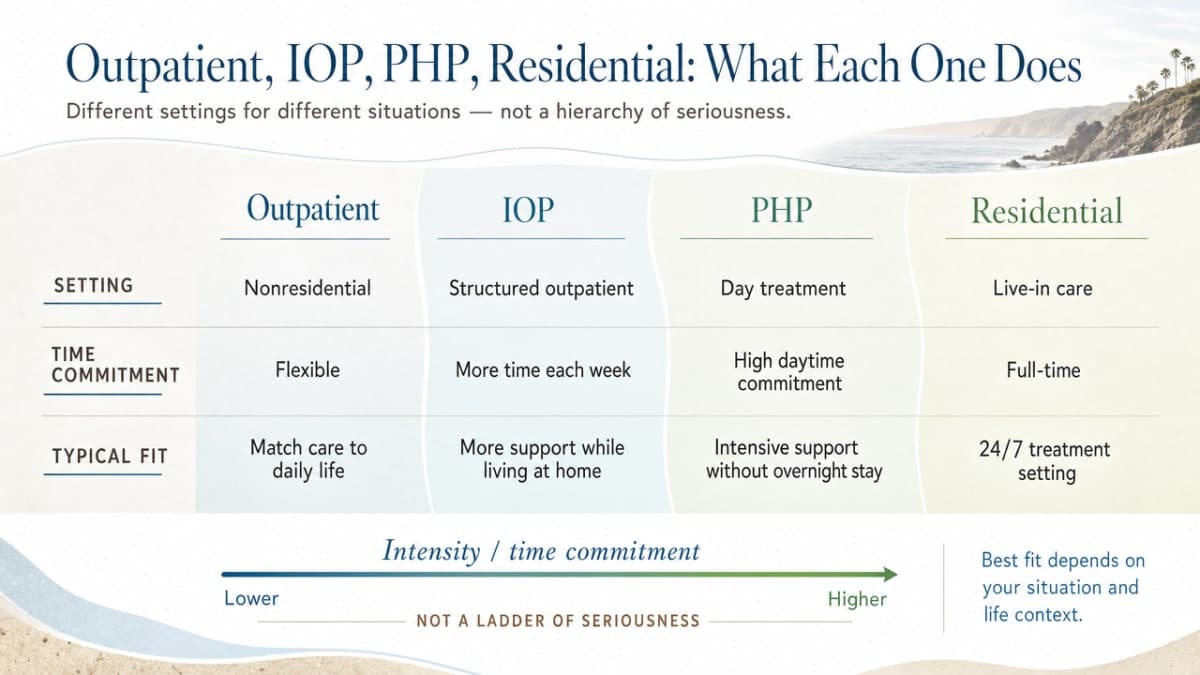
The words “outpatient,” “IOP,” “PHP,” and “residential” get thrown around like they’re interchangeable rungs on a ladder, with residential sitting at the top as the “real” treatment. That framing is off. These are different clinical settings designed for different situations, not a hierarchy of seriousness. When you’re weighing orange county ca drug rehab centers, matching the setting to your life is often more predictive of success than choosing the most intensive option available.
Under California’s licensing structure, outpatient treatment is defined as a nonresidential service for substance-related, addictive, and co-occurring disorders 8. That’s the legal category, and it’s broader than a lot of people assume. Outpatient services under the Drug Medi-Cal Organized Delivery System include assessment, care coordination, counseling, family therapy, medication services, and medication-assisted treatment for opioid use disorder 9. Medi-Cal beneficiaries can receive outpatient drug-free treatment, narcotic treatment services, and intensive outpatient treatment as part of that continuum 10.
Here’s a plain-language read on what each setting typically looks like:
- Standard outpatient. Nonresidential counseling, medication management, and coordinated care while you keep your job, your home, your school schedule. Fits people with milder symptoms or those stepping down from a more intensive level.
- Intensive outpatient (IOP). A more structured level of group and individual therapy that still lets you live at home. Includes the same clinical components — counseling, family therapy, medication services, care coordination 9.
- Partial hospitalization (PHP). A day-treatment level that sits between IOP and residential. This is where a lot of dual diagnosis work happens because it combines clinical intensity with living in your own environment.
- Residential. You live on-site. Programming runs across the day and evening. This fits people who need to be removed from the environment where use is happening or who need a live-in level of monitoring and support.
The right question isn’t “which level is best.” It’s which setting matches your current safety, stability, and support at home — and whether the program at that level actually integrates mental health care into the same plan.
When Outpatient Can Do the Work of Residential
There’s a stubborn assumption in recovery culture that residential is always the safer bet. If it’s more intensive, it must be more effective. That belief is worth challenging, especially if leaving home for thirty or ninety days would blow up your job, your custody arrangement, or your ability to keep a roof over your head.
Research on outpatient SUD treatment has found that intensive outpatient programs can achieve abstinence outcomes comparable to residential care for many individuals 2. A separate strand of that same research compared completion rates, relapse, and functional improvements across outpatient modalities 2. The word doing the work in the comparability finding is “comparable,” and the phrase doing the work is “many individuals.” It’s not a claim that IOP is universally as good as residential, and it’s not permission to send someone home who needs a monitored setting. It’s evidence that for appropriately selected people, the more intensive option isn’t automatically the better one.
Who tends to do well in an outpatient or IOP setting when a co-occurring mental health condition is part of the picture? People with a stable place to sleep. People whose home isn’t the primary trigger environment. People with at least one person in their corner. People who can commit to the schedule without their life falling apart in the meantime. Many of the orange county ca drug rehab centers built around dual diagnosis care are designed exactly for that population — folks who need real clinical intensity but who also need to keep showing up for their kids, their work, or their recovery from a previous residential stay.
Verifying a Program Before You Trust It
The DHCS Directory as Your First Stop
Before you fill out a single intake form, open a browser tab to the California Department of Health Care Services. DHCS maintains directories of licensed and certified facilities and programs, county alcohol and other drug offices, and referral information 7. That directory is the single most useful tool you have for filtering orange county ca drug rehab centers, and almost no one mentions it because it doesn’t run ads.
Here’s what checking the directory actually does for you. It tells you whether a program is currently licensed by the state. It shows the licensing category — outpatient, residential, adolescent, adult — so you know what the state has actually authorized the program to deliver. It also gives you a way to cross-check the story you hear on a marketing call against what the state’s records say.
If a program you’re considering doesn’t show up in the DHCS directory, that’s not automatically disqualifying — some legitimate mental health providers work adjacent to SUD care without holding a DHCS SUD license. But when you’re specifically looking at orange county ca drug rehab centers that treat substance use, the absence of a state listing is a question you deserve an answer to. Ask directly: which license do you hold, and where can I verify it? A trustworthy program will walk you through the answer without getting defensive.
You are allowed to check. Doing so isn’t rude. It’s the exact kind of clear-headed step that helps in a moment when clear-headedness is hard to come by.
Licensing, Certification, and Co-Occurring Capability
Licensing tells you a program is legally allowed to operate. Certification and clinical scope tell you what it’s actually built to treat. Those aren’t the same thing, and the difference matters when a mental health condition is in the picture.
Under California’s licensing framework, outpatient treatment is defined as a nonresidential service for substance-related, addictive, and co-occurring disorders 8. That last phrase — “and co-occurring disorders” — is the language that makes an outpatient license legally include dual diagnosis work. But a license permitting co-occurring care doesn’t automatically mean every program holding that license does the work well or does it in an integrated way. Permission and practice are different.
Under the Drug Medi-Cal Organized Delivery System, outpatient treatment services include assessment, care coordination, counseling, family therapy, medication services, and medication-assisted treatment for opioid use disorder 9. That list is your checklist for what a real outpatient dual diagnosis program should offer under one roof. If a facility can’t clearly point to each of those components — especially care coordination and medication services — you’re likely looking at a partial program that will refer pieces of your care elsewhere.
When you’re comparing orange county ca drug rehab centers, ask two things beyond the license. First, does the program employ or contract psychiatric prescribers who work inside the treatment team, not as an outside referral? Second, are the therapists trained in evidence-based approaches for both mental health and substance use — CBT, DBT, trauma-focused work — rather than only in substance use counseling? Those answers tell you what the license alone cannot.
Questions That Reveal Whether Integration Is Real
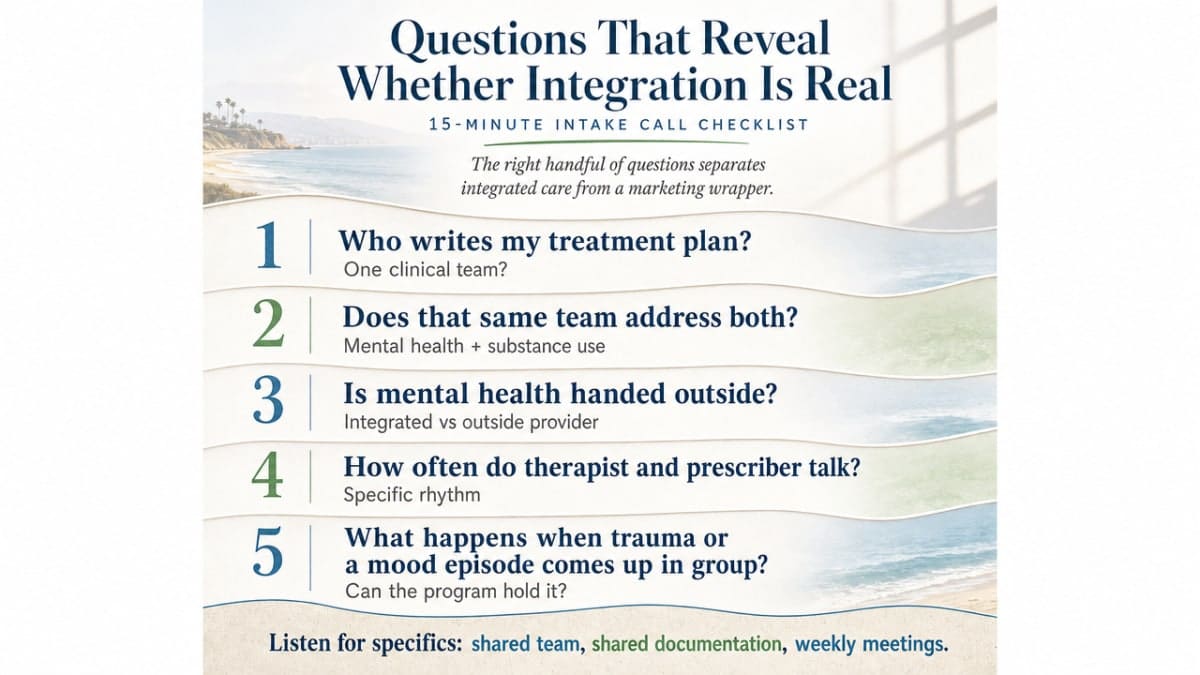
You can learn more in a fifteen-minute intake call than in an hour of scrolling. What you need is the right handful of questions. These are the ones that separate genuine integrated care from a marketing wrapper, and you can ask them of any of the orange county ca drug rehab centers on your short list.
- Who writes my treatment plan, and does that same team address both my mental health condition and my substance use? Listen for whether one clinical team owns both, or whether the mental health piece gets handed to an outside provider.
- How often does my therapist talk to my psychiatric prescriber? The right answer is a specific rhythm — weekly team meetings, shared documentation — not a vague reassurance that “we communicate.”
- What happens in a group when trauma or a mood episode comes up? A program built for co-occurring disorders can hold that conversation. A substance-use-only program will redirect it.
- Which therapies do you use for the mental health side, and who’s trained in them? You should hear specific modalities — DBT, CBT, EMDR, trauma-focused approaches — attached to specific clinicians, not a general reference to “holistic care.”
- If I need a medication adjustment, how quickly can that happen inside the program? Integrated programs handle this internally. Parallel programs make you wait for an outside appointment.
You are not being difficult by asking these. You’re doing exactly what someone who’s been through the parallel-care experience should do. Trust the answers that are specific, and be cautious of the ones that sound rehearsed.
Two Pathways Into Care: Drug Medi-Cal and Commercial Insurance
How you get into an Orange County drug rehab center usually depends on which coverage you have, not which program looks best on a website. There are two main pathways, and knowing which one applies to you cuts a lot of noise out of the search.
The first pathway is Drug Medi-Cal. If you have Medi-Cal, the state directs individuals seeking substance use disorder services to contact their county by using the SUD County Access Line for information and referrals 4. In Orange County, that access line is your entry point into the Drug Medi-Cal Organized Delivery System, which provides eligible Medi-Cal members with a comprehensive continuum of SUD treatment services including outpatient, intensive outpatient, residential treatment, withdrawal management, medications for addiction treatment, recovery services, care coordination, and mobile crisis services 5. DHCS reauthorized DMC-ODS through December 31, 2026 under CalAIM Section 1915(b) and 1115 waivers 6. Beginning in 2025, optional services such as contingency management, peer support, enhanced community health worker services, and supported employment can also be added under DMC-ODS 5. That matters for dual diagnosis care because peer support and care coordination are the connective tissue that keeps mental health and substance use work from drifting apart.
The second pathway is commercial insurance. If you’re covered through an employer plan or a private policy, you’re not routed through the county access line. You call orange county ca drug rehab centers directly, or you call the behavioral health number on the back of your insurance card and ask which in-network programs offer integrated dual diagnosis treatment at the level of care you need. Ask the intake team the same integration questions regardless of which pathway you’re on. Ask whether they take your specific plan. Ask whether the psychiatric prescriber sits inside the treatment team.
Neither pathway is a shortcut. Both can lead to strong care, and both can lead to programs that treat mental health as a side note. The pathway determines who takes your first call. The questions you ask on that call determine whether integration is real.
Choosing Well Under Pressure
You’re probably not making this decision from a calm place. You’re making it after a hard phone call, a hospital visit, a fight, or a quiet 2 a.m. where the fear got loud enough to type a search. That’s the honest context for most people choosing among orange county ca drug rehab centers, and it deserves acknowledgment before any checklist.
If you’re on Medi-Cal, start with the county SUD access line. If you have commercial insurance, call the number on the back of your card or call two or three orange county ca drug rehab centers directly and ask the integration questions from earlier. Take notes. Trust specific answers over reassuring ones.
Reaching this page is already a step. You are doing the work of someone who wants a different outcome than the last time. When you’re ready to make the call, programs like 449 Recovery in Mission Viejo are built for exactly this — outpatient dual diagnosis care with one team holding both sides of your story.
Frequently Asked Questions
How do I know if an Orange County drug rehab center actually treats dual diagnosis instead of just claiming to?
Ask who writes the treatment plan and whether the same clinical team handles both your mental health condition and your substance use. In genuine integrated care, one team meets together, shares documentation, and adjusts medication and therapy inside the same program. If the mental health piece gets referred out to an outside provider you rarely see, that’s parallel care wearing an integrated label.
Can intensive outpatient treatment really work as well as residential care for co-occurring disorders?
For appropriately selected people, yes. Research on outpatient SUD treatment found that intensive outpatient programs can achieve abstinence outcomes comparable to residential care for many individuals 2. A separate strand of that same research compared completion rates, relapse, and functional improvements across outpatient modalities 2. It doesn’t mean IOP fits everyone. If you have stable housing, some support, and no active withdrawal risk, IOP may do the work without pulling you out of your life.
How do I verify that a program is licensed and legitimate through DHCS?
Go to the California Department of Health Care Services directory. DHCS maintains directories of licensed and certified facilities and programs, county alcohol and other drug offices, and referral information 7. Look up the program by name and check the licensing category. If a program isn’t listed, ask directly which license they hold and where you can verify it. A trustworthy program will answer without hesitation.
What is the difference between Drug Medi-Cal and commercial insurance pathways into treatment?
If you have Medi-Cal, DHCS directs you to contact your county through the SUD County Access Line for referrals into the Drug Medi-Cal Organized Delivery System 4. That system covers a continuum from outpatient to residential care 5. If you have commercial insurance, you skip the access line and call orange county ca drug rehab centers directly, or the behavioral health number on your insurance card, to find in-network integrated programs.
What questions should I ask on an intake call to test whether integration is real?
Ask who writes your plan and whether one team handles both conditions. Ask how often your therapist and psychiatric prescriber talk, and listen for a specific rhythm rather than vague reassurance. Ask what happens when trauma or a mood episode comes up in group. Ask which mental health therapies they use and who’s trained in them. Specific answers tied to real clinicians are the tell.
Does having so many rehab centers in Orange County mean I’m more likely to get good care?
Not automatically. Research on treatment facility concentration in urban regions found that higher density may be associated with both increased access to care and complex patterns of overdose risk 3. More options nearby means shorter drives and more intake calls, but it does not guarantee integrated dual diagnosis care. Fit matters more than proximity. Use the verification and integration questions to filter the abundance down to what actually works for you.
References
- Integrated Treatment of Substance Use and Mental Health Disorders. https://www.ncbi.nlm.nih.gov/pmc/articles/PMC8027308/
- Outpatient Treatment for Substance Use Disorders: Effectiveness and Access. https://www.ncbi.nlm.nih.gov/pmc/articles/PMC7727493/
- Geographic Concentration of Substance Use Treatment Facilities and Overdose Outcomes. https://www.ncbi.nlm.nih.gov/pmc/articles/PMC10526903/
- Drug Medi-Cal Overview | DHCS. https://www.dhcs.ca.gov/services/drug-medi-cal-overview/
- Substance Use Disorder (SUD) Drug Medi-Cal and Drug Medi-Cal Organized Delivery System Penetration Rate FY 2022–23. https://www.dhcs.ca.gov/wp-content/uploads/2025/10/SUD-DMC-ODS-FY22-23-PenetrationRate.pdf
- Drug Medi-Cal Organized Delivery System Materials. https://www.dhcs.ca.gov/providers-partners/drug-medi-cal-organizeddelivery-system-materials/
- Directories for Substance Use Disorder Services – DHCS. https://www.dhcs.ca.gov/providers-partners/directories-for-substance-use-disorder-services/
- [PDF] Adolescent Residential SUD Treatment Facility Adult … – DHCS. https://www.dhcs.ca.gov/BHT/Documents/Licensing-and-Certification-Infographic.pdf
- BHIN 24-001 DMC ODS Requirements for the Period of 2022-26. https://www.dhcs.ca.gov/wp-content/uploads/2025/10/BHIN-24-001-DMC-ODS-Requirements-for-the-Period-of-2022-2026.pdf
- Drug Medi-Cal Organized Delivery System – DHCS. https://www.dhcs.ca.gov/services/Documents/CA-Public-MH-SUD-Services-Overview.pdf
- [PDF] Orange County – 01 Title Pages 20240212.indd. https://www.fullerton.edu/cdr/_resources/pdf/progressreport/Orange%20County.pdf