Key Takeaways
- California groups residential care into five licensed categories, from Adult Residential Treatment Service to DHCS-licensed SUD facilities, each with distinct staffing, admission criteria, and clinical scope 2, 9.
- 24-hour residential fits when withdrawal risk, acute psychiatric symptoms, or an unsafe home environment make outpatient work impossible; stable housing and manageable symptoms often make PHP or IOP a clinical match.
- Genuine integrated dual diagnosis care means one team and one treatment plan addressing mental health and substance use together, and research shows sustained remission and symptom stability a year after discharge 11, 7.
- Before committing, ask any Orange County program for its DHCS certification, ASAM level, integrated treatment planning process, step-down pathway, and how it handles 42 C.F.R. Part 2 confidentiality 3, 5, 9.
What You’re Actually Deciding Right Now
If you’re reading this, you’re probably somewhere between exhausted and scared. Maybe you’ve already tried therapy, or a detox, or an outpatient program that didn’t quite hold. Maybe someone you love is spiraling and you’re trying to figure out what a higher level of care even looks like. That’s a lot to carry, and the fact that you’re doing this research means you’re already moving in the right direction.
Here’s the honest reframe: the real decision in front of you usually isn’t which of the residential treatment centers in Orange County, CA has the nicest photos on its website. It’s whether 24-hour residential care matches your actual clinical need — or whether a structured outpatient program treating both the mental health and the substance use side at the same time can do the same work.
California recognizes several distinct categories of residential care, each governed by its own licensing rules and serving a specific population 2, 9. The rest of this guide walks through those categories, when residential is the right fit, when it isn’t, and how to evaluate any program against real clinical standards — so you can decide from information instead of fear.
How California Defines Residential Care
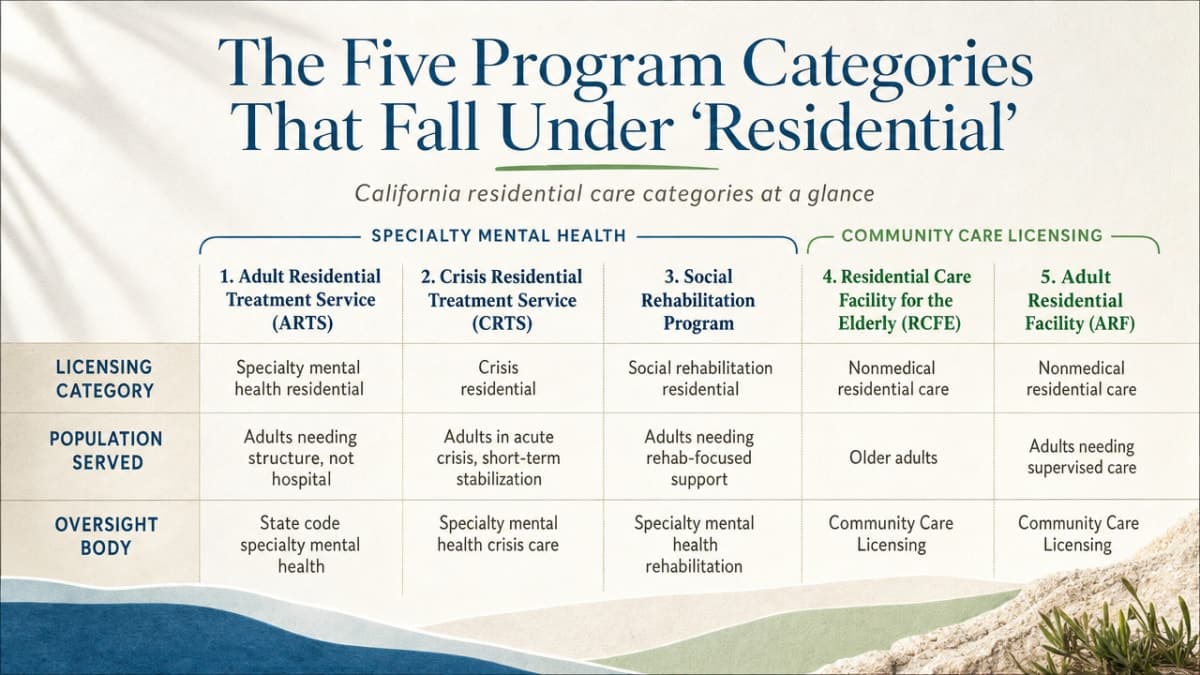
The Five Program Categories That Fall Under ‘Residential’
When people say “residential,” they usually picture one thing: a bed in a facility, someone in scrubs, meals on a schedule. California’s actual system is more layered than that, and knowing the layers helps you ask sharper questions when you call around.
There are five main categories that fall under the residential umbrella in California, and each one is built for a different clinical picture:
- Adult Residential Treatment Service (ARTS). This is the specialty mental health residential category defined in state code. It’s staffed and available 24 hours a day, seven days a week, and it’s meant for adults whose mental health symptoms need a structured living environment but not a hospital 2.
- Crisis Residential Treatment Service (CRTS). Also 24/7, but shorter-term and built specifically for acute crisis stabilization — a step down from psychiatric hospitalization or a step up from outpatient when someone is decompensating 2, 1.
- Social Rehabilitation Programs (SRPs). Adult Residential Treatment Services must actually be certified as a Social Rehabilitation Program by DHCS, in either a Transitional or Long-Term configuration, and licensed as a Social Rehabilitation Facility, Community Care Facility, or Mental Health Rehabilitation Center 9.
- Mental Health Short-Term Residential Therapeutic Programs (STRTPs), Community Treatment Facilities, and Special Treatment Programs. These sit under DHCS Community Services Division oversight and serve more intensive mental health needs, including some youth and adult populations that need higher supervision than an ARTS setting provides 8.
- DHCS-licensed SUD residential treatment. If the primary presenting issue is a substance use disorder, the facility falls under a different licensing track. Recent law now requires every adult SUD residential facility that enrolls in Medi-Cal to hold an ASAM designation matching the level of care it delivers 9.
Among the residential treatment centers in Orange County, CA, you’ll find programs operating under one or more of these categories — sometimes several under one roof. That’s why two facilities can both call themselves “residential” and offer very different clinical experiences. The category dictates staffing ratios, admission criteria, length of stay expectations, and what kinds of co-occurring conditions the program is actually built to treat.
Licensing, ASAM Designation, and What Oversight Means for You
Licensing sounds like paperwork, but for you it’s a shortcut. It tells you whether a program has been vetted against a defined standard — and by whom.
On the mental health side, DHCS’s Community Services Division provides oversight, certification, and approval for Mental Health Short-Term Residential Therapeutic Programs, Social Rehabilitation Programs, Community Treatment Facilities, and Special Treatment Programs 8. Adult Residential Treatment Services are certified as Social Rehabilitation Programs and then licensed as facilities by the Department of Social Services or authorized as a Mental Health Rehabilitation Center by DHCS 9. That’s two layers — the clinical certification and the facility license — and any legitimate program can tell you exactly which ones it holds.
On the substance use side, the requirement is more specific: adult SUD residential treatment facilities that enroll in Medi-Cal must be DHCS-licensed and carry an ASAM designation reflecting the intensity of care they provide 9. ASAM designation matters because it maps a facility to a level of care your clinical situation actually calls for, rather than letting any program label itself “residential” without a benchmark behind it.
When you’re comparing residential treatment centers in Orange County, CA, it’s fair — even smart — to ask two direct questions: what is your DHCS certification or license, and what is your ASAM level? A program that can answer clearly is a program that’s been through the process. One that dodges is telling you something too.
Parity, Confidentiality, and Coverage Rules Worth Knowing
You don’t need to become an insurance lawyer, but two pieces of California law are worth having in your back pocket before you make calls.
The first is parity. California’s mental health and substance use parity regulation, effective October 2022 under SB 855, defines behavioral health crisis services as “the continuum of services to address crisis intervention, crisis stabilization, and crisis residential treatment needs” for people with a mental health or substance use disorder crisis 1. In plain terms: when residential or crisis residential care is medically necessary, commercial insurers have coverage obligations they can’t sidestep. If a plan pushes back, that regulation is your ground to push back too.
The second is confidentiality. Information and records from DHCS-licensed residential or drug abuse recovery and treatment facilities must be kept confidential and comply with 42 C.F.R. Part 2 5. That’s the federal rule protecting substance use treatment records, and it shapes how any residential program can share information with family, outpatient providers, or employers — even with your consent, there’s a process. Ask a program how they handle release-of-information forms and discharge coordination. It’s a small question that reveals a lot about how organized the clinical operation really is.
When 24-Hour Residential Is the Right Level of Care
Twenty-four hour residential is the right call when your environment or your symptoms make outpatient work unsafe or impossible to sustain. That’s the honest test. Not “how bad is it,” but “can the clinical work actually happen where you’re currently sleeping tonight?”
A few situations point clearly toward a residential level of care. Active withdrawal from alcohol, benzodiazepines, or opioids that needs medical monitoring. Psychiatric symptoms severe enough that you can’t reliably keep yourself safe between appointments — suicidal ideation with a plan, psychosis, mania that’s disrupting sleep and judgment. A home environment where substances are present, or where the people around you are actively using. A recent hospitalization where discharging straight back to daily life would almost certainly undo the stabilization. Or a pattern of starting outpatient programs and not being able to hold them because the pull of the environment is stronger than the structure of a few weekly sessions.
California’s framework recognizes two distinct 24-hour tiers for these moments. Adult Residential Treatment Service is the longer-arc option — available 24 hours a day, seven days a week, built for adults whose mental health needs a structured living environment while the deeper clinical work gets done 2. Crisis Residential Treatment Service is the shorter, more acute option, designed for stabilization when someone is in a behavioral health crisis and needs the continuum between hospitalization and outpatient care 1.
If you’re recognizing yourself or your loved one in any of these descriptions, that’s useful information, not a verdict. Among the residential treatment centers in Orange County, CA, the good ones will do a thorough assessment and tell you honestly whether their level of care matches what you’re presenting with — or whether a different tier of the continuum would serve you better. What matters right now is naming the safety picture clearly, so the next call you make is aimed at the right door.
The Case for Integrated Dual Diagnosis Treatment
What ‘Integrated’ Actually Means Clinically
“Integrated” gets used loosely in this field. Some programs mean it. Some just have a psychiatrist on call and a substance use counselor down the hall and call the combination “integrated.” Those aren’t the same thing, and the difference matters when you’re the one showing up with both a mood disorder and a substance use disorder.
Real integration means one treatment team, one treatment plan, and both conditions worked on in the same room at the same time. Your therapist knows what your psychiatrist prescribed this week. Your psychiatrist knows what came up in group yesterday. The clinician running your DBT skills session knows you’re in early withdrawal and adjusts accordingly. Nobody is asking you to pick which diagnosis to talk about today.
California’s own best-practice guidance points in this direction. The CHHS practice guidelines for behavioral health disorders name screening, assessment, treatment planning, care continuity, and medication management as core domains — with co-occurring disorders explicitly on the list 3. When you’re evaluating residential treatment centers in Orange County, CA, ask how the team meets, how often, and who sees your chart. If the answer sounds like two parallel programs sharing a hallway, that’s sequential care wearing an integrated label.
Outcomes: What the Research Shows About Dual Diagnosis Residential Care
You deserve to know whether this actually works. Not “we help people every day” marketing language — what the outcome data says when researchers track people for a year after they leave.
A separate peer-reviewed study looked at longer-arc stability for people with co-occurring disorders after residential drug treatment and found that patients demonstrated stability of improvements in both substance use and psychiatric symptoms — meaning the psychiatric side didn’t get worse when the substance use side got better, which used to be a real concern with sequential models 7. A third study documented the implementation of a three-month integrated residential program for co-occurring disorders, with participants who completed treatment giving a mean satisfaction rating of 4.51 out of 5, clinically significant symptom improvements, and high program fidelity delivered below the cost of routine hospital inpatient units 10.
These are research samples, not guarantees for any individual, and the studies varied in follow-up length and population mix. But the direction is consistent: when residential care is genuinely integrated for co-occurring disorders, the improvements tend to hold. That’s the clinical case worth anchoring your next decision on, whether you’re weighing residential treatment centers in Orange County, CA or a structured outpatient program built on the same integrated model.
Where Residential Sits in the Continuum of Care
Residential, PHP, IOP, and Aftercare — Matching Intensity to Need
Residential is a tier, not the whole ladder. California’s own legislative framework points to “a system of residential treatment programs in every county” precisely because residential was designed as one part of a community-based continuum — not the default answer to every serious presentation 4. The continuum usually reads: residential, then partial hospitalization (PHP), then intensive outpatient (IOP), then aftercare. Each rung has a different intensity, a different daily footprint on your life, and a different clinical purpose.
Residential gives you 24-hour structure and staffing. PHP typically runs five to six hours a day, five days a week — full clinical days without the overnight stay. IOP runs roughly three hours a day, three to five days a week, and often has evening options built for people who need to keep working or caring for kids. Aftercare is the longer tail: weekly therapy, medication management, peer support, alumni connection, relapse prevention work that keeps the gains from unraveling six months out.
What holds the ladder together is care continuity. CHHS’s best-practice guidance names screening, assessment, treatment planning, care continuity, and medication management as core domains for behavioral health treatment — the same domains at every level 3. The intensity changes; the clinical logic doesn’t. When you’re comparing residential treatment centers in Orange County, CA against structured outpatient options, ask what the step-down pathway looks like at each rung. A program that can hand you off cleanly to the next tier is a program built for durable recovery, not just admission.
When a Structured Outpatient Program Can Do the Same Clinical Work
Here’s the part a lot of families miss: for many people with co-occurring conditions, a well-run PHP or IOP can deliver the same integrated clinical work as residential — as long as the environment outside the treatment day is safe enough to hold the gains.
Structured outpatient tends to fit when you have stable housing without active substance use in the home, no acute withdrawal risk, no immediate safety concerns around self-harm or psychosis, and enough day-to-day functioning to get yourself to sessions consistently. In that picture, PHP and evening IOP models can run the same evidence-based therapies — DBT, CBT, trauma-focused work, medication management, group and family therapy — while you keep sleeping in your own bed, keep your job, and keep parenting.
That’s not a lesser tier. It’s a different match. The same best-practice domains apply: screening, assessment, integrated treatment planning, care continuity, medication management 3. What changes is the container around them.
When you’re weighing residential treatment centers in Orange County, CA against a structured outpatient option, the honest question is which container makes the clinical work possible right now. If home is safe and your symptoms are manageable between sessions, outpatient can carry a lot of weight. If either of those isn’t true, residential earns its place. Neither path is a failure — they’re two different doorways into the same integrated dual diagnosis care.
How to Evaluate a Program Against Best-Practice Standards
Once you’ve narrowed the level of care, the next job is separating programs that meet a real clinical standard from programs that market well. California’s guidance actually gives you the checklist. CHHS names screening, assessment, treatment planning, care continuity, and medication management as the core best-practice domains for behavioral health treatment 3. Those five words are your rubric.
Here’s how to translate each one into a question you can ask on an intake call.
- Screening and assessment. Does the program screen for both mental health and substance use at intake, using validated tools, before proposing a treatment plan? A yes means they’ll catch the co-occurring picture. A vague answer means they may treat whichever diagnosis walked in the door first.
- Treatment planning. Is the plan built by one team addressing both conditions, or by two teams working in parallel? Ask who signs off on the plan and how often it’s reviewed. Integrated planning is what separates dual diagnosis care from sequential care.
- Care continuity. What does step-down look like? Which PHP, IOP, and aftercare partners do they routinely hand off to? A program that can’t name its next tier is one that treats discharge as an endpoint rather than a transition.
- Medication management. Is there a psychiatrist or psychiatric nurse practitioner on the clinical team, and how often will you meet with them? For co-occurring conditions, medication adjustments during early recovery matter — you want a prescriber embedded in the care, not consulting from a distance.
- Licensing and ASAM. Ask directly: what is your DHCS certification or facility license, and what is your ASAM level? Any of the legitimate residential treatment centers in Orange County, CA will answer both without hedging 9.
One more question worth asking, quietly: how do you handle release-of-information forms and family communication? Confidentiality rules under 42 C.F.R. Part 2 shape what any program can share and when 5, and a clear process signals a clinical team that runs on protocols rather than improvisation. If a program stumbles through that answer, keep calling.
The Orange County System Context
Orange County isn’t a blank map when it comes to behavioral health. It’s the third-most-populous county in California, with 3,186,989 residents packed at roughly 4,019.7 people per square mile 12. That density shapes everything downstream — demand for beds, referral speed, how quickly a crisis becomes a hospital visit, and how residential treatment centers in Orange County, CA fit into the broader system you’re trying to enter.
A few local system realities are worth knowing before you dial. The county has implemented CARE Court, with 128 petitions filed in 2025, and has activated Medi-Cal mobile crisis services 6. CARE Court is a civil court pathway that can order engagement with community-based behavioral health treatment, including residential care, for people with serious mental illness — a route that generates debate but is now part of how some families reach services. Mobile crisis, meanwhile, means a trained team can respond to a psychiatric emergency in the community rather than defaulting to an emergency room, which sometimes prevents a hospitalization and sometimes becomes the on-ramp to residential care.
Full-Service Partnerships are another piece of the local infrastructure — intensive, wraparound support tracked on the county’s behavioral health dashboard 6. You may not encounter these programs directly, but they shape which residential treatment centers in Orange County, CA have active county referral relationships and which operate primarily through commercial insurance. Ask any program where their referrals come from. The answer tells you how connected they are to the system around them.
Taking the Next Step
You’ve done a lot of reading. Give yourself credit for that — most people in the middle of a dual diagnosis crisis can’t get this far in one sitting. The next step is smaller than the whole picture: make one call, ask about DHCS licensing, ASAM level, and how the clinical team integrates mental health and substance use care in the same treatment plan 3, 9. Whether the answer points you toward residential treatment centers in Orange County, CA or a structured outpatient program like the ones 449 Recovery runs in Mission Viejo, you’ll be choosing from information now — not from panic.
Frequently Asked Questions
What qualifies as a residential treatment center in Orange County, CA under state law?
California uses several categories: Adult Residential Treatment Service and Crisis Residential Treatment Service under specialty mental health, Social Rehabilitation Programs, Mental Health Short-Term Residential Therapeutic Programs, Community Treatment Facilities, Special Treatment Programs, and DHCS-licensed SUD residential facilities 2, 8, 9. Any of the residential treatment centers in Orange County, CA should be able to name which category they fall under.
How do I know if I need residential care or if a structured outpatient program is enough?
The honest test is whether your home environment and current symptoms let clinical work happen safely between sessions. Active withdrawal, acute psychiatric symptoms, unsafe housing, or repeated outpatient starts that didn’t hold point toward residential. Stable housing, no immediate safety concerns, and consistent day-to-day functioning point toward PHP or IOP, which can deliver the same integrated dual diagnosis care 3.
What does ‘integrated’ dual diagnosis treatment actually mean?
One team, one treatment plan, both conditions addressed together. Your therapist, psychiatrist, and group clinicians share a chart and meet about your care. That’s different from a program with a psychiatrist on call and a substance use counselor working separately. California’s best-practice guidance names screening, assessment, treatment planning, care continuity, and medication management as the domains integrated care should cover 3.
Does commercial insurance have to cover residential treatment in California?
When care is medically necessary, yes. California’s parity regulation under SB 855, effective October 2022, defines behavioral health crisis services as the continuum including crisis intervention, stabilization, and crisis residential treatment, and clarifies coverage obligations commercial insurers must meet for mental health and substance use disorder care 1. If a plan pushes back, that regulation gives you clear ground to appeal.
What should I look for when evaluating a residential program for co-occurring disorders?
Ask five direct questions: what DHCS certification or facility license they hold, what their ASAM level is for SUD care, how screening and assessment cover both conditions, whether one team writes an integrated treatment plan, and what the step-down pathway to PHP, IOP, and aftercare looks like 3, 9. Also ask how they handle release-of-information forms under 42 C.F.R. Part 2 5.
How does CARE Court or mobile crisis response fit into the path toward residential care?
Orange County has implemented CARE Court, with 128 petitions filed in 2025, and has activated Medi-Cal mobile crisis services 6. CARE Court can order engagement with community-based behavioral health treatment for people with serious mental illness. Mobile crisis sends a trained team to a psychiatric emergency in the community, which sometimes prevents hospitalization and sometimes becomes the on-ramp to residential care.
References
- Mental Health and Substance Use Disorder Parity in Health Insurance – Text of Regulation (REG‑2021‑00008). https://www.insurance.ca.gov/0250-insurers/0500-legal-info/0300-workshop-insurers/upload/Mental-Health-and-Substance-Abuse-Disorder-Parity-in-Health-Insurance-Text-of-Regulation.pdf
- § 1810.100. General Program Description. Specialty mental health services. https://www.cdss.ca.gov/shd/res/pdf/1810.pdf
- Practice Guidelines for Treating Behavioral Health Disorders …. https://www.chhs.ca.gov/wp-content/uploads/2024/02/Branded-doc-BH-SUD-Brief-012624.pdf
- Code Section Group. https://leginfo.legislature.ca.gov/faces/codes_displayText.xhtml?lawCode=WIC&division=5.&title=&part=2.&chapter=2.5.&article=1.
- State Health Information Guidance 1.3 Sharing Behavioral Health Information. https://www.cdii.ca.gov/wp-content/uploads/2023/04/State-Health-Information-Guidance-1.3-Jan_2025.pdf
- Orange County – Behavioral Health Metrics (California Health and Human Services “Accountability” Dashboard). https://www.accountability.ca.gov/county/orange/behavioral-health/
- Stability of outcomes following residential drug treatment for patients with co-occurring disorders. https://pubmed.ncbi.nlm.nih.gov/21804769/
- Certified and Approved Residential Mental Health Programs. https://lab.data.ca.gov/dataset/certified-and-approved-residential-mental-health-programs
- California Summary — State Residential Treatment for Behavioral Health Conditions. https://aspe.hhs.gov/sites/default/files/2021-08/StateBHCond-California.pdf
- Implementing Residential Integrated Treatment for Co-occurring Disorders. https://pmc.ncbi.nlm.nih.gov/articles/PMC3746518/
- The effects of residential dual diagnosis treatment on alcohol abuse. https://pubmed.ncbi.nlm.nih.gov/28868159/
- 2020 Census Redistricting Profile – Orange County. https://dof.ca.gov/media/docs/forecasting/Demographics/2020-census-data/2020Census_PL942020_Profile_Calif_Orange.pdf