Key Takeaways
- Choosing between outpatient and inpatient care is a level-of-care decision based on safety, withdrawal risk, psychiatric acuity, and whether the home environment supports or undermines recovery.1
- The ASAM continuum defines at least five distinct levels, so the right fit is often a middle rung like IOP or PHP rather than either extreme.7
- Research shows intensive outpatient programs produce outcomes comparable to residential care for many people, with duration of engagement mattering more than setting.2,4
- Inpatient care earns its place when someone faces acute suicidality, severe withdrawal, unstable medical issues, or a home environment that makes outpatient participation unworkable.15
- For co-occurring disorders, integration—treating mental health and substance use in one plan with one team—matters more than whether care happens inpatient or outpatient.8
The Decision You’re Actually Facing
If you’re reading this, something has already shifted. Maybe there was a hospital visit, a hard conversation, a moment when you or someone you love finally said out loud what’s been true for a while. The fact that you’re here, comparing outpatient treatment vs inpatient treatment at 11 p.m. or on a Tuesday lunch break, means part of you is already moving toward help. That matters.
The question you’re asking sounds like a yes-or-no. Stay home or go away. Keep your life running or press pause on all of it. But that framing hides what’s really going on. Outpatient treatment vs inpatient treatment isn’t a choice between serious help and less serious help. It’s a level-of-care decision, and it hinges on specific things: how safe you are right now, whether your body needs medical supervision to stabilize, and whether the place you sleep at night supports recovery or works against it.1
When mental health and substance use are tangled together, the calculus gets more layered. Integrated dual diagnosis care exists in both settings, and honest triage matters more than instinct. This piece walks through what each level actually looks like, what the evidence shows about outcomes, and the signals that point one way or the other so you can walk into an intake call with your footing intact.12
What Each Level of Care Actually Looks Like
Inpatient and Residential Care: When You Stay
Inpatient care means you sleep at the facility. Somebody is awake at 3 a.m. if you can’t be. Meals, medications, group sessions, and rest are all built into a daily structure you don’t have to organize yourself, which is part of the point when your own routines have become unsafe or exhausting to hold together.
Within this category, there are meaningful differences. Medically managed inpatient care sits at the top of the ladder, designed for people who need physician-led monitoring for withdrawal, unstable psychiatric symptoms, or medical complications that could turn dangerous quickly. Residential care is also 24-hour, but the medical intensity is lower; the emphasis shifts to sustained clinical programming in a controlled environment, often for weeks at a time.10
What you gain is separation from the people, places, and cues that have been tied to using or to acute distress. What you set down, at least temporarily, is your job, your kids’ bedtime routine, your commute, your usual coping habits. That trade-off is real, and it’s worth naming out loud rather than pretending it doesn’t cost anything. In the outpatient treatment vs inpatient treatment conversation, inpatient earns its place when safety and stabilization have to come before everything else.15
Outpatient, IOP, and PHP: When You Sleep at Home
Outpatient care is a range, not a single thing. On one end, you might see a therapist and a prescriber once a week or twice a month while otherwise living your regular life. On the other end, you might be at a treatment center five days a week for most of the day, then go home to your own bed at night. Both are outpatient. Both count.1
Between those poles sit two structured programs worth knowing by name. Intensive outpatient programs, or IOP, involve several hours of clinical work per week across multiple days, with group therapy, individual sessions, and skills training organized around a treatment plan. Partial hospitalization programs, or PHP, run more like a full-day schedule, often five or six hours a day for most weekdays, and are used when you need substantial structure but don’t require overnight supervision.10
For people with co-occurring mental health and substance use conditions, this middle ground is where a lot of real work happens. You still cook dinner. You still see your kids. You practice new skills in the exact environment where you’ll have to use them, which is uncomfortable and also part of why it works. In the outpatient treatment vs inpatient treatment picture, PHP and IOP are not junior varsity—they are their own defined levels of care with their own indications and their own evidence base.
The ASAM Continuum: A Shared Vocabulary for Level of Care
When an intake counselor asks about “level of care” or mentions a “Level 2.5 program,” they are speaking the language of the American Society of Addiction Medicine, or ASAM. Learning even a little of this vocabulary changes what you can ask for. It turns a scary phone call into a real conversation.
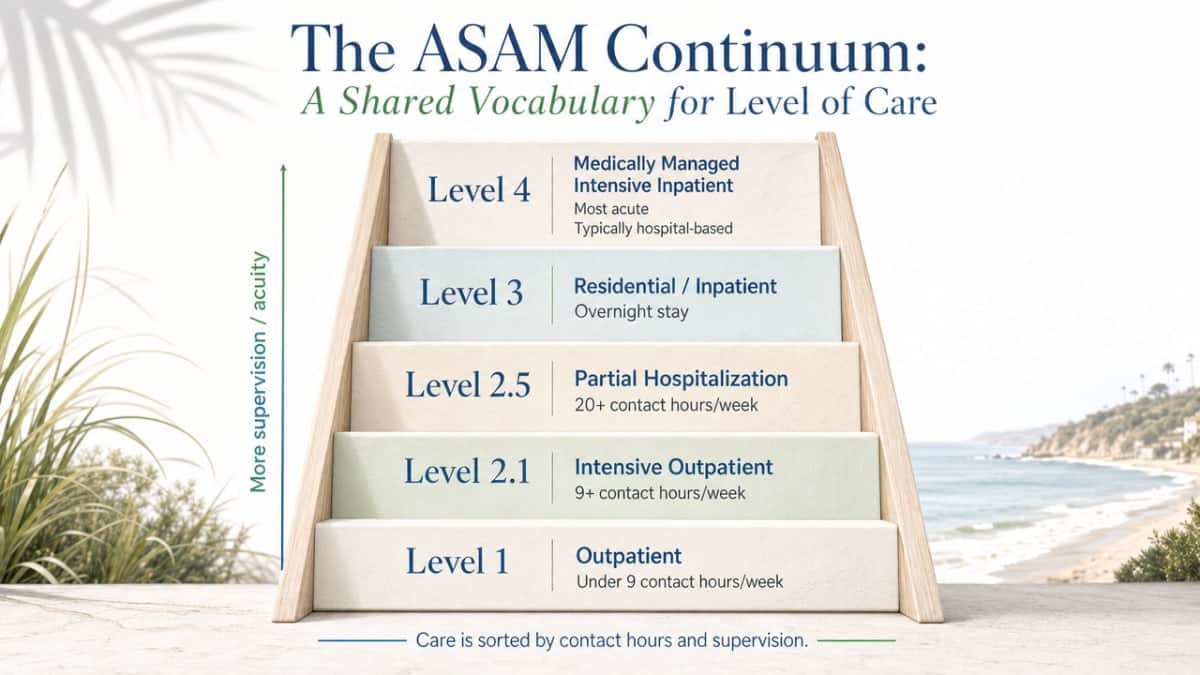
The ASAM continuum sorts care by how many contact hours per week you receive and how much supervision the setting provides. Level 1 outpatient runs under 9 contact hours per week. Level 2.1 intensive outpatient starts at 9 or more contact hours per week in a structured program. Level 2.5 partial hospitalization involves 20 or more contact hours per week. Level 3 covers residential and inpatient care, where you stay overnight. Level 4 is medically managed intensive inpatient, the most acute end of the ladder, typically hospital-based.7
Two things become clearer once you can see the ladder as a ladder. First, the outpatient treatment vs inpatient treatment framing collapses a lot of nuance—there are at least five distinct levels, and the right answer for you might be a middle rung, not either end. Second, the levels are meant to be moved between. You are not choosing your permanent home; you are choosing where to start, with the expectation that you’ll step down as stability returns or step up if a crisis needs more support.3
When you call an intake team, you can ask directly: “What ASAM level are you recommending, and why that one?” A good clinician will explain the reasoning in terms of your specific situation—withdrawal risk, psychiatric acuity, home environment, prior treatment history—rather than defaulting to whatever their facility happens to offer. That question alone can shift the outpatient treatment vs inpatient treatment conversation from a sales pitch into shared decision-making.
What the Evidence Says About Comparative Outcomes
Here’s the part that surprises most families researching outpatient treatment vs inpatient treatment for the first time: the outcomes are closer than the marketing suggests. A systematic review of intensive outpatient programs for substance use found that randomized trials and quasi-experimental studies consistently reported equivalent reductions in problem severity and comparable increases in days abstinent at follow-up between people who received IOP or day treatment and those who received inpatient or residential care. That is not a small finding. It reframes the whole outpatient treatment vs inpatient treatment conversation from “which is stronger?” to “which fits your situation?”2
The same review adds an important caveat worth sitting with. Any measurable advantage for inpatient care appears limited to people with the most severe impairment—those whose safety, medical needs, or environments would make outpatient participation genuinely unworkable. For a large middle of the clinical population, intensive day treatment can be comparable to residential programs in both services offered and effectiveness, provided the individual’s needs are matched to the setting.2,4
One variable does more work than any other: how long you stay engaged. NIDA’s research-based guidance is direct about this—participation of less than 90 days, whether outpatient or residential, is of limited effectiveness, and treatment lasting significantly longer is recommended. So the outpatient treatment vs inpatient treatment question is partly a question about staying power. A shorter inpatient stay followed by ongoing PHP or IOP often does more than a single episode of either alone. The setting matters. The duration matters more.4
Signals That Point Toward Inpatient First
There are moments when the outpatient treatment vs inpatient treatment question answers itself, and it helps to name those moments plainly so you don’t second-guess a decision that needs to be made quickly.
Acute suicidality or a recent self-harm episode is the clearest signal. When someone has a plan, has attempted, or cannot commit to safety between sessions, the intensity of 24-hour supervision is not overkill—it’s the point. The same is true for severe psychiatric symptoms like active psychosis, mania that’s compromising judgment, or dissociation that leaves the person unable to track basic safety. Structured outpatient care can hold a lot, but it cannot hold someone through the hours between appointments when those hours are dangerous.15
Moderate-to-severe withdrawal risk is the second signal, and it’s often underestimated. Alcohol and benzodiazepine withdrawal in particular can escalate into seizures or delirium tremens without medical management. If there’s daily heavy use, prior complicated withdrawals, or physiological dependence on sedatives, medically managed care belongs at the front of the plan, not tacked on after 10. Detox is not a moral checkpoint—it’s a medical event.
Unstable medical comorbidity that intersects with psychiatric or substance use symptoms also pushes toward inpatient. Uncontrolled diabetes, cardiac issues, pregnancy complications, or recent hospitalizations for medical crises all raise the acuity in ways that outpatient scheduling cannot absorb.15
The last signal is quieter and often the hardest to say out loud: the recovery environment itself. If home is where the using happens, where an abusive partner lives, where there is no stable place to sleep, or where every cue in the room is a trigger, then outpatient care is being asked to work against the current all day, every day. In the outpatient treatment vs inpatient treatment decision, environment is not a detail—it’s part of the clinical picture. Taking time away is not a failure of willpower. It’s letting the setting match what the moment requires.1
Signals That Support Outpatient Care
The other side of the triage question is just as important, and it often goes unspoken. A lot of people assume that if things got bad enough to research treatment, they must need the most intensive setting available. That’s not how level-of-care decisions actually work. Structured outpatient care is a legitimate first step—sometimes the right first step—when a specific set of conditions are in place.
Medical and psychiatric stability come first. If withdrawal risk is mild and can be managed with outpatient medication support, if suicidal thoughts are absent or passive without plan or intent, and if psychiatric symptoms are present but not disorganizing daily functioning, then Level 2.1 IOP or Level 2.5 PHP can hold the clinical work. Integrated dual diagnosis programming in these settings addresses both conditions in the same treatment plan rather than sending you to two disconnected providers.6,10
A workable home base matters just as much. If you have somewhere safe to sleep, at least one person who knows what you’re doing and supports it, and enough separation from active using in your immediate surroundings, the outpatient treatment vs inpatient treatment math changes. You can practice recovery skills where you’ll actually need them—the kitchen at 9 p.m., the drive home from work, the group text that used to mean something else.
Motivation to engage, even if it’s shaky, is another green light. You don’t need certainty. You need enough willingness to show up, take the medication, do the homework between sessions 1. If that’s there, outpatient care can meet you where you are without asking you to disappear from your life to prove you’re serious.
Why the Co-Occurring Disorder Lens Changes the Question
When mental health and substance use are happening at the same time, the outpatient treatment vs inpatient treatment question stops being about addiction alone. It becomes about whether both conditions can be treated in the same room, by the same team, in the same plan. That single design choice—integration—matters more than the setting itself. A residential program that treats substance use while telling you to see an outside psychiatrist for your bipolar disorder is doing something fundamentally different from a PHP or IOP that treats both together, even though the residential program looks more intensive on paper.8
The evidence on integrated outpatient dual diagnosis care has been building for a while. Comprehensive, integrated outpatient programs have shown they can engage people with co-occurring disorders, reduce substance use, and support remission—results that used to be assumed to require a residential stay. For a lot of families in Orange County and beyond, this reshapes the outpatient treatment vs inpatient treatment conversation entirely: the real question isn’t inpatient or outpatient, it’s whether the program you’re looking at actually treats both conditions as one clinical picture.6
Availability has caught up with the evidence, at least partly. By 2020, about half of outpatient mental health and substance use treatment facilities had a program to provide integrated care for people with co-occurring disorders, and adoption among substance use facilities had risen by roughly 10 percentage points since 2014. Integrated outpatient dual diagnosis care is no longer a rare specialty—it’s a mainstream option worth asking for by name.11
Two practical things follow. First, when you call an intake team, ask directly whether mental health and substance use are treated in the same plan by the same clinicians, or whether one is referred out. Second, if a program says it treats co-occurring disorders, ask what that actually means: shared treatment plan, on-site psychiatry, integrated groups, medication management for both sides. The answers separate real integration from the label. In the outpatient treatment vs inpatient treatment picture, integration is the variable that changes what’s clinically possible without leaving your life behind.10
The Bridge Model: When Inpatient Hands Off to Outpatient
One of the most useful reframes in the outpatient treatment vs inpatient treatment conversation is that the two are not competitors. They’re often chapters of the same plan. A hospital admission or short residential stay stabilizes the acute piece—withdrawal, a psychiatric crisis, a medical event—and then hands you off to structured outpatient care that carries the longer work of recovery.
This bridge is not incidental. A 2026 systematic review and meta-analysis of inpatient addiction consult services found they are associated with increased inpatient initiation of medication for substance use treatment and improved post discharge linkage and adherence. Put plainly: when the hospital team starts medication and warm-hands you to an outpatient program before discharge, you are measurably more likely to stay connected to care. The inpatient episode becomes a launch point, not an endpoint.5
For someone with co-occurring disorders, the handoff is where integration has to hold. A PHP or IOP that continues the same psychiatric medications, picks up the trauma work, and keeps treating both conditions in one plan turns an isolated stabilization into ongoing recovery. Ask the discharge team a specific question: which outpatient program will I start, on what date, and who is coordinating my medications? That’s the sentence that closes the gap where the outpatient treatment vs inpatient treatment split most often loses people.8.
Life Continuity: Work, Family, and the Recovery Environment
The part of the outpatient treatment vs inpatient treatment decision that gets underweighted is what happens to the rest of your life while treatment is happening. A job you’ve held for years. A kid who reads with you at bedtime. A parent you drive to appointments. These aren’t distractions from recovery—they’re often part of what makes recovery worth doing, and they can be part of what makes it stick.
Structured outpatient care is designed to hold treatment and daily life in the same frame. Evening IOP schedules exist precisely because a lot of people cannot step away from work without losing it, and PHP schedules leave evenings and weekends intact for family. Vocational and educational engagement is a recognized part of comprehensive dual diagnosis care, not an optional extra, because maintaining community roles supports long-term recovery outcomes.13
The honest counterweight: if home is the trigger, continuity becomes the problem. That’s when inpatient earns its place. But for many people weighing outpatient treatment vs inpatient treatment, keeping the scaffolding of ordinary life—paycheck, dinner table, morning routine—while doing the clinical work is not a shortcut. It’s the treatment plan.
Talking to an Intake Team Without Losing Your Footing
The phone call is often the hardest part. You’ve been thinking about outpatient treatment vs inpatient treatment for days, maybe weeks, and now a stranger with a headset is asking you to describe the worst parts of your life in the first ten minutes. It’s okay to feel wobbly walking in. It doesn’t mean you’re not ready.
A few questions can steady the ground. Ask what ASAM level of care they are recommending and what specifically about your situation points there. Ask whether mental health and substance use are treated in the same plan by the same team, or referred out. Ask what the weekly schedule actually looks like—hours, days, group versus individual time—so you can picture it against your real week. Ask what happens if you need to step up or step down.3,8
If the answers feel like a script, keep calling. A good intake conversation in the outpatient treatment vs inpatient treatment decision sounds like two people working on the same problem, not a pitch. You’re allowed to take notes. You’re allowed to say you need to think. Bringing a family member on the line is not weakness—it’s smart triage.
A Next Step, Not a Verdict
Whatever you decide about outpatient treatment vs inpatient treatment, the decision you make today is not the whole plan. It’s the first step. People move between levels of care as circumstances change, and a good treatment team expects that.
If safety is uncertain right now, start with the more supervised setting and let stabilization open the door to structured outpatient work later. If the clinical picture supports it, an integrated PHP or IOP that treats mental health and substance use in the same plan can hold real recovery without asking you to disappear from your life. Either way, the outpatient treatment vs inpatient treatment question is answered best by a specific clinician looking at your specific situation—not by an internet search at midnight.
You already did the hard part by taking this seriously. When you’re ready, the team at 449 Recovery can walk through your options with you and help you find the right starting point.
Frequently Asked Questions
Is outpatient treatment less effective than inpatient treatment for substance use?
No. A systematic review of intensive outpatient programs found equivalent reductions in substance use and comparable increases in days abstinent when compared to inpatient or residential care for many clients. In the outpatient treatment vs inpatient treatment question, fit matters more than intensity—outcomes track with clinical match and sustained engagement, not with whether you sleep at the facility.2
How do I know if I need inpatient care instead of an outpatient program?
Certain signals point toward 24-hour care: active suicidality, moderate-to-severe withdrawal risk (especially from alcohol or benzodiazepines), unstable medical conditions, acute psychiatric symptoms like psychosis, or a home environment where safety cannot be maintained between sessions. If those aren’t present and you have a workable home base, structured outpatient care in the outpatient treatment vs inpatient treatment continuum can often carry the clinical work.1,15
Can outpatient programs treat co-occurring mental health and substance use disorders?
Yes. Integrated outpatient dual diagnosis programs treat both conditions in the same plan, by the same team, and research shows they can engage clients, reduce substance use, and support remission. When comparing outpatient treatment vs inpatient treatment for co-occurring disorders, the deciding variable is often integration—whether the program treats both sides together—not the setting itself.6,8
What is the difference between IOP and PHP?
Both are structured outpatient programs, but they differ in intensity. Intensive outpatient (Level 2.1) involves 9 or more contact hours per week across several days. Partial hospitalization (Level 2.5) runs 20 or more contact hours per week, often five or six hours a day on weekdays. PHP sits closer to inpatient in the outpatient treatment vs inpatient treatment ladder without requiring overnight stays.7
Can I keep working or caring for my family during outpatient treatment?
Often, yes. IOP schedules—including evening options—are designed to preserve work and family responsibilities, and PHP typically leaves evenings and weekends open. Maintaining community roles is a recognized part of comprehensive dual diagnosis care, not a distraction from it. That said, if home is the primary trigger environment, the outpatient treatment vs inpatient treatment math shifts and a period of inpatient care may serve you better first.13
What happens after an inpatient stay ends?
An inpatient stay works best when it hands off to structured outpatient care rather than ending abruptly. Research on inpatient addiction consult services shows they improve postdischarge linkage and adherence when medication and follow-up are arranged before discharge. In the outpatient treatment vs inpatient treatment plan, PHP or IOP typically picks up the longer recovery work, continuing psychiatric medications and integrated dual diagnosis programming.5,8
References
- Treatment Types for Mental Health, Drugs and Alcohol. https://www.samhsa.gov/find-support/learn-about-treatment/types-of-treatment
- Substance Abuse Intensive Outpatient Programs: Assessing the Evidence. https://pmc.ncbi.nlm.nih.gov/articles/PMC4152944/
- Chapter 3. Intensive Outpatient Treatment and the Continuum of Care. https://www.ncbi.nlm.nih.gov/books/NBK64088/
- Principles of Drug Addiction Treatment: A Research-Based Guide (Third Edition). https://nida.nih.gov/sites/default/files/podat-3rdEd-508.pdf
- Outcomes associated with an inpatient addiction consult service: Systematic review and meta-analysis. https://pmc.ncbi.nlm.nih.gov/articles/PMC13191137/
- Review of integrated mental health and substance abuse treatment for patients with dual diagnosis. https://pubmed.ncbi.nlm.nih.gov/9853791/
- ASAM Criteria Training – Levels of Care (Part 2). https://www.mass.gov/files/documents/2020/01/24/ASAM_Part2_NEIAS1DAY2019-compressed.pdf
- Chapter 7—Treatment Models and Settings for People With Co-Occurring Disorders. https://www.ncbi.nlm.nih.gov/sites/books/NBK571024/?report=reader
- Chapter 6. Traditional Settings and Models. https://www.ncbi.nlm.nih.gov/books/NBK64182/
- Substance Use Disorder Treatment for People with Co-Occurring Disorders. https://library.samhsa.gov/sites/default/files/pep20-06-04-006.pdf
- Adoption of Integrated Care for People with Co-Occurring Mental Health and Substance Use Disorders. https://aspe.hhs.gov/sites/default/files/documents/e2ccdd7991f1de5060983598cb66624f/adoption-integrated-care.pdf
- Chapter 1—Introduction to Co-Occurring Disorders. https://www.ncbi.nlm.nih.gov/books/NBK571022/
- Chapter 8—Vocational and Educational Rehabilitation. https://www.ncbi.nlm.nih.gov/books/NBK571028/
- Chapter 6—Co-Occurring Disorders and Special Populations. https://www.ncbi.nlm.nih.gov/books/NBK571026/
- Chapter 2—High-Priority Co-Occurring Disorders. https://www.ncbi.nlm.nih.gov/books/NBK571023/