Key Takeaways
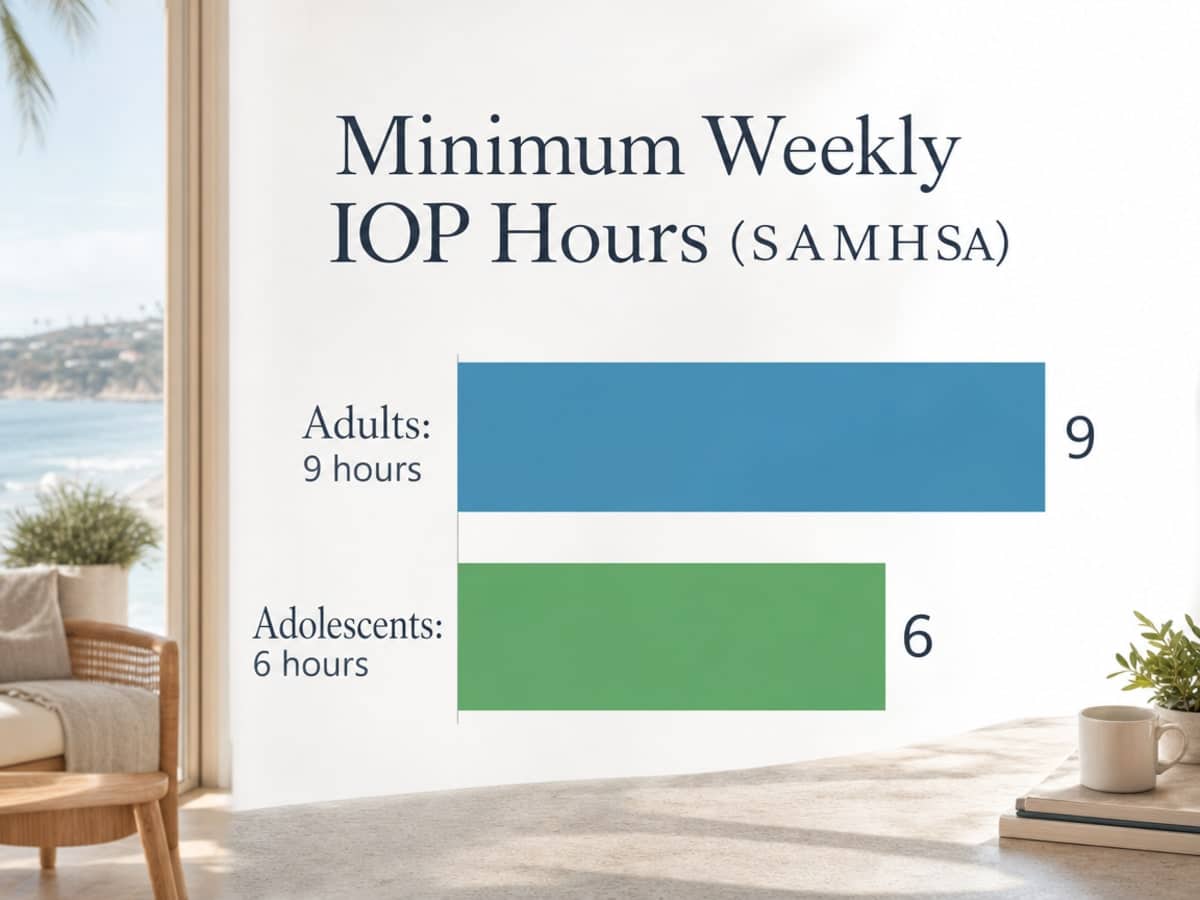
- Intensive outpatient treatment delivers at least 9 hours of structured therapy per week, often delivered as three sessions, placing it between standard outpatient care and partial hospitalization 1, 2.
- Most adults spend 6 to 12 weeks in IOP, with a 42-day average episode length and an 81-day median for adults who completed treatment 1, 5.
- Personal timelines shift based on symptom severity, early treatment response, home environment, co-occurring conditions, and engagement rather than a fixed calendar date.
- Stepping down happens when symptoms stabilize, coping skills hold under pressure, outside support is in place, and progress stays consistent across several weeks 10.
The Direct Answer: Weeks, Hours, and What the Calendar Really Looks Like
If you’re trying to figure out how long is intensive outpatient treatment before you commit, here’s the honest, upfront answer: most adults spend about 6 to 12 weeks in an intensive outpatient program, attending at least 9 hours of therapy each week 1, 2. That’s often delivered as three sessions per week, about three hours each, though some programs run four shorter sessions or offer evening blocks built around a full-time work schedule.
Real-world data backs this range up. A national utilization study found the average IOP episode lasts about 42 days, roughly six weeks 5. Adults who complete the full course of care stay longer — the median completed length of stay is 81 days, closer to 12 weeks 1. Washington State caps IOP at up to 90 days 9. Other state frameworks let it stretch longer if your progress calls for it 10.
So the calendar isn’t rigid. Think of it this way: you’re not signing up for a fixed sentence. You’re committing to a weekly rhythm — around 9 hours of clinical support — that continues until you and your treatment team agree you’re steady enough to step down. That decision is based on your symptoms, your coping skills, and how life outside the room is going, not on a preset date.
The rest of this article walks through what shapes your personal timeline, what an actual week looks like when you’re still working, and how you’ll know you’re ready to graduate.
What Counts as ‘Intensive’ — The 9-Hour Weekly Floor
The word “intensive” sounds heavy, and that’s part of why the question how long is intensive outpatient treatment feels loaded. But the definition itself is more concrete than the word suggests. At its core, an adult IOP is any program that delivers at least 9 hours of structured therapeutic services per week 1. Below that threshold, you’re in standard outpatient care. Above roughly 20 hours a week, you’ve stepped up into a partial hospitalization program (PHP) 2.
Nine hours is the floor, not the ceiling. And here’s something most articles skip: what actually counts as IOP varies by state. Washington defines IOP as 9 to 12 hours per week and caps most programs at 90 days 9. Connecticut allows adult IOP to run as high as 19 hours per week, with duration tied to your progress rather than a fixed date 10. Maryland’s regulations set the range at 9 to 20 hours per week for adults 11. So a program in one state might look meaningfully different from one across the country, even though both wear the same label.
What this means for you is practical: when you’re comparing programs, the schedule matters as much as the name on the door. A 9-hour-per-week evening IOP is a very different weekly commitment than a 15-hour daytime program, even though both are technically “intensive outpatient.” The clinical intent is the same — enough structured contact to actually move symptoms, not so much that you can’t hold onto your job or your family life.
The 9-hour floor exists because research and payer policy agree that below that threshold, most people don’t get enough therapeutic contact to shift entrenched patterns 1, 2. Above it, you get real momentum: group work, skills practice, individual sessions, and check-ins that reinforce each other across the week. That’s the trade-off the number represents — enough intensity to make change stick, structured to fit around the rest of your life.
How Long Is Intensive Outpatient Treatment in Real Life? The 6-to-12-Week Range
Clinical minimums and lived experience are two different things. When you ask how long is intensive outpatient treatment, the technical answer is “at least 9 hours a week, for as long as your care plan says you need it.” The real-world answer is more useful: most adults land somewhere between six and twelve weeks, and where you fall in that range depends on why you started and how the weeks go.
Here’s what the utilization data shows. A national study of adult IOP episodes across mental health, substance use, and co-occurring cohorts found an average length of stay of about 42 days — right at the six-week mark 5. That’s the arithmetic average, which includes people who left early, transferred to a different level of care, or wrapped up in less time because their symptoms responded quickly.
The picture shifts when you look at people who finish the full course of treatment. SAMHSA’s discharge data puts the median completed length of stay at 81 days — closer to twelve weeks 1. That gap between the 42-day episode average and the 81-day completion median tells you something important: staying the full course tends to mean staying longer than the average episode, because the average is pulled down by early exits.
Reviewed IOP programs typically run between 30 and 90 days per expert treatment guidance, with weekly programming individualized to the client’s needs rather than pinned to a fixed schedule 3. Washington State formalizes this by capping IOP at up to 90 days 9. Other state frameworks tie length of stay directly to individual progress rather than the calendar 10.
So if you’re picturing your own timeline, six to twelve weeks is a reasonable planning window. Plan for the longer end if you’re managing co-occurring conditions, if you’re early in your recovery from a substance use concern, or if your symptoms have been building for a while. Plan for the shorter end if you’re stepping down from a higher level of care and using IOP to consolidate gains. Either way, the number that matters most isn’t the total days — it’s whether the weeks are actually moving you forward.
Why Mental Health, Substance Use, and Co-Occurring Timelines Differ
Your diagnosis shapes your timeline more than you might expect. The same program can look like a six-week commitment for one person and a three-month commitment for another, and the difference often traces back to what you’re working on in the room.
The national utilization data breaks this down clearly. Adults whose primary reason for entering IOP was a mental health concern — anxiety, depression, trauma, mood disorders — averaged 44.15 days in treatment. Adults treated primarily for substance use or co-occurring conditions averaged about 41.5 days as a combined cohort. The overall population average landed at 42 days 5. Those numbers sit close together, but the story underneath them is different for each cohort.
Here’s what those averages don’t show. When SAMHSA looked specifically at adults who completed an IOP episode — meaning they stayed through discharge rather than leaving early — the median length of stay was 81 days 1. That’s roughly twice the average episode length. The gap tells you two things: treatment tends to run longer when people see it through, and averages get pulled down significantly by early departures.
Why do mental health episodes trend slightly longer on average? Symptoms like depression and trauma often respond to treatment on a slower curve than acute crisis stabilization. You might feel better within a few weeks, but the skills work — practicing new responses, building steadier routines, testing what holds up under stress — takes time to consolidate. Programs typically extend care until those changes feel durable, not just present.
Substance use timelines carry a different clinical logic. Early recovery involves rebuilding daily structure, addressing triggers as they come up in real life, and often coordinating medical or psychiatric support alongside therapy. Programs frequently extend beyond the initial weeks to give those changes time to hold.
Co-occurring conditions — where mental health and substance use concerns are being treated together — often require the most individualized planning. When two conditions interact, progress in one area can stall progress in the other, and clinicians typically build in extra time to work on both without shortchanging either.
If you’re weighing your own timeline, don’t anchor on the six-week average. Anchor on what your treatment plan actually names as your goals, and expect the calendar to follow the work.
A Working Professional’s Week Inside IOP
Let’s make the 9-hour weekly minimum concrete, because a number on a page is very different from a Tuesday night on your calendar. ASAM defines IOP as a minimum of 9 hours per week, often delivered as three 3-hour sessions 12. That’s it. Three evenings, or three mornings, or some combination that fits around your job.
Here’s what a typical evening block tends to hold. You arrive, settle in, and the first stretch is usually a process group — a facilitated conversation where you and 6 to 10 other adults talk through what’s come up since the last session. The middle stretch is skills work: cognitive behavioral therapy tools, dialectical behavior therapy modules, relapse prevention practice, or trauma-focused techniques depending on the program’s focus. The final stretch might be a shorter individual check-in, a family session, or a specialty group like medication management or process work around a specific concern.
The rhythm is the point. Attending Monday, Wednesday, and Thursday evenings — for example — means you’re never more than 48 hours away from your next contact with the clinical team. If something hard comes up at work on Tuesday, you’re bringing it into group on Wednesday, not sitting with it alone for six days. That short feedback loop is a big part of why the 9-hour floor exists in the first place.
For a full-time employee, a well-built evening IOP tends to look like this on paper: you leave the office at 5, grab dinner or eat during the drive, arrive by 5:45 or 6, and you’re home by 9. Three nights a week, for roughly six to twelve weeks. That’s the shape of the commitment when you ask how long is intensive outpatient treatment and picture it inside your actual schedule.
You will feel tired some weeks. That’s honest. But the trade — nine hours of real clinical work in exchange for keeping your job, your home, and your relationships intact — is why this level of care exists.
What Actually Determines Your Personal Length of Stay
If you’re still wondering how long is intensive outpatient treatment for you specifically, the answer lives in a handful of clinical variables your treatment team weighs from your first assessment onward. Understanding those variables can take some of the guesswork out of the calendar.
The first is symptom severity at intake. Someone entering IOP after a recent crisis — a hospitalization, a serious depressive episode, a relapse — typically starts with more clinical ground to cover. Someone stepping down from a partial hospitalization program has already done part of the acute work and may move through IOP faster. Programs individualize the weekly hour count and duration based on that starting point rather than a one-size schedule 3.
The second is how you respond in the first two to three weeks. Early treatment tells your clinical team a lot. Are you attending consistently? Are the skills sticking between sessions? Is your sleep, appetite, or substance use pattern shifting in the direction you want? Programs that use progress-based length of stay — like the model Connecticut’s policy describes — adjust duration based on outcomes rather than a preset endpoint 10.
The third is what’s happening outside the room. Your home environment, work stress, family dynamics, and access to sober or supportive relationships all shape how quickly gains translate into stability. A person with a settled home life and a supportive partner may consolidate progress faster than someone still sorting out housing, custody, or a high-conflict workplace. Neither timeline is a failure — they’re just different.
The fourth is co-occurring conditions. When anxiety and alcohol use are being treated together, or depression is layered under trauma, clinicians typically build in more time so neither concern gets shortchanged. Research reviews of IOP consistently show that outcomes hold up for appropriately matched patients when the program length reflects the clinical picture rather than a fixed cap 4.
The fifth — and the one most people underestimate — is your own honest engagement. Showing up is the baseline. Bringing real material into group, doing the between-session work, and telling your clinician when something isn’t landing all shorten the distance between where you are and where you’re trying to be. That doesn’t mean pushing yourself harder than is sustainable. It means treating the weeks as active work, not a waiting room.
The Step-Down Decision: What Has to Change Before You Graduate
Graduation from IOP isn’t a date on a calendar — it’s a clinical judgment that you’ve built enough stability to succeed with less structure. Understanding what your treatment team is actually watching for can make the whole question of how long is intensive outpatient treatment feel less like waiting and more like working toward something specific.
The first shift they’re looking for is symptom stabilization. Not the disappearance of every hard feeling — that’s not the goal, and any program that promises it isn’t being honest with you. What they want to see is that the acute symptoms that brought you in have settled into a manageable range. Panic attacks that were daily are now rare. Depressive episodes that flattened your week are shorter and less severe. Cravings or substance use urges are showing up less often and you have tools that work when they do.
The second is skills you can actually use under pressure. It’s one thing to name a coping strategy in group on a Wednesday night. It’s another to reach for it on Sunday afternoon when your in-laws are pushing your buttons or a work deadline is closing in. Your clinical team is listening for evidence that the tools have moved from the training room into your real life.
The third is a functioning support system outside the program. Before step-down, most teams want to see you connected to something that continues — a therapist for weekly individual work, a support group, a psychiatrist for medication management, or an aftercare track. This is why programs that use progress-based length of stay adjust the exit point based on outcomes rather than a preset endpoint 10. You don’t graduate into a void; you graduate into a lighter but still real structure.
The fourth is consistency. A single strong week doesn’t signal readiness. Several steady weeks in a row do. That’s why the median completed length of stay tends to run longer than the average episode — durability takes time to prove.
When IOP Runs Longer — And When That’s the Right Call
Sometimes the honest answer to how long is intensive outpatient treatment is: longer than you first pictured. That’s not a setback. For some people, it’s exactly the right clinical call.
Reviewed IOP programs typically run between 30 and 90 days per expert treatment guidance, but the field explicitly builds in room for longer stays when the clinical picture calls for it 3. Connecticut’s policy framework is direct about this: duration follows individual progress and outcome, not a fixed endpoint 10. Translation — if the weeks are working but you’re not yet steady, extending IOP is a legitimate treatment decision, not a failure.
A few situations tend to warrant more time. Trauma work that surfaces mid-program often needs additional weeks to process safely rather than rushed to fit a calendar. A relapse during treatment usually calls for extension rather than discharge, so the reset happens inside the support structure. New life stressors — a job change, a loss, a shift in family circumstances — can reasonably reset your timeline. And when co-occurring conditions are both actively in play, research on IOP outcomes supports longer engagement for appropriately matched patients rather than premature step-down 4.
If your team suggests extending, ask what specific goals the extra weeks target and what would signal readiness. A longer stay with a clear focus is very different from drifting past a discharge date. The point of more time is more progress, not more sessions.
Fitting IOP Around Work, Family, and Privacy
One of the real reasons people ask how long is intensive outpatient treatment is because they’re doing the math in their head: How many evenings? Which nights? What do I tell my manager? Can I still pick up my kid on Thursday? The clinical timeline matters, but the logistical timeline is what actually decides whether you can say yes.
Evening IOP tracks exist precisely for this reason. A well-designed program builds the 9-hour weekly minimum into blocks that start after typical work hours 1. That usually means you’re at your desk during the day, in group in the evening, and home before it gets too late to reset for tomorrow. For many working professionals, this is the difference between getting real clinical care and putting it off another year.
Family logistics take a little more planning. If you have kids, three evenings a week means coordinating childcare, dinner, or a co-parent’s schedule for roughly six to twelve weeks. That’s a real ask. But it’s a finite ask — not an open-ended one — and framing it that way with the people in your household tends to make the conversation land differently.
Privacy is often the quiet worry underneath the scheduling question. You do not have to disclose IOP to your employer. Attending after work hours means there’s no medical leave paperwork, no gap in your calendar to explain, and no clinical detail your workplace ever sees. Your treatment records are confidential. What you choose to share is entirely yours.
Talking to a Program About Your Timeline
When you call an intake line and ask how long is intensive outpatient treatment, the answer you get in the first two minutes will tell you a lot about the program. A thoughtful team won’t hand you a fixed number. They’ll ask about your symptoms, your work schedule, whether you’re stepping down from higher care, and what your support system looks like at home. That’s a good sign — it means duration will be shaped around you, not a template.
A few questions worth asking directly: How many hours per week does your program run, and on what schedule? Is there an evening track for people working full-time? How do you decide when someone is ready to step down? What does aftercare look like when I graduate? Programs that use progress-based length of stay will describe specific milestones, not just a day count 10.
If you’re in Orange County and weighing your options, a program like 449 Recovery’s evening IOP is built for exactly this conversation — timeline shaped around your work life, not the other way around.
Frequently Asked Questions
Can I keep working full-time while I’m in an intensive outpatient program?
Yes, and that’s a large part of why IOP exists. Programs are built around the 9-hour weekly minimum, and many offer evening tracks specifically for people who work standard business hours 1. You attend three evening blocks a week, keep your daytime schedule intact, and come home the same night. It takes real energy, but your job stays yours.
What happens if I miss an IOP session because of work or a family emergency?
Missing an occasional session isn’t the end of your progress. Most programs build in makeup options — a weekend group, a telehealth session, or a one-on-one with your counselor — so you still meet the weekly hour threshold that defines IOP 1. Tell your clinical team as early as you can. What matters is a pattern of consistent attendance, not a perfect record.
Is telehealth IOP available alongside in-person programming?
Telehealth IOP expanded significantly after 2020 and now runs alongside in-person programming at many facilities 1. For working professionals, virtual attendance can remove a real barrier — commute time, childcare gaps, privacy at the office. If you have a private, reliable space to attend from, it can be a practical way to engage with group process and skills practice.
Will my employer or coworkers find out I’m in IOP?
Not unless you tell them. Evening IOP happens after work hours, so there’s no schedule gap, no medical leave paperwork, and no clinical detail your employer ever sees. Your treatment records are confidential. If you want to share with a manager or HR partner, that’s your call — but no part of the program requires it.
What’s the difference between IOP and PHP, and how does that affect how long I’ll be in treatment?
The main difference is intensity. IOP requires a minimum of 9 hours per week; PHP generally requires around 20 hours per week and functions as a step down from inpatient care 2. Many people move through PHP first and then transition into IOP as they stabilize. That step-down structure often means your total time across both levels is longer than IOP alone, but the weekly load lightens as you go.
Can I extend IOP if I don’t feel ready to step down at the end of the program?
Yes, and that’s a legitimate clinical option, not a failure. Policy frameworks that use progress-based length of stay explicitly allow duration to follow your outcomes rather than a preset calendar 10. If you’re close but not steady, ask your team what specific goals an extension would target. A focused extra few weeks with clear milestones is very different from drifting past a discharge date.
References
- CLINICAL ISSUES IN INTENSIVE OUTPATIENT TREATMENT FOR SUBSTANCE USE DISORDERS. https://library.samhsa.gov/sites/default/files/pep20-02-01-021.pdf
- MLN1986542 – Medicare & Mental Health Coverage. https://www.cms.gov/files/document/mln1986542-medicare-mental-health-coverage.pdf
- Chapter 3. Intensive Outpatient Treatment and the Continuum of Care. https://www.ncbi.nlm.nih.gov/books/NBK64088/
- Substance Abuse Intensive Outpatient Programs. https://pmc.ncbi.nlm.nih.gov/articles/PMC4152944/
- Intensive Outpatient Treatment (IOP) of Behavioral Health Disorders: Utilization Patterns and Length of Stay. https://pubmed.ncbi.nlm.nih.gov/32043237/
- Intensive Outpatient Program Services | Medicare Coverage. https://www.medicare.gov/coverage/mental-health-care-outpatient-intensive-outpatient-program-services
- CY 2025 Medicare Hospital Outpatient Prospective Payment System / Ambulatory Surgical Center Payment System Final Rule Fact Sheet. https://www.cms.gov/newsroom/fact-sheets/cy-2025-medicare-hospital-outpatient-prospective-payment-system-ambulatory-surgical-center-payment
- Medicare Benefit Policy Manual – Chapter 6. https://www.cms.gov/files/document/r12425bp.pdf
- Substance use disorder outpatient treatment and residential treatment fact sheet. https://www.hca.wa.gov/assets/program/fact-sheet-sud-residential-outpatient-treatment.pdf
- Substance Use Disorders Services Policy and Clinical Assumptions Grid: IOP and PHP. https://portal.ct.gov/dss/-/media/departments-and-agencies/dss/health-and-home-care/substance-use-disorder-demonstration-project/ct-outpatient-sud-assumptions-grid-iop-and-php-7123.pdf?rev=7fb7ec83b89e4ef9b45e807572c485aa&hash=C3B7E8521B87D58B57C6FB698AE302AC
- .05 Intensive Outpatient Services Level II.1 and Partial Hospitalization. https://regs.maryland.gov/us/md/exec/comar/10.47.02.05
- Chapter 4. Services in Intensive Outpatient Treatment Programs. https://www.ncbi.nlm.nih.gov/books/NBK64094/