Local Care That Works Around Your Life
Finding mental health support that actually fits your schedule shouldn’t feel impossible. You’re juggling work deadlines, family commitments, and the day-to-day demands that don’t pause just because you’re struggling. That’s exactly why an evening intensive outpatient program in South Orange County—with flexible scheduling that works around your life—makes all the difference. This article explores how evening intensive outpatient programs in Orange County provide the structured mental health treatment you need without requiring you to sacrifice your career or daily responsibilities.
An evening intensive outpatient program creates space for you to prioritize your mental health without sacrificing your career or responsibilities. Instead of choosing between maintaining your professional commitments and getting the care you need, you can do both. Evening intensive outpatient programs typically run in the late afternoon or evening hours, allowing you to complete your workday before transitioning to structured support for anxiety, depression, or co-occurring conditions.
When your evening intensive outpatient program is located right here in South Orange County, you eliminate the added burden of lengthy commutes. Treatment in Mission Viejo or nearby areas means you can transition from your workday to your therapy session without the stress of fighting traffic across Southern California. That proximity matters when you’re already managing mental health challenges—every bit of reduced stress helps you focus on what matters most: your recovery.
An evening intensive outpatient program offers the structure and clinical depth you need, with multiple sessions per week that include individual therapy, group work, and skill-building components. You’re getting comprehensive care that addresses your specific needs—whether that’s evidence-based approaches like cognitive behavioral therapy or dialectical behavior therapy—all scheduled around the life you’re working hard to maintain.
The reality is that seeking help shouldn’t require you to put your entire life on hold. Evening intensive outpatient programs recognize that you have responsibilities, goals, and a routine that matters to you. By bringing quality mental health treatment to Orange County with scheduling that respects your time, you can invest in your recovery without dismantling everything else. That’s what accessible care really looks like—support that meets you where you are, both geographically and in your daily life.
What an Intensive Outpatient Program Offers
Structure, Hours, and Evidence-Based Therapies
You know the Orange County routine: juggling meetings at the Great Park, school pickups in Ladera Ranch, and late emails from your office in Newport Center. It’s tough to fit real healing into that mix—unless the structure of your intensive outpatient program Orange County CA is built for people exactly like you.
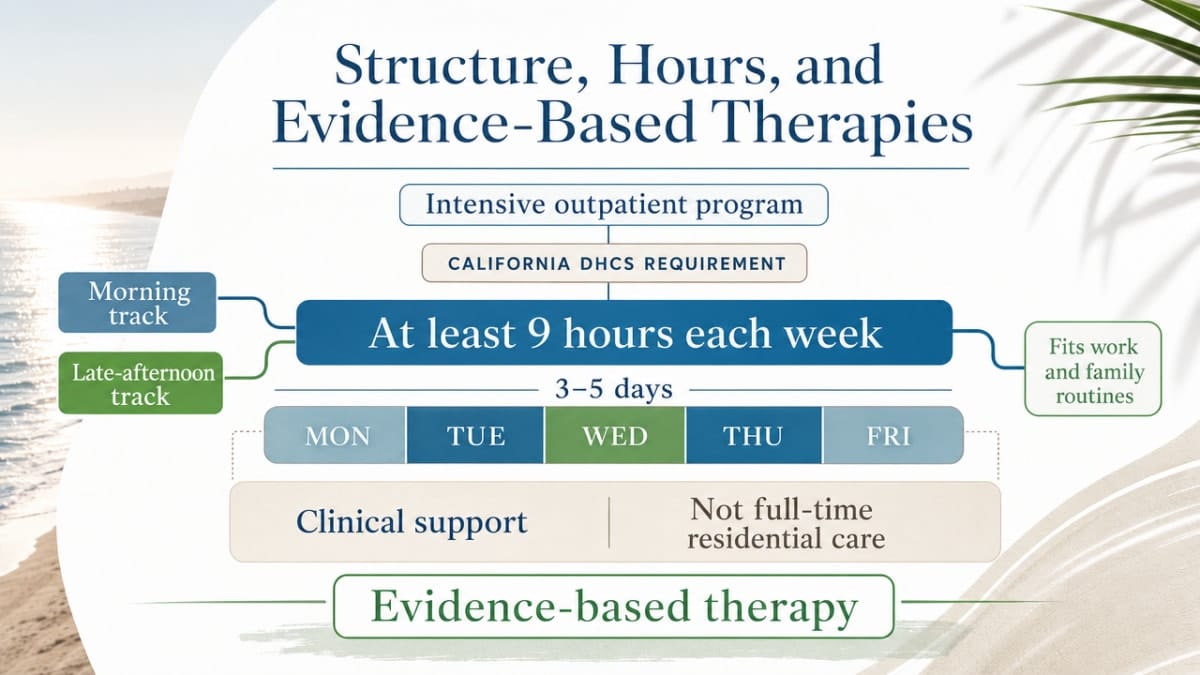
A standard intensive outpatient program Orange County CA delivers at least nine hours of evidence-based therapy each week, typically spread across three to five days. This isn’t just a formality—it’s a state requirement under California DHCS guidelines, ensuring you get enough clinical support without the disruption of full-time residential care 1. Flexible programs in the region often offer morning and late-afternoon tracks, making it possible to attend sessions before heading to the office in Tustin or after wrapping up a shift in Laguna Niguel.
The therapies themselves are proven to help drive outcomes. Most programs use cognitive behavioral therapy (CBT), trauma-informed care, and group sessions tailored for professionals managing anxiety, depression, or dual diagnoses. Research shows that intensive outpatient programs can lead to significant reductions in symptoms and improved daily functioning, matching the results seen in more intensive treatment settings for many adults 3.
Safety, privacy, and accessibility are always top of mind. Orange County programs must meet strict licensing standards for staffing and environment. You’ll see protocols for secure documentation, safe parking even after dark, and comfortable group spaces—often just minutes from neighborhoods like Dana Point, Garden Grove, or San Juan Capistrano.
There’s no perfect formula, but the right structure can make all the difference. Next, discover how evening options can help you fit consistent care into even the busiest professional schedule.
Evening Options for Working Professionals
Evening options in an intensive outpatient program Orange County CA are a lifeline for professionals who can’t press pause on their careers, families, or commitments. Maybe you’re wrapping up your last Zoom call at 6 p.m. in South Coast Metro, or you’re just leaving the courthouse in Santa Ana after a long day. Evening tracks are designed so you can access meaningful support—without having to explain away long absences or sacrifice your progress at work.
In Orange County, evening sessions are particularly popular among those commuting from Brea, Fullerton, and Laguna Hills, where daytime traffic or unpredictable work hours make traditional appointments impossible. Many programs offer groups and individual therapy after 5 p.m., so you can join from The Block at Orange, or stop by after work in the Platinum Triangle. Research consistently shows that working adults are more likely to complete treatment and see better results when they have access to flexible evening schedules 6.
One client from Fountain Valley shared how attending sessions at 7 p.m. meant he could be home for dinner with his kids and still prioritize his mental health. Another, living near John Wayne Airport, found that evening options let her join peer support groups without missing project deadlines or worrying about parking during rush hour.
Yes, juggling so much is tough—but the right schedule gives you a fighting chance. Next, see how these programs serve neighborhoods throughout Orange County, so you can find support close to home or work.
Neighborhoods Served Across Orange County
When you’re looking for mental health support that fits your life, accessibility matters just as much as quality of care. This region offers a diverse landscape of communities, and finding outpatient mental health treatment close to home—or on your commute route—can make all the difference in maintaining consistency with your recovery.
Throughout South County, residents from Laguna Niguel, Aliso Viejo, and Laguna Hills have convenient access to outpatient mental health treatment that includes Dialectical Behavior Therapy (DBT), Cognitive Behavioral Therapy (CBT), and specialized group therapy formats for anxiety, depression, and co-occurring conditions. These neighboring communities are typically less than 15 minutes from Mission Viejo, with easy access via the 5 freeway and Crown Valley Parkway. Whether you’re managing work stress, mood disorders, or substance use concerns, you don’t need to travel far to find evidence-based support that understands the unique pressures facing working professionals.
The Saddleback Valley region, including Lake Forest and Rancho Santa Margarita, connects easily to structured outpatient mental health treatment programs designed around your schedule. Evening treatment options mean you can attend therapy after work without sacrificing your career momentum or using precious PTO for appointments that fit your life rather than disrupting it. Individual therapy, process groups, and trauma-focused interventions are all available with flexible scheduling that respects your professional commitments.
For those in San Juan Capistrano, Dana Point, and San Clemente, quality outpatient mental health treatment is within reach without the stress of long commutes—typically 20-25 minutes via Pacific Coast Highway or the 5 freeway. Geographic convenience removes one more barrier to getting started, and ample parking means you’re not adding extra stress to your treatment days. You’re not alone in seeking help, and accessible care makes it easier to maintain consistency with your recovery plan.
No matter where you call home in Orange County, you deserve outpatient mental health treatment that doesn’t require you to reorganize your entire life. From Irvine and Tustin in the north to the coastal communities in the south, central Orange County locations offer accessibility for professionals throughout the region. Proximity to care, flexible scheduling, and evidence-based approaches—including DBT skills training, CBT techniques, EMDR for trauma, and medication management—work together to support your journey toward improved mental health and functioning. Your location shouldn’t determine whether you can access the quality outpatient mental health treatment you need.
What to Expect From Treatment and Insurance
Your First Weeks: Assessment to Aftercare
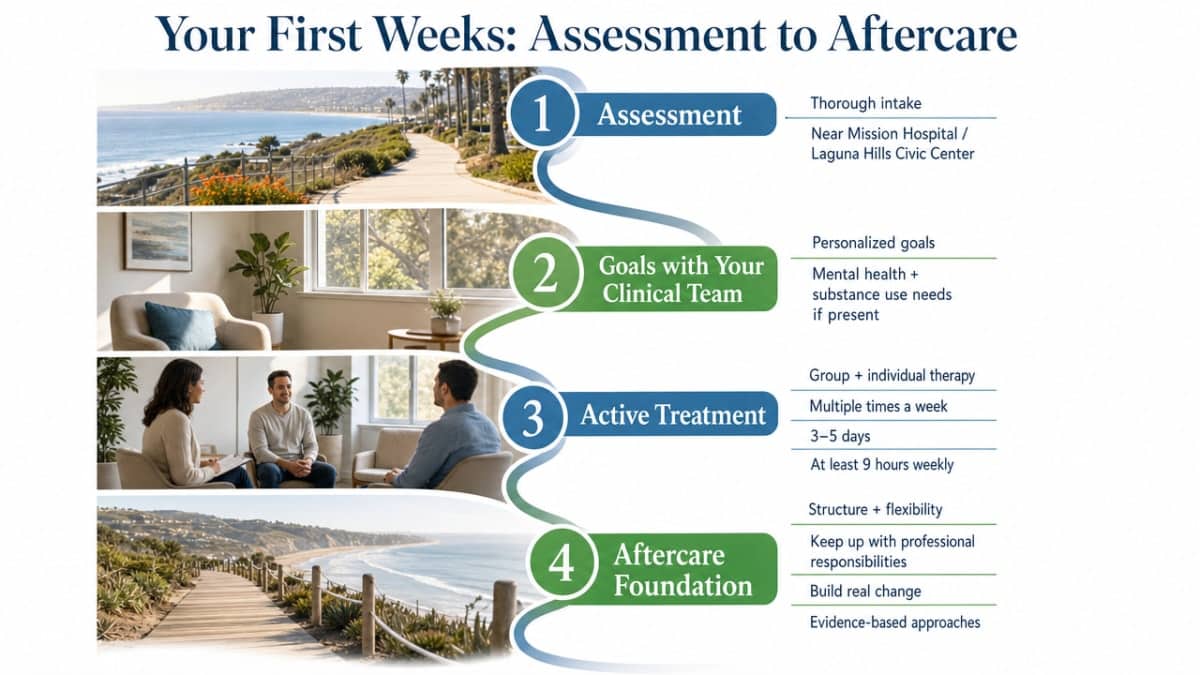
Your first weeks in an intensive outpatient program Orange County CA are designed to give you both structure and flexibility, so you can keep up with your professional responsibilities while building a foundation for real change. The journey typically begins with a thorough assessment—often right near major hubs like Mission Hospital or the Laguna Hills Civic Center—where you’ll collaborate with your clinical team to set personalized goals and address both mental health and substance use needs if present.
From there, you’ll enter the active phase of treatment, attending group and individual therapy sessions multiple times a week. Programs in Orange County commonly spread these sessions across three to five days, totaling at least nine hours weekly as required by state guidelines 1. You’ll see evidence-based approaches in action, including cognitive behavioral therapy and skills training, all designed to help you manage anxiety, depression, or dual diagnoses without stepping away from your work or family life.
After a few weeks, you and your care team will review your progress. For many, this means gradually stepping down intensity while staying connected through aftercare planning. This could include alumni groups or ongoing counseling near your home in Aliso Viejo or close to your office in Newport Center. Research shows that structured aftercare and strong support networks are key to maintaining improvements long-term 4.
Every adjustment is a win—yes, even the small ones—because this process is about building sustainable progress. Up next: see how insurance, access, and California standards make it possible to get started without added stress.
Insurance, Access, and California Standards
Navigating insurance and access in an intensive outpatient program Orange County CA can feel daunting, but recent changes in California are making it easier for professionals to step into care without extra stress. Most local programs accept major commercial insurers—and thanks to the state’s ‘no wrong door’ policy, you can now access mental health services through different delivery systems (like Medi-Cal managed care or county behavioral health) and still get support, no matter where you enter 10. This is especially valuable for those living or working near Mission Viejo, Santa Ana, or Costa Mesa, who may need flexible entry points based on where they spend most of their day.
Every intensive outpatient program Orange County CA must meet strict California DHCS and Title 9 standards for licensing, safety, and documentation—so you can count on a secure, professional environment whether you’re attending evening sessions near John Wayne Airport or early-morning groups in Lake Forest 2. These standards help ensure the quality of care and protect your privacy as a working professional.
Access isn’t just about insurance cards—it’s also about real-world logistics. Local programs are often designed with Orange County’s unique geography in mind, offering locations near major freeways, OCTA bus routes, and safe, well-lit parking. This means you can get to your session after work in Newport Center or before heading home to Aliso Viejo, without worrying about long detours or late-night safety concerns 9.
Every step you take toward care is one you don’t have to take alone. Next, we’ll answer some of the most common questions working professionals have about starting a flexible intensive outpatient program Orange County CA.
Conclusion: Getting Started With Confidence
Taking the first step toward treatment can feel overwhelming, especially when you’re balancing work responsibilities and personal commitments. But you don’t have to figure everything out before reaching out. The most important thing is simply starting the conversation about mental health treatment in South Orange County.
If you’re struggling with anxiety, depression, or co-occurring challenges, know that flexible treatment options exist that work around your schedule. Mental health treatment in South Orange County includes evening programs and outpatient structures that allow you to maintain your professional life while getting the support you need. You don’t have to choose between your career and your wellbeing.
Recovery isn’t about achieving perfection—it’s about progress. Every small step forward matters, whether that’s calling to speak with an intake coordinator, scheduling an initial assessment to discuss your specific needs, or attending your first evening session after work. The path gets clearer as you move along it, especially when you’re working with a local team that understands the realities of maintaining professional commitments during treatment.
For South Orange County residents ready to explore their options without disrupting their careers, 449 Recovery offers evidence-based mental health treatment in South Orange County designed for professionals like you. Our Mission Viejo location provides convenient access with evening intensive outpatient programs that fit around work schedules. Our local team understands the unique challenges you face and can help you find a treatment plan that honors both your professional responsibilities and your need for meaningful support. You deserve care that meets you where you are—geographically, professionally, and personally.
Frequently Asked Questions
Can I attend a flexible intensive outpatient program Orange County CA if I commute from Irvine or Santa Ana on OCTA buses?
Absolutely—you can attend a flexible intensive outpatient program Orange County CA if you commute from Irvine or Santa Ana on OCTA buses. The Orange County Transportation Authority (OCTA) operates routes that connect all major cities, including direct service to neighborhoods with treatment centers, so you can reliably get to sessions even if you don’t drive 9. Many professionals working near MainPlace Mall or in the heart of the Civic Center use OCTA’s affordable routes to fit care into their routines. Evening and daytime sessions are often scheduled with public transit users in mind, giving you a practical, accessible way to prioritize your mental health without extra commuting stress.
Which freeway exits make it easiest to reach a flexible intensive outpatient program Orange County CA after work?
Orange County’s major freeways—like the 5, 405, and 55—make it surprisingly convenient to reach a flexible intensive outpatient program Orange County CA after work. Popular exits include Crown Valley Parkway in Mission Viejo, MacArthur Boulevard near John Wayne Airport, and Bristol Street for those coming from Santa Ana or Costa Mesa. If you work in Newport Center or Irvine, Jamboree Road and Culver Drive provide quick access from office parks to nearby treatment centers. These exits are well-lit and connect directly to neighborhoods such as Aliso Viejo, Lake Forest, and Tustin, helping you get to evening sessions without unnecessary detours or parking hassles 9.
How do I explain time away to my employer when starting a flexible intensive outpatient program Orange County CA?
It’s natural to feel anxious about discussing time away for an intensive outpatient program Orange County CA with your employer. Many professionals in the area find it helpful to frame treatment as a health commitment—similar to ongoing physical therapy or specialist appointments. Keep it simple: you’re attending necessary medical appointments that support your well-being and work performance, without needing to share personal details. Flexible evening and after-work options mean you may not need to miss work hours at all, especially if your sessions are after 5 p.m. near business hubs like Irvine or Costa Mesa 6. If you need documentation, programs can provide work-friendly attendance notes without disclosing your diagnosis.
Will my information stay private if I enroll in a flexible intensive outpatient program Orange County CA while still working?
You can trust that your information will stay private if you enroll in a flexible intensive outpatient program Orange County CA while working. Local programs must follow strict California DHCS and Title 9 standards for confidentiality, secure documentation, and HIPAA compliance, which means your records and attendance are protected by law 2. Staff are trained to handle sensitive information discreetly, so your participation won’t be shared with your employer or colleagues unless you give written consent. This lets you focus on your recovery with peace of mind, knowing your privacy is respected throughout your care.
How does a flexible intensive outpatient program Orange County CA coordinate care under California’s ‘no wrong door’ policy?
A flexible intensive outpatient program Orange County CA coordinates care under California’s ‘no wrong door’ policy by working directly with multiple mental health systems. This policy means you can access services through Medi-Cal managed care, county behavioral health, or even fee-for-service providers, and your treatment will be supported regardless of where you first seek help 10. Care teams in Orange County collaborate with these systems to ensure your clinical information, referrals, and ongoing support follow you—so there are no gaps, even if you move between providers near South Coast Plaza, Santa Ana, or Mission Viejo. This approach gives you steady, coordinated care while you focus on your recovery.
Is a flexible intensive outpatient program Orange County CA as effective as residential treatment for working professionals?
Yes—a flexible intensive outpatient program Orange County CA can be just as effective as residential treatment for many working professionals. Multiple studies have found that intensive outpatient programs produce substantial reductions in symptoms, substance use, and overall distress, with outcomes comparable to residential care for most adults 3. This means you can access high-quality, evidence-based therapy while still maintaining your career and family life. Flexibility and real-world structure let you apply coping skills in your daily environment, which helps reinforce progress. If your needs change, care teams can help coordinate a higher level of support. Every step you take in your own community counts toward real, lasting recovery.
What happens if I need to miss a session at a flexible intensive outpatient program Orange County CA for a work obligation?
If you need to miss a session at a flexible intensive outpatient program Orange County CA for a work obligation, don’t worry—you’re not alone. Programs in the area understand that professionals may face last-minute schedule changes. Most will work with you to reschedule missed groups or individual therapy, so you can keep your momentum going. Consistent attendance is encouraged because it supports your progress, but local providers are used to helping clients navigate real-world work commitments and can often offer make-up sessions or support between appointments 1. Remember, needing flexibility is normal—what matters most is staying engaged and returning when you’re able.
References
- Intensive Outpatient Treatment and the Drug Medi‑Cal Organized Delivery System – Frequently Asked Questions. https://www.dhcs.ca.gov/provgovpart/Documents/DMC-ODS_Waiver/DMC_ODS_IOT_FAQ_06.18.pdf
- Residential and Outpatient. https://www.dhcs.ca.gov/provgovpart/Pages/Residential_and_Outpatient.aspx
- Substance Abuse Intensive Outpatient Programs: Assessing the Evidence. https://pmc.ncbi.nlm.nih.gov/articles/PMC4152944/
- TIP 47: Substance Abuse: Clinical Issues in Intensive Outpatient Treatment. https://www.samhsa.gov/resource/ebp/tip-47-substance-abuse-clinical-issues-intensive-outpatient-treatment
- Effectiveness of Intensive Outpatient Treatment for Co-Occurring Disorders (example co-occurring study). https://www.ncbi.nlm.nih.gov/pmc/articles/PMC3268207/
- Outpatient Treatment of Depression in Working Adults: Role of Program Scheduling (example clinical study). https://pubmed.ncbi.nlm.nih.gov/24080020/
- Mental Health Care Access in California: Assessing the Evidence. https://www.rand.org/pubs/research_reports/RRA1341-1.html
- Chapter 3. Intensive Outpatient Treatment and the Continuum of Care. https://www.ncbi.nlm.nih.gov/books/NBK64088/
- How to Use Public Transportation in OC. https://sites.uci.edu/graduateinterconnect/2022/08/24/how-to-use-public-transportation-in-oc-2/
- CalAIM Behavioral Health Initiative. https://www.dhcs.ca.gov/Pages/BH-CalAIM-Webpage.aspx
- Behavioral Health Services – DHCS. https://www.dhcs.ca.gov/services/Pages/BHS.aspx