Key Takeaways
- San Juan Capistrano programs vary widely in how they handle co-occurring conditions, so look for integrated care where one team treats mental health and substance use together 4.
- DHCS certification is California’s baseline requirement for outpatient substance use programs; if a facility can’t share a current certification number, treat that as a hard stop 5.
- Think about which level of care—PHP, IOP, or evening IOP—best fits your actual work, caregiving, and language needs in South Orange County, not what a brochure describes.
- Before committing, compare dual diagnosis depth, medication coordination for opioids, alcohol, or benzodiazepines, in-network insurance status, and aftercare continuity with the same clinical team 2, 7, 10.
Start With the Pattern You’re Actually Living With
If you’re reading this at 11 p.m. after another hard day, take a breath. The search for the right drug rehab San Juan Capistrano CA offers can feel like a second full-time job, especially when mental health symptoms and substance use are tangled together. That exhaustion is real, and it’s not a character flaw.
Start here: describe the actual pattern you or your loved one is living with, not the label on a brochure. Is anxiety driving the drinking, or is the drinking making the anxiety worse? Did a trauma history come before the opioid use, or did an injury and a prescription come first? Are panic attacks showing up on days without Xanax? Writing two or three honest sentences about the real pattern gives every program you call something concrete to respond to.
According to SAMHSA national data, about 21.2 million U.S. adults were living with a co-occurring mental illness and substance use disorder in 2024, which means this overlap is the rule, not the exception 1, 3. That matters because the right drug rehab San Juan Capistrano CA option for you is the one that can treat both sides of the pattern at the same time, not one after the other.
Why Dual Diagnosis Capability Decides Almost Everything Else
Integrated vs. Sequential vs. Parallel Care
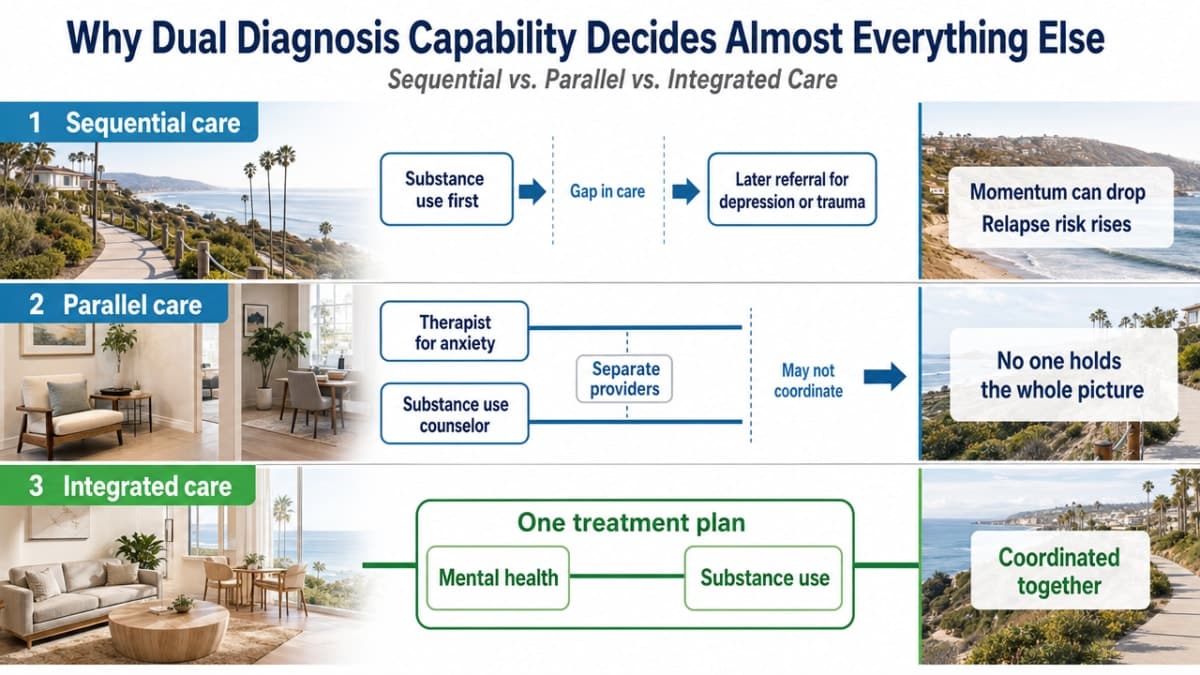
When you call around to drug rehab San Juan Capistrano CA programs, you’ll quickly notice that most of them say they “treat co-occurring disorders.” That phrase hides three very different models, and the difference matters more than any amenity on a brochure.
- Sequential care
- treats one condition first, then the other. You stabilize the substance use, then get referred out for depression or trauma work later. The gap between those two phases is where a lot of people lose momentum and relapse.
- Parallel care
- runs both at the same time, but through separate providers who may or may not talk to each other. You see a therapist for anxiety on Tuesday and a substance use counselor on Thursday, and nobody is holding the whole picture.
- Integrated care
- coordinates both inside one treatment plan, with one team. Screening, assessment, therapy, and medication decisions happen together, not in silos. SAMHSA describes a “no wrong door” approach: whether you walk in talking about panic attacks or about drinking, you get routinely screened for the other condition as well, so neither side of the picture gets missed 4.
For co-occurring conditions, integrated care is the preferred model because it stops treating your mental health and your substance use like they’re strangers who happen to live in the same body 3. When you’re vetting a drug rehab San Juan Capistrano CA option, ask directly: “Is the therapist treating my depression the same team treating my substance use, or are those handed off?” The answer tells you which of the three models you’re actually looking at.
What ‘Integrated’ Should Actually Look Like Inside a Program
Language is cheap. What you want to hear are specifics about how the program delivers integrated care day to day. SAMHSA’s TIP 42 advisory describes integrated treatment as routine screening for both conditions, coordinated assessment, a single treatment plan, and clinical staff who can address mental health and substance use together rather than in separate silos 2.
Translate that into questions you can ask the person on the phone:
- Does every person admitted get screened for both a mental health condition and a substance use disorder, no matter which symptom brought them in?
- Who writes the treatment plan, and does it name both the mental health diagnosis and the substance use diagnosis together?
- Is there a psychiatrist or psychiatric provider on the team who can evaluate medications for depression, anxiety, PTSD, bipolar, or ADHD alongside any medications for substance use?
- When you share something in group therapy about a mental health symptom, is the clinician trained to work with it, or will you be told “that’s for your outside therapist”?
- How do the therapy groups themselves address co-occurring patterns—trauma, mood, personality dynamics—not just substance use education?
A program built for dual diagnosis will answer these quickly and in plain language. If you hear a long pause or a pivot to amenities, that’s a signal. A good drug rehab San Juan Capistrano CA option should be able to describe its integrated model without reaching for a script 4.
The California-Specific Due-Diligence Checklist
DHCS Certification and What It Does (and Doesn’t) Prove
Before you book a tour or share insurance information, confirm one thing: the program is certified by the California Department of Health Care Services. DHCS has sole authority to certify and monitor outpatient substance use disorder programs in California, including those offering treatment, recovery, detoxification, or medication for addiction treatment 5. If a drug rehab San Juan Capistrano CA option can’t produce a current DHCS certification number when you ask, that’s a hard stop.
What certification does prove: the program meets California’s baseline regulatory requirements, submits to monitoring, and renews on a defined schedule. That’s not nothing. It means someone outside the facility is checking the work.
Insurance Verification and In-Network Status Without the Runaround
Insurance calls are their own kind of exhausting. You deserve clear answers, not three transfers and a callback that never comes. When you reach a drug rehab San Juan Capistrano CA program, ask whether they are in-network with your specific plan, not just your carrier. Many commercial carriers offer multiple product lines, and in-network status can differ by plan.
Ask the admissions team to run a verification of benefits in writing and to tell you, in plain language, what levels of care are covered, how many days or sessions are authorized, and what the renewal process looks like if you need to step up or step down. A program that treats verification as a routine part of intake will handle this quickly. One that gets evasive is telling you something important.
If you’re uninsured or your plan isn’t accepted, ask what referral pathways the program uses so you don’t lose a week bouncing between phone trees.
Questions to Ask a Drug Rehab San Juan Capistrano CA Program on the First Call
Keep this list next to you when you dial. You don’t need to ask every question in order, and you don’t need to apologize for asking. A program worth your time will respect the fact that you’re doing your homework.
- Certification: “What is your current DHCS certification number, and when does it renew?” 5
- Dual diagnosis screening: “Do you screen every person admitted for both a mental health condition and a substance use disorder, regardless of what brought them in?” 4
- Integrated treatment plan: “Will my treatment plan name both diagnoses together, and will the same clinical team address both?” 2
- Psychiatric services: “Is there a psychiatric provider on the team who can evaluate and manage medications for mental health conditions alongside any medications for substance use?”
- Medication coordination: “Can you coordinate FDA-approved medications for opioid or alcohol use disorder, and how do you handle benzodiazepine tapers?”
- Level of care: “Do you offer PHP, IOP, and evening IOP, and how do you decide which fits?”
- Aftercare: “What does continuing care look like after I step down, and who holds the plan?”
- Insurance: “Are you in-network with my specific plan, and can you verify benefits in writing today?”
- Language and scheduling: “What languages do your clinicians speak, and what are the actual session times?”
If a drug rehab San Juan Capistrano CA program answers these clearly and without defensiveness, you’ve found a team that can hold the full picture. That’s the bar.

Matching Level of Care to Real Life in South Orange County
Outpatient care in South Orange County usually comes in a few intensities, and the right drug rehab San Juan Capistrano CA fit depends on how much structure your week can actually hold without breaking the other things that keep you steady.
- Partial Hospitalization (PHP)
- is the most structured outpatient level, typically meeting for several hours on most weekdays. It’s a reasonable step down from a residential stay or a reasonable step up when weekly therapy isn’t enough and symptoms are escalating. You sleep at home, which matters for parents, caregivers, and anyone whose recovery depends on staying tethered to their own bed.
- Intensive Outpatient (IOP)
- meets several days a week for shorter sessions. It leaves room for part-time work, school, or childcare while still giving you a clinical container most days of the week.
- Evening IOP
- is the quiet workhorse for people in San Juan Capistrano, Dana Point, San Clemente, and Mission Viejo who cannot step away from a 9-to-5 or a swing shift. Sessions start after work, which makes the difference between starting treatment this month and putting it off again.
Ask any drug rehab San Juan Capistrano CA program how they decide between levels, and whether they can step you up or down inside the same team without starting over with new clinicians 2. Continuity inside one program beats a clean referral to a stranger almost every time.
Substance-Specific Questions Worth Asking
Opioids: Methadone, Buprenorphine, Naltrexone, and Withdrawal Support
If opioids are part of the picture—heroin, fentanyl, oxycodone, prescription painkillers—medication plays a central role. NIDA states that medication should be the first line of treatment for opioid addictions, usually combined with behavioral therapy or counseling 7. A drug rehab San Juan Capistrano CA program that still frames medication as “a crutch” or “not real recovery” is working from an outdated playbook.
Three FDA-approved medications anchor opioid treatment: methadone, buprenorphine, and naltrexone. Lofexidine can help ease acute withdrawal symptoms during the first days 6. Each works differently, and the right choice depends on your history, your current use, pregnancy status, co-occurring conditions, and what’s realistic for your week.
Here’s a quick comparison of FDA-approved medications across the four substance categories this section covers:
- Opioids: methadone, buprenorphine, naltrexone; lofexidine for withdrawal 6
- Alcohol: naltrexone, acamprosate, disulfiram 8
- Stimulants: no FDA-approved medications; contingency management is the leading evidence-based behavioral intervention 9
- Benzodiazepines: no FDA-approved “treatment” medication; individualized tapering under medical supervision, never abrupt discontinuation 10
Ask any drug rehab San Juan Capistrano CA program whether a prescriber on their team can start or coordinate these medications, or whether you’ll be referred out and left to coordinate it yourself.
Alcohol: Medical Evaluation and Three FDA-Approved Medications
Alcohol gets treated casually in a lot of programs because it’s legal and familiar. That’s a mistake. Withdrawal can be medically serious, and the medications that help with long-term recovery are underused.
NIAAA identifies three FDA-approved medications for alcohol use disorder: naltrexone, acamprosate, and disulfiram. They are nonaddictive and can be used alone or with counseling 8. Each one works on a different part of the problem—cravings, post-acute symptoms, or deterrent effect—and choosing between them is a clinical conversation, not a coin flip.
When you call a drug rehab San Juan Capistrano CA program about alcohol, ask three things: Will I get a medical evaluation to assess withdrawal risk and liver or kidney considerations? Can your team prescribe or coordinate naltrexone, acamprosate, or disulfiram if they’re appropriate for me? And how do you combine medication with counseling, rather than treating them as either/or?
If the answer to any of those is a shrug, keep looking.
Stimulants: Why Contingency Management Matters When No Medication Is Approved
Methamphetamine and cocaine put you in a different spot. There is no FDA-approved medication specifically for stimulant use disorder, which can feel discouraging when every other substance category has a pill-based option on the table 9. The absence of medication doesn’t mean the absence of effective treatment—it means the center of gravity shifts to behavioral care.
SAMHSA describes contingency management as particularly effective for stimulant use disorders and calls it a potentially life-saving intervention 9. The model is straightforward: you receive structured, documented reinforcement—often small incentives—for meeting specific treatment goals like attendance or negative drug screens. It’s not a bribe. It’s a well-studied way of helping the brain’s reward system re-learn what to pay attention to.
When you’re vetting a drug rehab San Juan Capistrano CA option for a stimulant pattern, ask whether contingency management is formally part of the program, how incentives are structured and tracked, and what other behavioral therapies—CBT, motivational interviewing—round out the plan. Any psychiatric medications for co-occurring depression, ADHD, or anxiety should be handled by the same team.
Benzodiazepines: Individualized Tapering, Not Abrupt Stops
Benzodiazepines deserve their own conversation because stopping them wrong can hurt you.
The FDA updated boxed-warning language to emphasize patient-specific taper plans, monitoring, and support 10. In plain terms: there’s no universal schedule. The pace depends on how long you’ve been taking the medication, your dose, your medical history, past withdrawal experience, and how stable things are around you right now.
A drug rehab San Juan Capistrano CA program that handles benzodiazepines well will say so plainly. Ask whether a prescriber will design and monitor a taper, how often you’ll be seen during the taper, what the plan is if symptoms escalate, and how they’ll treat the underlying anxiety or trauma that may have led to the prescription in the first place. A program that promises a fast detox from benzodiazepines is not the one you want.

Continuity of Care After the Program Ends
The weeks after you step down from a structured program are where a lot of hard-won progress gets tested. A drug rehab San Juan Capistrano CA option worth your trust will treat aftercare as part of the treatment plan, not an afterthought printed on your discharge paperwork.
Ask what continuing care actually includes. A real aftercare plan names your ongoing clinician by role, schedules the first follow-up before you leave, continues medication management without a gap, and keeps the mental health side of your care connected to the substance use side 2. If you’ve been stabilized on buprenorphine or naltrexone, someone on the team should hold that prescription forward or hand it off with a confirmed appointment, not a phone number.
Alumni groups, peer support, family sessions, and a clear plan for what to do during a hard week all matter. So does step-up access: if symptoms escalate, can you return to a higher level of care with the same team instead of starting over? Continuity means the people who know your story stay in the story.
Culturally Responsive Care, Language Access, and Scheduling in San Juan Capistrano
San Juan Capistrano is a community where many households speak more than one language at home and where residents span a wide range of ages and backgrounds. Those details matter when you’re choosing a drug rehab San Juan Capistrano CA option, because a program that doesn’t fit your language, your work shift, or your caregiving life is a program you won’t finish.
Ask whether clinicians and medical staff speak Spanish, not just the front desk. Ask whether family sessions can be held in the language your parents or spouse actually use at home. For older adults juggling retirement, grief, or chronic pain alongside substance use, ask how the program adapts group content so it doesn’t feel built for someone 30 years younger.
Scheduling is its own access issue. Daytime PHP may be impossible if you’re the only driver in the house. Evening IOP opens the door for restaurant workers, nurses on rotating shifts, and parents handling school pickup. A drug rehab San Juan Capistrano CA program that offers real evening hours, telehealth check-ins for medication management, and flexible family session times is treating access as part of clinical care, not a courtesy.
Red Flags That Should End the Phone Call
Some answers tell you everything you need to know. If a drug rehab San Juan Capistrano CA program hits one of these on the first call, you can politely end the conversation and move on without guilt.
- They can’t produce a current DHCS certification number. This is a California baseline, not an upgrade 5.
- They promise a fast benzodiazepine detox or suggest you can “just stop.” The FDA is clear that abrupt discontinuation can cause serious withdrawal reactions, including seizures 10.
- They dismiss medication for opioid use disorder as a crutch or insist on medication-free care for everyone. That contradicts current federal guidance 7.
- They can’t say who treats the mental health side. If no one on the team addresses depression, PTSD, or anxiety alongside substance use, you’re being offered parallel care at best 4.
- They pressure you to commit before verifying insurance in writing or before you’ve toured, met a clinician, or asked questions.
- They talk amenities before they talk clinical model. Pools and chef-prepared meals don’t treat co-occurring conditions.
Trusting these signals isn’t being picky. It’s being responsible with a decision that matters.
A Humane Next Step for Drug Rehab San Juan Capistrano CA
You don’t have to solve this tonight. Pick one program, make one call tomorrow, and run through three or four of the questions from earlier. That’s enough for day one.
If the first drug rehab San Juan Capistrano CA call doesn’t land, that’s information, not failure. Try another. The right fit is a program that screens for both sides of the picture, holds DHCS certification, coordinates medication when it’s warranted, and keeps the same team with you as you step down 2, 5.
When you’re ready to talk with a local dual diagnosis team that works this way, 449 Recovery is here to answer the questions on your list.
Frequently Asked Questions
How do I know if a drug rehab in San Juan Capistrano, CA can actually treat both mental health and substance use at the same time?
Ask who writes the treatment plan and whether it names both diagnoses together. Integrated programs screen every person for both conditions at intake, assign one clinical team, and coordinate therapy with any psychiatric medications. If you hear “we’ll refer you out for the mental health piece,” that’s parallel care, not integrated care 4.
What does DHCS certification mean for an outpatient program in California?
The California Department of Health Care Services has sole authority to certify and monitor outpatient substance use disorder programs, including those offering treatment, detoxification, or medication for addiction treatment 5. Certification confirms the program meets state baseline requirements and submits to monitoring. It’s a floor, not a guarantee of clinical quality or dual diagnosis depth.
Will my insurance cover drug rehab in San Juan Capistrano, CA?
Many programs work with a range of commercial carriers, but in-network status can vary by specific plan. Ask admissions to run a verification of benefits in writing and tell you which levels of care are covered, how many sessions are authorized, and the renewal process.
What medications should a program be able to coordinate for opioid, alcohol, or benzodiazepine use?
For opioid use disorder, the FDA-approved options are methadone, buprenorphine, and naltrexone, with lofexidine for withdrawal 6. For alcohol use disorder, naltrexone, acamprosate, and disulfiram are FDA-approved and nonaddictive 8. Benzodiazepines require an individualized taper under medical supervision, never abrupt discontinuation, because rapid reduction can cause serious withdrawal reactions including seizures 10.
What questions should I ask on the first phone call with a drug rehab San Juan Capistrano CA program?
Ask for the current DHCS certification number, whether every person is screened for both mental health and substance use, who holds the integrated treatment plan, whether a psychiatric provider is on the team, how they coordinate medications, which levels of care they offer, what aftercare looks like, and whether they are in-network with your specific plan 2, 5.
What are the warning signs that a program isn’t the right fit?
Watch for no verifiable DHCS certification, promises of a fast benzodiazepine detox, dismissing medication for opioid use disorder as a crutch, no clear answer about who treats the mental health side, pressure to commit before written insurance verification, and heavy focus on amenities before clinical model. Any one of these is reason to keep looking 5, 10.
References
- Results from the 2024 National Survey on Drug Use and Health. https://www.samhsa.gov/data/sites/default/files/reports/rpt56287/2024-nsduh-annual-national/2024-nsduh-annual-national-html-071425-edited/2024-nsduh-annual-national.htm
- Advisory: Substance Use Disorder Treatment for People with Co-Occurring Disorders. https://www.samhsa.gov/resource/ebp/advisory-substance-use-disorder-treatment-people-co-occurring-disorders-based-tip-42
- Co-Occurring Disorders and Other Health Conditions. https://www.samhsa.gov/substance-use/treatment/co-occurring-disorders
- SAMHSA – Substance Abuse and Mental Health Services Administration. https://www.samhsa.gov/mental-health/serious-mental-illness/co-occurring-disorders
- Program Certification. https://www.dhcs.ca.gov/providers-partners/program-certification/
- Medications for Opioid Use Disorder. https://nida.nih.gov/research-topics/medications-opioid-use-disorder
- Treatment and Recovery. https://nida.nih.gov/publications/drugs-brains-behavior-science-addiction/treatment-recovery
- Treatment for Alcohol Problems: Finding and Getting Help. https://www.niaaa.nih.gov/publications/brochures-and-fact-sheets/treatment-alcohol-problems-finding-and-getting-help
- Advisory: Contingency Management for the Treatment of Substance Use Disorders. https://library.samhsa.gov/sites/default/files/contingency-management-advisory-pep24-06-001.pdf
- FDA requiring Boxed Warning updated to improve safe use of benzodiazepine drug class. https://www.fda.gov/drugs/drug-safety-and-availability/fda-requiring-boxed-warning-updated-improve-safe-use-benzodiazepine-drug-class