Key Takeaways
- Sober living homes in Orange County provide structured, substance-free housing after inpatient care, but they are not licensed treatment—clinical therapy and medication management happen through separate outpatient providers.
- Orange County zoning requires 1,000 feet between recovery residences and a Group Home Permit for homes with seven or more residents, so verify permits and Sheriff’s certification before signing anything 1.
- Length of stay matters more than most people expect; residents who stayed six months to a year showed stronger gains in sobriety, employment, and mental health across 18 months of follow-up 5.
- Compare houses on written rules, testing procedures, relapse response, outpatient coordination, and resident access before choosing—vague answers or one-strike removal policies signal a house to keep looking past.
The first ninety days after inpatient care in Orange County
Leaving inpatient treatment can feel like the ground shifts under you. One day the schedule is decided for you—meals, groups, meds, lights out. The next day you are standing in your own kitchen at 7 a.m. wondering what to do with your hands. That gap is real, and you are not weak for feeling it.
The first ninety days after discharge are where most of the hard work happens. Research on continuing care shows that structured support after intensive treatment—things like recovery housing, outpatient therapy, and mutual-help groups—is tied to better long-term outcomes and lower relapse risk 6. That is why so many people stepping down from residential care in south county, from Mission Viejo to Costa Mesa to Anaheim, look at sober living Orange County CA options before heading straight home.
A good sober living Orange County CA residence gives you a soft place to land. You keep the drug- and alcohol-free environment you got used to in treatment, but you also start rebuilding regular life: going to a morning meeting, cooking one meal, calling your sponsor, showing up to a PHP or IOP session that afternoon. Small, unglamorous wins.
This guide walks you through what sober living Orange County CA actually looks like on the ground here—what the county rules require, how to tell a solid house from a shaky one, and how to layer clinical care on top so the plan holds past day ninety. You do not have to figure this out alone.
What sober living actually is (and what it is not)
Sober living is a house. Not a hospital, not a rehab, not a lockdown program. It is a shared residence where everyone living there has agreed to stay off alcohol and other drugs, follow some basic house rules, and support each other’s recovery. California law defines a recovery residence as primary housing for people seeking a cooperative living arrangement that supports recovery from a substance use disorder 10. That word primary matters. It is your home while you live there, not a bed you rent by the hour.
Here is what sober living Orange County CA does offer:
- A drug- and alcohol-free environment
- Peer accountability
- Random testing
- A curfew or check-in system
- Often help getting to meetings, work, or outpatient sessions
Some houses have a manager on-site. Some organize house meetings once a week. Rules vary, but the frame is the same—you live there, you contribute, you stay sober.
Here is what it is not. It is not licensed treatment. Sober living homes do not provide therapy, medication management, or medical detox. State law draws a clear line: if a residence starts offering services that require a treatment license, the Department of Health Care Services can step in 11. That line protects you. It means the house you live in and the clinical care you receive are two separate things, run by two separate teams, held to two separate standards.
Think of sober living Orange County CA as the roof over your head while your treatment team handles the clinical work. Both matter. Neither replaces the other.
Why sober living works after inpatient care
Inpatient care ends before recovery does. That is not a failure of treatment—it is the design. Residential programs are built to stabilize you, break the physical hold of a substance, and start the psychological work. What they cannot do is walk with you into your first Tuesday night alone. Sober living Orange County CA fills that gap by keeping the structure going while you slowly take back the parts of your life that used to be automatic.
The clearest research on this comes from Jason and colleagues, who followed sober living residents for 18 months. Residents showed meaningful gains across four areas:
- Less alcohol and drug use
- More employment
- Fewer arrests
- Lower psychiatric symptoms 5
The scope matters here. Residents chose to enter sober living rather than being randomly assigned, so the study cannot prove the housing alone caused the gains. What it does show is that people who commit to this kind of environment tend to hold onto the progress they made in treatment—and often build on it.
Length of stay is the piece most people underestimate. The residents who did best were not the ones who stayed a few weeks. They were the ones who stayed long enough for a real routine to form: a job or school schedule, a home group meeting they never miss, a roommate whose name they know. Ninety days is a floor, not a goal. Six months to a year is closer to where the research points 5.
The everyday version of this is smaller than the studies make it sound. It is having someone notice when you skip breakfast three days in a row. It is a house meeting on Sunday night where you say out loud that Thursday was hard. It is not needing to explain why you cannot go to your cousin’s wedding open bar this year, because your housemates already get it. That kind of quiet accountability is what keeps the gains from inpatient care from slipping through your fingers.
The Orange County rules that shape your options
County zoning and the 1,000-foot separation rule
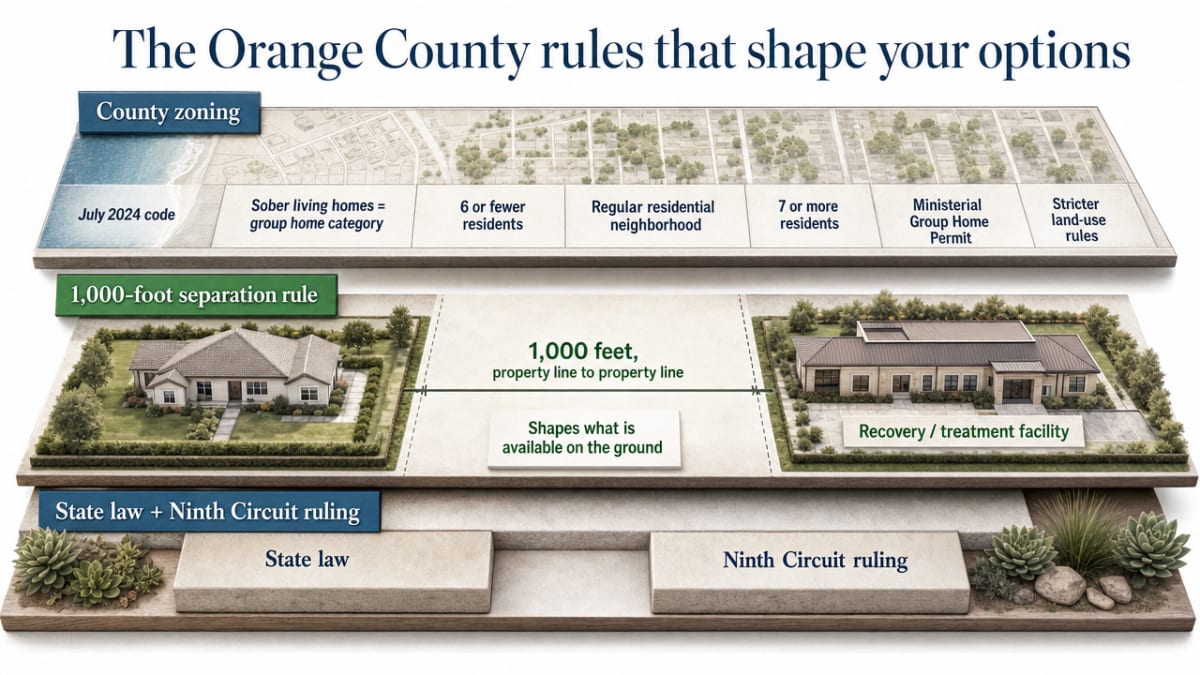
Before you tour a single house, it helps to know what the county actually requires of the people running it. Orange County’s zoning code, adopted in July 2024, treats sober living homes as a specific category of group home. Any home with six or fewer residents can operate in a regular residential neighborhood the same as any other household. Homes with seven or more residents need a ministerial Group Home Permit and have to meet stricter land-use rules 1.
The rule that shapes what you will find on the ground is the separation requirement. The code states that there must be 1,000 feet of separation, measured from property lines, between any two sober living homes, or between a sober living home and an alcoholism or drug abuse recovery/treatment facility 1. In practice, this is why you rarely see two sober living Orange County CA residences on the same block. The rule is meant to prevent over-concentration in any one neighborhood.
For you as a resident, this has two effects worth knowing. First, a permitted house has been reviewed against county standards, which is a small but real signal of legitimacy. Second, the geography of sober living Orange County CA options is spread across cities like Mission Viejo, Costa Mesa, Anaheim, Santa Ana, and Huntington Beach rather than clustered in one corridor. When you compare houses, ask whether the home has its Group Home Permit on file. A house that cannot answer that question straight is a house you should keep looking past.
What the Ninth Circuit ruling means for you
There is a piece of legal history worth understanding, because it affects how confident you can be that the sober living Orange County CA home you choose is operating on solid ground. In late 2024, the Ninth Circuit Court of Appeals upheld Costa Mesa’s sober living home ordinance, which had been challenged on fair housing grounds. The County of Orange ordinance is modeled after Costa Mesa’s, so the ruling extends to unincorporated areas of the county as well 3.
What that means for you is simple. The regulatory framework you are dealing with is settled law, not a work in progress that might get thrown out next year. Homes that follow county rules are on stable footing. Homes that ignore the rules cannot hide behind an argument that the rules themselves are illegitimate.
It also means the county is likely to keep enforcing standards. That is good for residents. It shifts the incentive for house operators toward doing things the right way—permits, house rules, testing, coordination with treatment providers—rather than running loose homes that put you at risk. When someone tells you a sober living Orange County CA home is “exempt” or “above the rules,” that is now a warning sign, not a selling point.
What state law (SB 1334 and SB 406) means for residents
Two California laws shape the everyday experience of living in a recovery residence, and they matter more to you than they sound. SB 1334 defines a recovery residence as primary housing for individuals seeking a cooperative living arrangement that supports recovery from a substance use disorder, and it authorizes local jurisdictions to require permits and spacing for these homes 10. The word primary is the one to hold onto. Legally, this is your home while you live there. You have tenant-like standing, not the status of a hotel guest.
SB 406 draws the other important line. It requires the Department of Health Care Services to act against unlicensed facilities that hold themselves out as recovery residences while actually providing services that need a treatment license—things like therapy sessions, medication management, or clinical assessments 11. If a sober living Orange County CA home is quietly offering “treatment” without a license, the state has authority to shut that down.
How to choose a residence: a quality checklist
Touring a sober living Orange County CA home can feel like touring an apartment while also interviewing for a job. You are anxious, the manager is friendly, and you may leave without asking the questions that actually matter. So write them down before you go. The Orange County Adult Alcohol and Drug Sober Living Facilities Certification Program lays out voluntary standards around staff qualifications, inspection guidelines, background checks, and house rules that promote recovery and public safety 2. You can use those same criteria as your personal screening tool.
Here is what to ask, and what a solid answer sounds like.
Is this home certified through the Orange County Sheriff’s program, and can I see the paperwork? Certification is voluntary, so a “no” is not automatic disqualification—but a house that is certified has signed up for outside review 8. A vague answer is a flag.
Does the home have its Group Home Permit if it houses seven or more residents? A legitimate operator will show it to you without hesitation.
Who runs the house day-to-day, and what training do they have? Ask about the house manager’s own recovery time, any certifications, and how they handle a crisis at 2 a.m.
What are the house rules, in writing? You want to see them on paper before you sign anything. Curfew, chores, meeting requirements, guest policies, testing procedures—all of it.
How does drug and alcohol testing work? Random, observed, and consistent are the words you want to hear.
What is the policy if someone uses again? A thoughtful answer names both accountability and a plan to get the person to a higher level of care, not just a suitcase on the curb.
How does the home coordinate with outpatient treatment? If you are heading to PHP or IOP, ask whether the house has worked with your clinical team before and how transportation is handled.
What does a normal week look like here? House meetings, shared meals, chore rotation, curfew times. You are trying to picture yourself living there on a Wednesday, not just standing in the living room on a Saturday tour.
Can I talk to a current resident, privately? The answer should be yes. The house that will not let you talk to residents alone is telling you something.
What happens when I am ready to move out? A good sober living Orange County CA home has a plan for transitioning out, not just moving in.
You do not have to ask all ten questions in one breath. Bring the list. Take notes. Trust your gut on the small things—how the kitchen looks, whether the people you meet seem present, whether the manager answers questions or dodges them. You are choosing where you will wake up every morning for the next several months. That deserves careful attention.
Pairing sober living with PHP or IOP for dual diagnosis care
The residence gives you a stable place to sleep and a community that gets it. The clinical work happens somewhere else. If you are managing a substance use disorder alongside anxiety, depression, PTSD, ADHD, bipolar disorder, or another mental health condition, that clinical piece is not optional. People with substance use disorders often have co-occurring mental health conditions, and integrated treatment that addresses both is tied to better outcomes than treating either one in isolation 7. Sober living Orange County CA works as a step-down because it holds the daily structure while a licensed outpatient team handles the therapy, medication, and diagnostic work.
For most people leaving inpatient care, the next clinical level is either a Partial Hospitalization Program (PHP) or an Intensive Outpatient Program (IOP). PHP usually means five or six hours of programming, five days a week. IOP is lighter—often three hours a day, three to five days a week, sometimes in the evening so you can hold a job. Both include individual therapy, group work, psychiatric care, and medication management. Neither includes a bed at night. That is where the residence comes in.
A workable weekday might look like this. You wake up in your sober living Orange County CA home, ride-share or catch a ride with a housemate to your PHP session in Mission Viejo, spend the morning in DBT and process groups, meet with your psychiatrist that afternoon about your medication, and get back to the house in time for dinner and a house meeting. Two treatment teams, one recovery plan. The house manager knows you have an appointment Thursday at 2. Your therapist knows you live in a structured environment where use gets caught quickly. That kind of coordination is what makes dual diagnosis care actually work.
When you tour a sober living Orange County CA home, ask specifically how they communicate with outpatient providers. A house that has worked with local PHP and IOP programs before knows how to schedule around your groups, how to handle medication storage safely, and how to loop your clinical team in if something shifts. That is the kind of quiet infrastructure you want under you during the first year.
House rules, drug testing, and what happens if you use again
Every sober living Orange County CA home has rules, and the rules are not there to punish you. They are there to make the environment predictable, which is exactly what your nervous system needs right now. A typical house will have a curfew, chore rotations, mandatory attendance at house meetings, guest restrictions, and a testing schedule. You will also be expected to be working, in school, in outpatient treatment, or actively looking for one of the above. Idle time is the enemy in early recovery, and good houses know it.
Drug and alcohol testing is standard. Expect randomness—no set day of the week—and expect observed collection. That can feel invasive the first time. It is also one of the reasons the environment stays safe for everyone in it, including you.
Ask about this directly on your tour. A thoughtful sober living Orange County CA operator will describe a graduated response—an honest conversation, a higher level of care referral, sometimes a short stay elsewhere while you stabilize, and a path back if that fits. If the answer is “one strike and you’re out,” ask what happens to the person that night. Where do they go. Who calls them the next morning. Those answers tell you whether the house sees you as a resident or as a bed.
Building the wider support system: peers, family, and daily rhythm
The residence is one layer. The clinical team is another. The rest of your support system is the part you build with your own hands, and it is often what carries you through the Tuesday nights that inpatient care and sober living Orange County CA cannot cover on their own.
Peer support is the closest thing to a load-bearing wall here. That might mean a 12-step home group where the same faces show up every week, a SMART Recovery meeting if that language fits you better, or an alumni group from your inpatient program. What matters is repetition. Going once is a nice story. Going every Thursday for a year is what changes your brain. Housemates count too—the person you make coffee with at 6 a.m. sees things your therapist will never see.
Family is complicated, and you do not have to pretend otherwise. Some families are ready to help right away. Some need time, or family therapy, or clear boundaries before they can be safe for you. A good sober living Orange County CA home will support family visits and encourage family involvement in your outpatient work without forcing contact you are not ready for. If a relationship is not healthy yet, that is information, not failure.
Daily rhythm is the quiet piece that ties it all together. Wake up at the same time. Eat something. Move your body, even a short walk in the Mission Viejo hills or along the beach. Show up to your PHP or IOP session. Call one person. Go to a meeting. Sleep. That is enough for today. Small, repeatable actions are what build the year, and each one you keep is a win worth naming.
When you are ready to make the call
You do not have to have the whole year figured out today. You just have to make the next call. If you are still in inpatient care, ask your case manager to help you tour two or three sober living Orange County CA homes before discharge, and ask them to connect the house with your outpatient team so the handoff is not left to you alone.
If you are already home and the walls are closing in, that is also a fine place to start. A good sober living Orange County CA residence paired with PHP or IOP can steady the ground under you within a week. 449 Recovery in Mission Viejo can help you sort out the clinical piece and coordinate with a residence that fits your situation. One phone call. That is enough for today.
Frequently Asked Questions
How long should I plan to stay in sober living Orange County CA?
Plan on at least ninety days, and give yourself permission to stay six months to a year if the environment is working. Research on sober living outcomes found that residents who stayed longer showed stronger gains in substance use, employment, and psychiatric symptoms over 18 months of follow-up 5. Time is the ingredient most people underestimate. There is no medal for leaving early.
Can I stay in sober living Orange County CA while attending PHP or IOP?
Yes, and for many people that pairing is the whole point. The residence provides the drug- and alcohol-free environment and daily structure. Your PHP or IOP handles therapy, groups, and medication management. Continuing care that combines recovery housing with outpatient treatment is tied to better long-term outcomes than treatment that stops at discharge 6. Ask the house how they coordinate with outpatient teams before you move in.
What happens if I relapse while living in a sober living home?
It depends on the house. California’s 2025 Recovery Housing guidance states that for programs receiving public funding, relapse cannot be the sole reason for removal, and providers must offer relapse support and help connect you to alternative housing if a discharge is needed 4. Private houses vary. Ask directly during your tour what the response looks like, and listen for a plan rather than a one-strike rule.
How do I know if a sober living Orange County CA home meets quality standards?
Start with the Orange County Sheriff’s voluntary certification program, which sets standards around staff qualifications, background checks, inspections, and house rules that support recovery and public safety 2. Ask if the home is certified and request the paperwork. Also ask whether homes with seven or more residents hold their Group Home Permit. Legitimate operators show documents without hesitation. Vague answers tell you what you need to know.
Does sober living Orange County CA work for people with co-occurring mental health conditions?
It can, when the residence is paired with integrated dual diagnosis care. People with substance use disorders often have co-occurring mental health conditions, and treatment that addresses both together is associated with better outcomes 7. The house is not treatment. It holds your daily structure while a licensed outpatient team handles therapy and medication. Ask whether the residence has coordinated with dual diagnosis PHP or IOP programs before.
Is sober living the same as a licensed treatment facility?
No, and that distinction protects you. A recovery residence is defined in state law as primary housing for people in a cooperative living arrangement that supports recovery 10. It does not provide therapy, medication management, or clinical assessments. If a house offers services that require a treatment license, the Department of Health Care Services has authority to act 11. Housing and clinical care stay separate on purpose.
References
- Adopted Orange County Zoning Code (2024) – Group Homes and Sober Living Homes. https://pwds.oc.gov/sites/ocpwocds/files/2024-08/Adopted%20Orange%20County%20Zoning%20Code%207-25-24.pdf
- Orange County Adult Alcohol and Drug Sober Living Facilities Certification Program Guidelines. https://ocsheriff.gov/sites/ocsd/files/import/data/files/7377.pdf
- OC Supervisor Releases Statement Following 9th Circuit Court of Appeals Ruling on Costa Mesa Sober Living Home Ordinance. https://bos5.oc.gov/pr-9th-circuit-sober-living-home-ordinance
- Implementing Recovery Housing Programs in Alignment with Housing First. https://www.gov.ca.gov/wp-content/uploads/2025/10/FINAL-Recovery-Housing-Guidance.pdf
- What Did We Learn from Our Study on Sober Living Houses?. https://www.ncbi.nlm.nih.gov/pmc/articles/PMC3057870/
- NIDA: Principles of Drug Addiction Treatment – Continuing Care. https://www.nida.nih.gov/publications/research-reports/substance-use-disorder-treatment/continuing-care
- NIMH: Substance Use and Mental Health. https://www.nimh.nih.gov/health/topics/substance-use-and-mental-health
- OC Adult Alcohol & Drug Sober Living Facilities Certification Program. https://ocsheriff.gov/commands-divisions/custody-inmate-services-command/inmate-services/sober-living-facilities
- What did we learn from our study on sober living houses and where do we go from here?. https://pubmed.ncbi.nlm.nih.gov/20689601/
- California Senate Bill 1334 – Recovery Residences. https://leginfo.legislature.ca.gov/faces/billNavClient.xhtml?bill_id=2021SB1334
- California Senate Bill 406 – Recovery Residence Oversight. https://leginfo.legislature.ca.gov/faces/billNavClient.xhtml?bill_id=2019SB406
- Orange County Supervisor Katrina Foley Announces State Legislation to Address Sober Living Home Issues. https://bos5.oc.gov/pr-sb1334-feb22