Key Takeaways
- Orange County offers deeper outpatient capacity than most California counties, with fentanyl-related deaths dropping from 613 in 2023 to 407 in 2024, a five-year low 16.
- Co-occurring mental health and substance use conditions feed each other, so an OC rehab worth choosing treats both from intake forward with one integrated clinical team 7.
- PHP, IOP, and evening IOP differ in hours and structure, and quality programs weave CBT, DBT, MI, EMDR, and medication-supported care into a single plan.
- Verify any OC rehab through DHCS licensing directories, ask who manages psychiatric medication on staff, and treat in-network insurance status as an accountability signal 14, 13.
If You’re Reading This, Something’s Already Shifted
Something brought you here. Maybe it was a long night, a hard conversation, a moment when you looked at the person you love (or the person in the mirror) and thought, this can’t keep going. Whatever it was, you opened a tab and typed in oc rehab. That’s not nothing. That’s a small, real move toward a different week than the one you just had.
You don’t need to have it figured out yet. Most people searching for an oc rehab don’t. They’re tired, scared, and trying to sort out whether outpatient care is even a real option when both mental health and substance use are tangled together. It is. And in Orange County, you have more local choices than most people realize, including programs built specifically for co-occurring conditions.
This guide is written for you, not for someone shopping vendors. You’ll get a clear picture of what serious outpatient treatment actually looks like, how to tell a good oc rehab from a marketing storefront, and what to do this week if waiting another month isn’t safe. Take it one section at a time.
The Orange County Picture Right Now
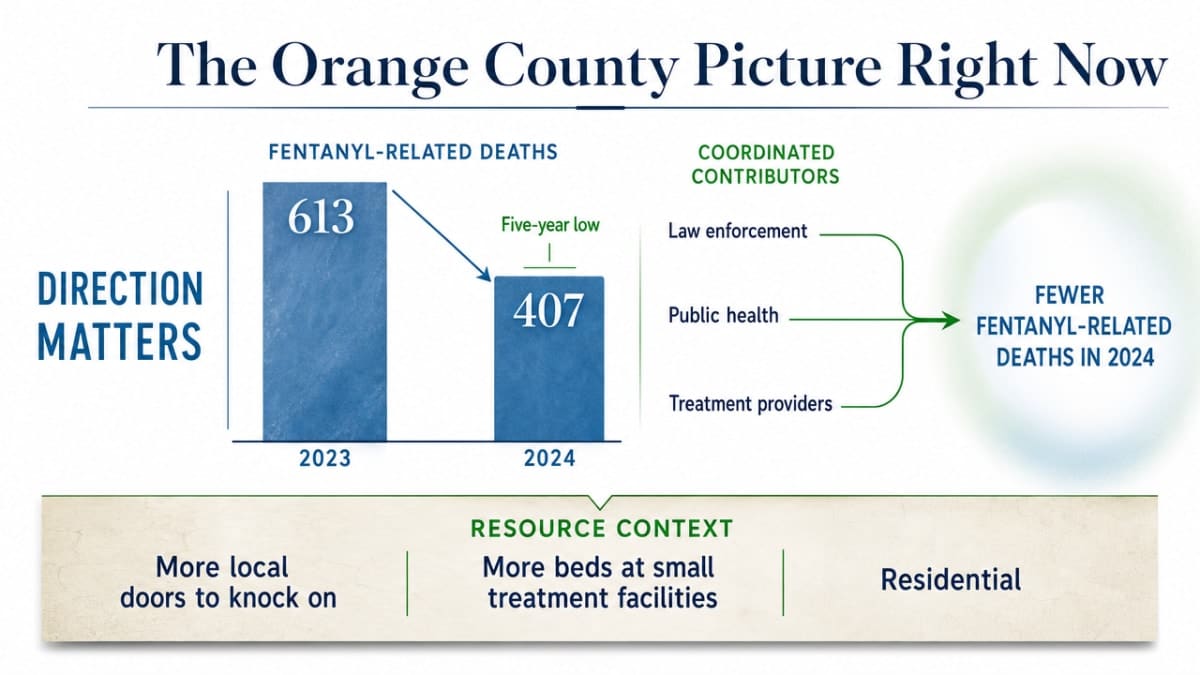
Here’s something worth holding onto before you read further: Orange County saw fentanyl-related deaths drop from 613 in 2023 to 407 in 2024, a five-year low 16. That’s still 407 people, and behind each number is a family that lost someone. But the direction matters. It means coordinated work between law enforcement, public health, and treatment providers is starting to show up in the data. It means the landscape you’re stepping into is not the same one your neighbor faced two years ago.
You’re also stepping into a county that’s better resourced than most. California’s State Auditor noted that Orange County has more beds at small treatment facilities per 10,000 residents than several other California counties 15. Translated out of audit language: there are more local doors to knock on here than in much of the state. That includes residential programs, but more importantly for many people, it includes a deep bench of outpatient and dual-diagnosis-capable oc rehab options that let you sleep at home and keep your job.
The regulatory backbone matters too. The California Department of Health Care Services licenses and certifies treatment facilities, maintains public directories, and runs a complaint system you can actually use if something feels off 3, 14. Every county, including Orange, also runs a 24/7 SUD access line that can screen you and route you toward an appropriate level of care, including Drug Medi-Cal services 1. None of this means picking an oc rehab is simple. It means the scaffolding is there. The encouraging part of the local picture isn’t that the problem is solved. It’s that the trend lines, the capacity, and the oversight are pointed in a direction that gives you something real to work with.
Why Treating Addiction and Mental Health Separately Fails
What Co-Occurring Really Looks Like Day to Day
Co-occurring isn’t a diagnosis you carry around on paper. It’s the Tuesday afternoon where your anxiety spikes hard enough that a drink at 3 p.m. feels like the only off-switch you have. It’s the depression that flattens you so completely that the only thing strong enough to push back is the substance you swore you’d stop using last weekend. It’s the trauma response that surfaces in traffic on the 5 and the prescription you’ve been taking more of than your bottle says.
If any of that sounds familiar, you’re not weak and you’re not failing. You’re describing what clinicians mean by co-occurring disorders: a mental health condition and a substance use disorder running in parallel, each one feeding the other. The anxiety drives the drinking. The drinking wrecks the sleep. The wrecked sleep cranks the anxiety. By the time you reach for help, you can’t tell which condition started the spiral, and honestly, it doesn’t matter much for what comes next.
What matters is that a thoughtful oc rehab will see both at once. Not the substance first, then maybe the mental health later if there’s time. Both. From intake forward. That’s the difference between a program that treats a symptom and one that treats you.
Integrated Care as the Clinical Standard
For decades, the system asked people to pick a door. The mental health door treated the depression but sent you elsewhere for the drinking. The addiction door treated the substance use but told you to come back for your bipolar diagnosis after you got sober. People fell through the gap between those two doors constantly, and many didn’t come back.
The research caught up. A peer-reviewed review of integrated treatment for co-occurring disorders concluded that addressing mental health and substance use concurrently is more effective than non-integrated approaches for many outcomes among individuals with both conditions 7. In plain terms: one team, one treatment plan, one set of clinicians who actually talk to each other about you, beats two parallel programs that don’t.
In practice, integrated care at a quality oc rehab looks like a psychiatrist who can manage your bipolar medication while a therapist runs DBT skills groups three afternoons a week, while a case manager helps you sort out the prior authorization. Nobody hands you off mid-week. Nobody tells you to come back when you’re more stable, because the program is built to work with you exactly as unstable as you are right now.
What a Serious Outpatient Week Actually Looks Like
PHP, IOP, and Evening IOP: The Real Differences
The acronyms hide what’s actually different. Here’s the plain version.
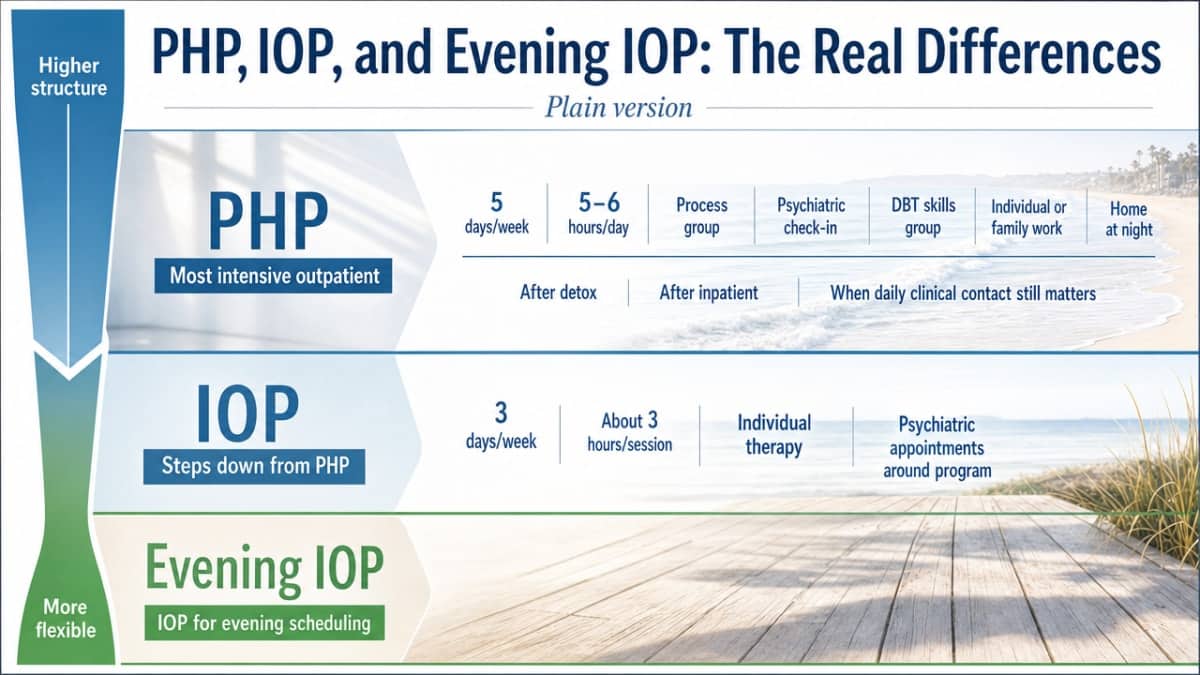
A Partial Hospitalization Program (PHP) is the most intensive outpatient level you can get without sleeping at a facility. You’re typically there five days a week, roughly five to six hours a day. Mornings might be a process group, then a psychiatric check-in, then a DBT skills group after lunch, then individual therapy or family work later in the afternoon. You go home at night. PHP is where most people land when they’ve just finished detox, just left an inpatient stay, or when the people around them aren’t sure it’s safe to drop below daily clinical contact yet.
An Intensive Outpatient Program (IOP) steps down from there. You’re usually in three days a week for about three hours per session, plus individual therapy and psychiatric appointments scheduled around that. IOP is built for people who are stable enough to spend more of the week back in their own life but still need real clinical structure several times a week.
Evening IOP exists because not everyone can disappear from work at 1 p.m. on a Tuesday. Same clinical intensity, same evidence-based groups, just scheduled after the workday ends. For a parent, a teacher, a nurse on day shift, an evening track at an oc rehab is often the difference between getting treatment and pretending you’re fine for another six months.
The Therapies, in Plain Language
If someone hands you a brochure full of acronyms, ask what each one actually does on a Wednesday afternoon. Here’s what to expect from a serious oc rehab.
CBT (Cognitive Behavioral Therapy) targets the thoughts and behaviors driving the use. In a group, you might map out the exact sequence: 4 p.m. stress at work, the thought “I can’t get through tonight without it,” the drive past the liquor store, the drink. Then you work backward and rebuild that sequence with different choices at each link. CBT has strong empirical support as an effective intervention for a range of substance use disorders, which is why it sits at the core of most evidence-based programs 8.
MI (Motivational Interviewing) is the conversation style your therapist uses, especially early on, when part of you wants to stop and part of you doesn’t. MI doesn’t argue with the ambivalence. It works with it. Research shows MI is associated with significant reductions in substance use compared with minimal or no treatment, particularly for people who walk in unsure 9.
DBT (Dialectical Behavior Therapy) teaches concrete skills for the moments that wreck you: distress tolerance for when the craving is loud, emotion regulation for when the depression flattens you, interpersonal effectiveness for the conversations you’ve been avoiding. DBT is especially relevant if a personality disorder, severe mood swings, or self-harm patterns are part of your picture.
EMDR (Eye Movement Desensitization and Reprocessing) is a trauma-focused therapy used when unprocessed trauma is driving the substance use. It’s not talk therapy in the usual sense. You work through specific memories with a trained clinician using bilateral stimulation, and the goal is to reduce the charge those memories carry.
Contingency Management (CM) uses small, tangible reinforcements for verified abstinence or attendance. It sounds simple, and it is, and it works. CM is one of the most effective psychosocial interventions for stimulant use disorders, which matters because methamphetamine and cocaine don’t have a medication equivalent to what buprenorphine offers for opioids 10.
In a real outpatient week, these aren’t separate programs you pick from. A good oc rehab weaves them together: CBT and DBT in group, MI threaded through your individual sessions, EMDR scheduled when you and your therapist agree you’re ready, and CM running quietly in the background for the substances where it helps most.
Medication-Supported Care for Opioids, Alcohol, and Benzos
Therapy alone isn’t always the right answer, and a thoughtful oc rehab will say so out loud. For opioid use disorder in particular, medication is part of the standard of care, not a fallback.
SAMHSA describes Medication-Assisted Treatment (MAT) as the evidence-based use of medications such as buprenorphine, methadone, and naltrexone combined with counseling, and notes that MAT is clinically effective and significantly reduces the need for inpatient detoxification services 5. Translated: for many people with opioid use disorder, the right medication paired with the therapies above lets you stabilize without disappearing from your life for 30 days. You go to group, you go to your job, you go home, and the medication holds the physical floor steady while the therapy does the harder work.
For alcohol use disorder, naltrexone and acamprosate can take the edge off cravings. For benzodiazepines, the conversation is different and the stakes are higher. Benzo withdrawal can be medically dangerous, and abrupt cessation is rarely the right move. The CDC has documented substantial increases in overdoses involving illicit benzodiazepines in combination with opioids, which is exactly the polysubstance pattern outpatient clinicians watch for 4. A serious oc rehab handles benzodiazepine dependence with medically supervised tapering, often over weeks or months, coordinated with a prescribing psychiatrist who actually understands the pharmacology.
Three things to listen for when a program describes its medication approach:
- Is a psychiatrist or addiction medicine physician involved, not just a primary care provider signing off?
- Is MAT discussed as an option you can choose, not a stigma to avoid?
- And is there a real tapering plan for benzodiazepines, not a “we don’t do that here” deflection?
Those answers tell you a lot.
How to Tell a Good OC Rehab From a Marketing Front
DHCS Licensing, CARF Accreditation, and the Paper Trail
Search results don’t tell you who’s safe. A polished website with stock photos of the coast and the word “luxury” stamped on every page can sit next to a thoughtful, accountable program in the same row of results, and they look identical from the outside. The paper trail is how you tell them apart.
Start with DHCS. The California Department of Health Care Services has sole authority to license residential nonmedical alcoholism and drug abuse recovery facilities, and it certifies outpatient programs as well 13. That license or certification number should be easy to find on a real oc rehab’s website or available the moment you ask. DHCS also maintains public directories of licensed and certified facilities you can search directly, which means you don’t have to take a program’s word for its status 14.
Then there’s the complaint system. If something goes wrong, or if you’re checking up on a program before you commit, DHCS runs a public process for filing complaints about licensed or certified treatment facilities, and facilities are required to report counselor misconduct 3. Programs that have been disciplined leave a record.
CARF accreditation is a separate, voluntary layer on top of state licensing. A CARF-accredited oc rehab has opened its clinical practices, staffing, and outcomes tracking to outside reviewers and met a published standard. It’s not a guarantee, but combined with active DHCS licensure, it’s a strong signal that the program operates like a clinical organization, not a marketing one.
Questions That Reveal Whether a Program Is Dual-Diagnosis Capable
Plenty of programs say “we treat dual diagnosis.” Fewer can describe what that looks like on a Tuesday. When you call an oc rehab, a few direct questions will tell you most of what you need to know.
Ask who manages psychiatric medication. A real dual-diagnosis program has a psychiatrist or psychiatric nurse practitioner on staff, not a referral list. If the answer is “we’ll connect you with someone in the community,” the mental health side isn’t fully integrated 7.
Ask how the treatment plan handles both conditions. The right answer describes one plan that addresses depression, trauma, or bipolar disorder alongside the substance use, with the same clinical team coordinating. The wrong answer treats mental health as a separate track you’ll deal with later.
Ask what specific therapies are used and for what. A program that can explain when it uses DBT versus CBT, when EMDR enters the picture, and how MI shows up in early sessions is doing the actual clinical work. A program that lists modalities without specifics is reading from its own brochure.
Ask about medication-supported care. Is MAT offered for opioid use disorder, and is it presented as a clinical option rather than something to be avoided 5? Is there a real benzodiazepine tapering protocol with psychiatric oversight? These answers separate evidence-based oc rehab programs from the ones that haven’t updated their thinking in fifteen years.
Insurance In-Network as an Access Signal
In-network status with major commercial insurers tells you more than you might think. To stay in-network with carriers like Blue Shield of California, Cigna, Anthem, or Magellan, an oc rehab has to meet credentialing standards, document outcomes, follow utilization review, and operate inside a compliance framework that out-of-network programs can skip entirely.
This isn’t about cost, which your insurer and the program will work through directly. It’s about the kind of program you’re walking into. In-network providers are accountable to a payer that audits their clinical work. That’s an additional layer of oversight on top of DHCS licensing.
If a program won’t give you a straight answer about which insurance plans it accepts, treat that as information. A serious oc rehab will tell you on the first call.
Taking the Next Step Locally
OC Access Lines, SAMHSA, and Same-Week Intake
If this week feels like the wrong week to wait another month, you have more than one number to call. Orange County runs a 24/7 SUD access line that can screen you over the phone and route you toward an appropriate level of care, including Drug Medi-Cal services if that’s how you’re covered 1. The person who answers isn’t there to judge what you’ve been using or how long. They’re there to ask a structured set of questions and point you toward a door that fits.
SAMHSA’s National Helpline (1-800-662-HELP) runs parallel to that, free and confidential, twenty-four hours a day. It provides referrals to local treatment facilities, support groups, and community-based organizations, and it’s a useful second call if the county line is backed up or you want a separate read 6. You can also search DHCS directories of licensed and certified facilities directly when you want to verify a specific oc rehab before you call it 14.
Same-week intake is more available than you’d guess. A serious oc rehab will usually offer a clinical assessment within a few business days, sometimes the same day if there’s an open slot. When you call, ask three things:
- How soon can I be assessed?
- What does intake actually look like?
- What happens between the assessment and my first group?
If the answers are specific, you’re talking to a program that runs on a schedule. If they’re vague, keep dialing.
What Family Members Can Actually Do This Week
If you’re the one reading this for someone else, the urge to fix everything by Sunday is real, and it usually backfires. Here’s what actually helps in seven days.
Call the county access line yourself first 1. You don’t need permission to gather information. Get a short list of dual-diagnosis-capable oc rehab options, ask which ones are accepting new intakes this week, and ask what your loved one will need to bring to an assessment. That’s homework you can do quietly.
Then have one conversation, not ten. Pick a calm moment, name what you’ve noticed without a list of grievances, and offer something concrete: I made a call, there’s an intake slot Thursday, I’ll drive. The specificity matters more than the speech.
And take care of your own week. Al-Anon, Nar-Anon, or a family therapist who knows dual diagnosis can keep you steady enough to be useful for the long stretch ahead. You don’t have to be the whole treatment plan. You just have to stay in the room.
Frequently Asked Questions
What’s the difference between PHP, IOP, and outpatient at an OC rehab?
PHP runs about five days a week, five to six hours a day, with daily clinical contact. IOP steps down to roughly three days a week, about three hours per session. Standard outpatient is typically once or twice a week for individual therapy and a group. The right level at an oc rehab depends on how much structure you need right now, not where you want to be in three months.
Can I keep working or going to school while in an OC rehab program?
For many people, yes. IOP and evening IOP at an oc rehab are built specifically so you can keep your job, your classes, or your role at home. PHP is harder to fit around a full work schedule because of the hours, but employers covered by FMLA may allow protected leave. Talk with the program’s intake team about scheduling before you assume you have to choose one or the other.
How do I know if an OC rehab is actually dual-diagnosis capable?
Ask who manages psychiatric medication on staff, how the treatment plan addresses mental health and substance use together, and whether the same clinical team coordinates both. A real dual-diagnosis oc rehab will name its psychiatrist, describe specific therapies like DBT or EMDR for the mental health side, and explain how those weave into substance use treatment. Integrated care is more effective than parallel programs that don’t talk to each other 7.
Do I need to detox before starting outpatient treatment?
It depends on what you’ve been using and how much. For opioid use disorder, medication-supported care like buprenorphine can often start in outpatient and significantly reduces the need for inpatient detoxification 5. Alcohol and benzodiazepine withdrawal can be medically dangerous and usually require medical oversight first 4. A reputable oc rehab will assess you before your first group and tell you honestly whether you need a higher level of care first.
How can I verify an OC rehab is properly licensed and accredited?
Search the DHCS public directories of licensed and certified substance use disorder treatment facilities to confirm a program’s status directly 14. DHCS holds sole authority over facility licensing in California, so its records are the source of truth 13. If something feels off about a program, DHCS also runs a public complaint process for licensed or certified facilities 3. CARF accreditation on top of active DHCS status is a strong additional signal.
What can a family member do this week if a loved one is struggling?
Call the Orange County 24/7 SUD access line first to gather options and ask which dual-diagnosis-capable oc rehab programs have intake slots open this week 1. SAMHSA’s National Helpline (1-800-662-HELP) is a confidential second resource for referrals 6. Then have one calm, specific conversation offering a concrete next step, not a list of grievances. If opioids or benzodiazepines are involved, push for medical guidance before any attempt to stop cold.
References
- SUD County Access Lines. https://www.dhcs.ca.gov/individuals/Pages/sud_county_access_lines.aspx
- 2025 Statewide Needs Assessment and Planning (SNAP) Report. https://www.dhcs.ca.gov/provgovpart/Documents/2025-SNAP-Report.pdf
- Licensing and Certification – Complaints. https://www.dhcs.ca.gov/individuals/Pages/Sud-Complaints.aspx
- Trends in Nonfatal and Fatal Overdoses Involving Benzodiazepines — 38 States and the District of Columbia, 2019–2020. https://www.cdc.gov/mmwr/volumes/73/wr/mm7303a3.htm
- Medication-Assisted Treatment (MAT). https://www.samhsa.gov/medication-assisted-treatment
- National Helpline. https://www.samhsa.gov/find-help/national-helpline
- The Effectiveness of Integrated Treatment in Co-Occurring Disorders. https://www.ncbi.nlm.nih.gov/pmc/articles/PMC4037840/
- Cognitive-Behavioral Therapy for Substance Use Disorders. https://www.ncbi.nlm.nih.gov/pmc/articles/PMC3865332/
- Motivational Interviewing for Substance Use Disorders. https://www.ncbi.nlm.nih.gov/pmc/articles/PMC4518708/
- Contingency Management: Incentives for Recovery. https://www.ncbi.nlm.nih.gov/pmc/articles/PMC2781227/
- 2022 National Survey on Drug Use and Health (NSDUH) Releases. https://www.samhsa.gov/data/data-we-collect/nsduh-national-survey-drug-use-and-health/national-releases/2022
- State Data Tables and Reports from the 2021-2022 NSDUH. https://www.samhsa.gov/data/data-we-collect/nsduh-national-survey-drug-use-and-health/state-releases/2021-2022
- Licensing and Certification Facility Licensing – DHCS – CA.gov. https://www.dhcs.ca.gov/provgovpart/Pages/Licensing-and-Certification-Facility-Licensing.aspx
- SUD Directories – DHCS – CA.gov. https://www.dhcs.ca.gov/provgovpart/Pages/sud-directories.aspx
- 2023-120 Drug and Alcohol Treatment Facilities. https://www.auditor.ca.gov/reports/2023-120/
- Fentanyl-related deaths in Orange County see five-year low. https://ocsheriff.gov/news/fentanyl-related-deaths-orange-county-see-five-year-low